Best Large Language Models in 2026: The Full Comparison
A current, source-verified comparison of the 14 leading large language models on price, context window, benchmark standing and real-world cost, plus a free interactive calculator to price any workload across every model.
The 14 leading large language models of 2026, compared on price, context window, benchmark standing and real cost. Illustration: Santage
Choosing a model in 2026 is no longer about one clear winner. Claude Fable 5 leads on raw intelligence, GPT-5.6 Sol tops coding agents, Gemini 3.1 Pro wins on value, and challengers like Kimi K3 and DeepSeek V4 now sit inside striking distance of the frontier at a fraction of the price. This page compares the 14 leading large language models on the numbers that actually decide a project, explains what input and output tokens mean for your bill, covers how voice changes the cost, and lets you price your own usage in the interactive LLM cost calculator further down.
Santage verdict, in one line each
Highest measured intelligence: Claude Opus 5 tops the Artificial Analysis Intelligence Index at 60.7, just ahead of Claude Fable 5 at 60, with GPT-5.6 Sol close behind at 58.9 for a fraction of the blended price. That is a score on one benchmark, not an absolute verdict on capability.
Best value: DeepSeek V4 by a wide margin, then Qwen 3.7 Max and Gemini 3.1 Pro.
Strongest challenger to the big labs: Kimi K3 reaches 57 on the index at roughly a third of Fable 5's price, and its weights are now openly downloadable under the bespoke Kimi K3 License.
Best for coding: Claude Fable 5 on SWE-bench, GPT-5.6 Sol on agentic coding.
Longest context here: GPT-5.6 Sol at about 1.05 million tokens, with Fable 5, Gemini 3.1 Pro and Kimi K3 at 1 million. See the note below on Llama.
Tokens explained: input, output, and why the split changes your bill
Every price on this page is quoted per million tokens, so it helps to know what that means. A token is a chunk of text, roughly four characters, or about three quarters of an English word. So how many tokens is a word? Roughly three quarters of one. As a rule of thumb, 1,000 tokens is about 750 words, a single page of text is around 500 tokens, and a 2,000 word document is about 2,700 tokens. Turned into money, generating 1,000 words of output costs about $0.04 on GPT-5.6 Sol, about $0.07 on Claude Fable 5, and about a tenth of a cent on DeepSeek V4. Models do not read letters or words, they read tokens, which is why billing is measured this way. Our guide to how large language models work covers the mechanics in depth.
Input tokens are everything you send the model. That includes your prompt, any documents or data you paste in, and, in a chat, the entire conversation so far, which is resent with every turn. Output tokens are everything the model writes back. The split matters because output is almost always the expensive half, though the multiple varies by model and is worth checking for the one you actually use. It is six times on GPT-5.6 Sol ($5 in, $30 out) and five times on Claude Fable 5 ($10 in, $50 out), but only about twice on DeepSeek V4 ($0.44 in, $0.87 out).
Counts as input (what you send, cheaper)
Counts as output (what you get back, pricier)
Your question or instruction
The written answer
Documents, code or data you paste in
Generated reports, code or summaries
The full chat history, resent every turn
Step-by-step reasoning the model writes out
System prompts and tool definitions
Tool calls the model produces
The practical consequence is that your bill is driven by the shape of your workload, not just the model you pick. Pasting a long report and asking for a one line answer is cheap. Asking for a long generated document is expensive. Long chat sessions quietly inflate input costs, because the whole history is resent on each turn until it fills the context window. That is a simplification worth qualifying: most providers now offer prompt caching, which bills repeated context at a steep discount (Kimi K3 caches input at $0.30 against $3.00, Qwen at $0.25 against $2.50), so a well-engineered app pays considerably less than the naive arithmetic suggests. That is also why retrieval-augmented generation is so widely used, it sends only the relevant passages instead of everything.
The full comparison table
Every price is in US dollars per one million tokens, shown as input / output. The Intelligence Index is the Artificial Analysis composite score for July 2026. The value score is Santage's own price-performance measure, explained in the methodology. If you are used to seeing prices quoted per 1,000 tokens, divide by a thousand: GPT-5.6 Sol's $5 per million is $0.005 per 1,000 input tokens and $0.03 per 1,000 output, Claude Fable 5 works out at $0.01 and $0.05, and DeepSeek V4 at roughly $0.0004 and $0.0009.
Model
Maker
Type
Context
Price in/out (per 1M)
Intelligence Index
Value score
Best at
GPT-5.6 Sol
OpenAI
Closed
1.05M
$4 / $20
58.9
7.4
Agentic, coding, tool-heavy work
GPT-5.6 Terra
OpenAI
Closed
1M-class*
$2 / $12
55.0
12.2
Balanced cost and quality
GPT-5.6 Luna
OpenAI
Closed
1M-class*
$0.2 / $1.2
51.2
113.8
High-volume, budget
Claude Fable 5
Anthropic
Closed
1M
$10 / $50
62.1
3.1
Hardest coding and reasoning
Claude Opus 5
Anthropic
Closed
1M
$5 / $25
63.0
6.3
Agentic knowledge work and coding
Claude Opus 4.8
Anthropic
Closed
1M
$5 / $25
57.3
5.7
Complex agentic and writing
Claude Sonnet 5
Anthropic
Closed
1M
$2 / $10
55.3
13.8
Balanced everyday workhorse
Claude Haiku 4.5
Anthropic
Closed
200K
$1 / $5
Not rated
Not rated
Low latency, high volume
Gemini 3.1 Pro
Google
Closed
1M
$2 / $12
47.7
10.6
Reasoning at value, multimodal
Grok 4.5
xAI
Closed
500K
$2 / $6
55.8
18.6
Real-time, X-native tasks
Muse Spark 1.1
Meta
Closed
1M
$1.25 / $4.25
53.2
26.6
Agentic, tool and computer use
Kimi K3
Moonshot
Open weights
1M
$3 / $15
59.7
10.0
Reasoning, long-horizon coding
DeepSeek V4
DeepSeek
Open weights
1M
$0.66 / $1.98
53.2
53.7
Low-cost reasoning at scale
Qwen 3.7 Max
Alibaba
API only
1M
$2.5 / $7.5
46.7
12.5
Strong-value flagship, multilingual
* GPT-5.6 Terra and Luna sit in the same 1M-class family as Sol, but their exact per-tier context windows are not separately disclosed, so we mark them rather than guess.
A note on Llama. We have left Meta's Llama out of the comparison table rather than risk misleading anyone. The widely reported Llama 5, said to carry a 5 million token context window, could not be confirmed against an official Meta model card or announcement, so we will not publish specifications or a value score we cannot stand behind. What Meta does officially document is the previous generation: Llama 4 Scout, with a context window of up to 10 million tokens, the largest of any widely available model. We will add Llama to the table as soon as an official model card for the current generation exists.
A note on Kimi K3's status. Kimi K3 is Moonshot AI's July 2026 flagship, reported at 2.8 trillion parameters with a 1 million token context window. As of August 1, 2026 it is available through Moonshot's API and app, and since July 26, 2026 its weights are also openly downloadable on Hugging Face under the bespoke Kimi K3 License, so the table now lists it as open weights. Moonshot positions K3 for advanced reasoning, long-horizon coding and multimodal work, and early benchmark reports place it close to the frontier, but those remain reported benchmark claims rather than settled proof of overall leadership.
What "open weights" actually means. A closed model can only be used through the provider's API: you rent access, and the model itself stays on their servers. An open-weight model has had its trained parameters published, so anyone can download it, run it on their own hardware, adapt it, or host it privately. That is not the same as open source, because the training data and code usually remain private and the licence often restricts commercial use. The practical trade is that you stop paying per token and start paying for GPUs, engineering and operations instead. That is usually cheaper at high volume and better for privacy, but it is not free, which is why an open-weight model is not simply free. Labels also matter here: of the models in this table, DeepSeek V4 is genuinely open weight, published under an MIT licence and downloadable, and Kimi K3 released its own open weights on July 26, 2026 under a bespoke Kimi K3 License. Alibaba's Qwen 3.7 Max is API only, even though earlier Qwen generations were open. We label each by what is actually true on August 1, 2026, not by reputation.
Price at a glance
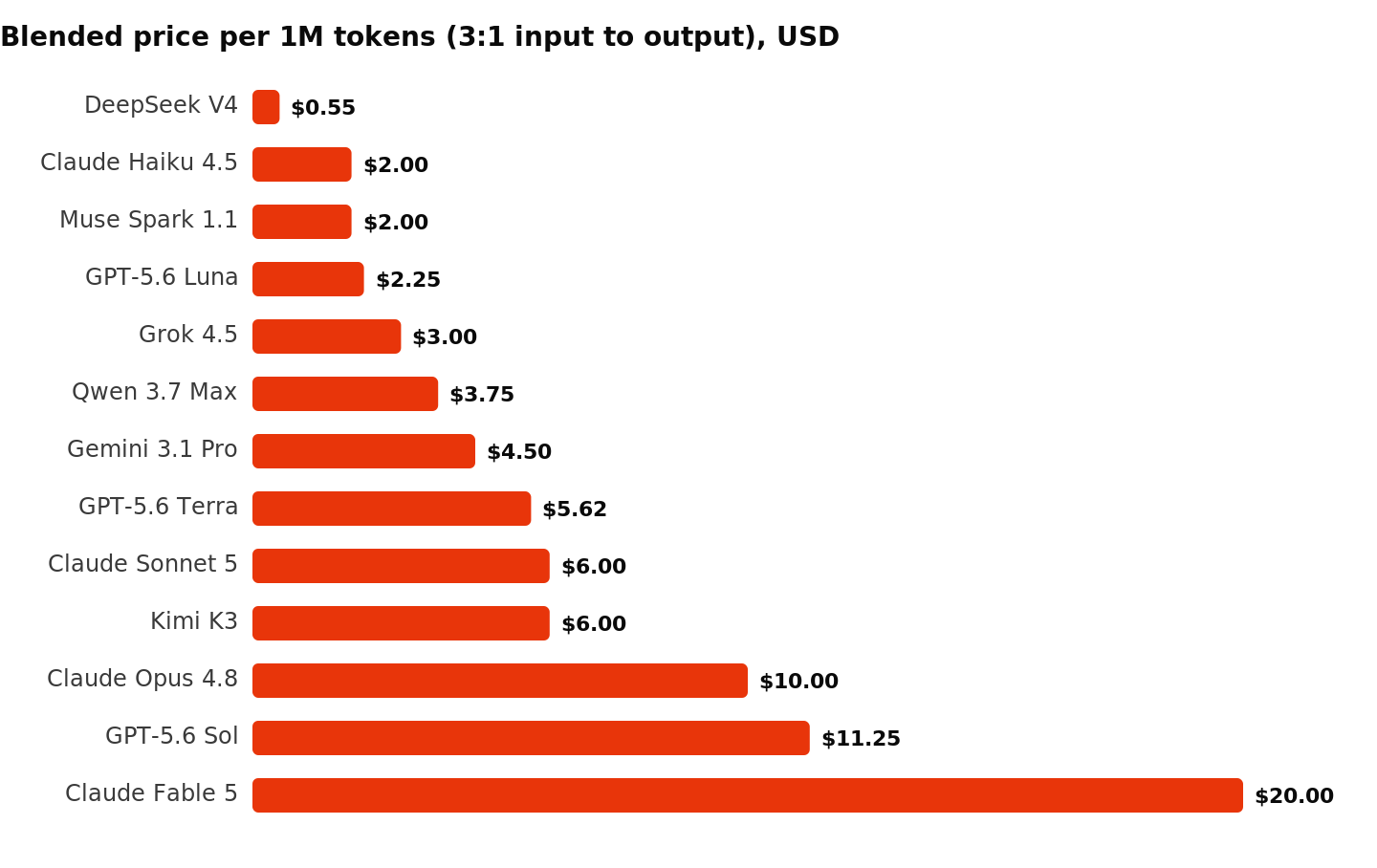
The chart below shows the blended cost per million tokens for each model that publishes a price, using a 3:1 input-to-output ratio (the typical real-world mix). The spread is enormous: the priciest frontier model costs roughly forty times the cheapest.
Blended price per million tokens, weighting input and output 3:1. The spread across the field is roughly fortyfold. Chart: Santage analysis
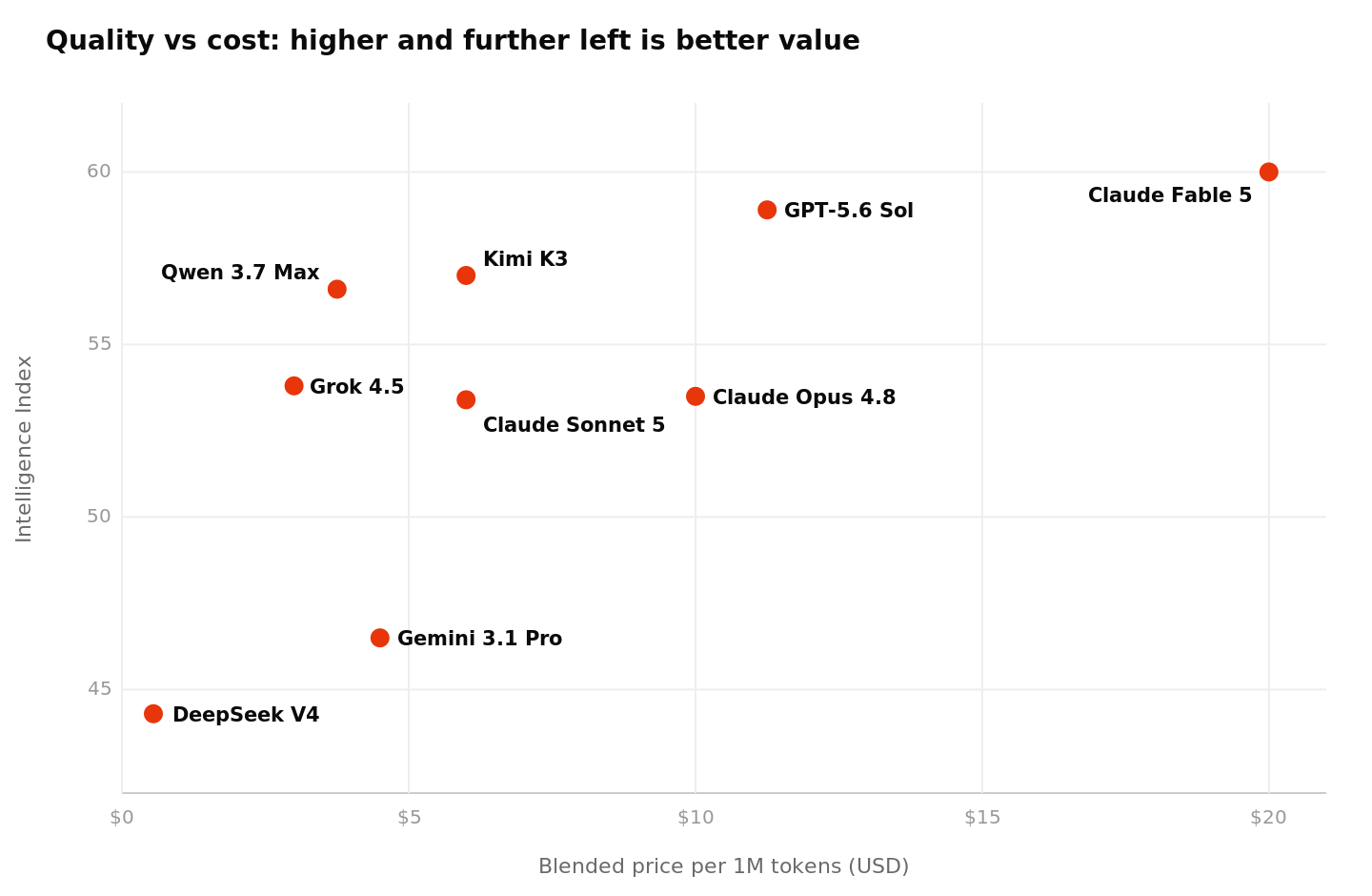
Raw price only tells half the story. This chart plots each model's intelligence against its blended cost. Models toward the upper left deliver the most quality per dollar.
Quality against cost. Models toward the upper left return the most measured intelligence per dollar. Chart: Santage analysis
What it actually costs (worked examples)
These are Santage-computed scenarios so you can see real spend, not just per-token rates. Assumptions: a typical chat is 1,000 input and 500 output tokens; a document summary is a 2,000-word input (about 2,700 tokens) with a 200-word output (about 270 tokens). All figures in US dollars.
Model
1M in + 1M out
1,000 chats
Summarise 1,000 docs
GPT-5.6 Sol
$24.00
$14.00
$16.20
GPT-5.6 Terra
$14.00
$8.00
$8.64
GPT-5.6 Luna
$1.40
$0.80
$0.86
Claude Fable 5
$60.00
$35.00
$40.50
Claude Opus 5
$30.00
$17.50
$20.25
Claude Opus 4.8
$30.00
$17.50
$20.25
Claude Sonnet 5
$12.00
$7.00
$8.10
Claude Haiku 4.5
$6.00
$3.50
$4.05
Gemini 3.1 Pro
$14.00
$8.00
$8.64
Grok 4.5
$8.00
$5.00
$7.02
Muse Spark 1.1
$5.50
$3.38
$4.52
Kimi K3
$18.00
$10.50
$12.15
DeepSeek V4
$2.64
$1.65
$2.32
Qwen 3.7 Max
$10.00
$6.25
$8.78
Interactive LLM API cost calculator
Use the free interactive calculator below to estimate and compare the monthly API cost of GPT-5.6 Sol, Claude Fable 5, Gemini 3.1 Pro, Kimi K3, DeepSeek V4 and every other model on this page for your own usage. Enter your monthly input and output tokens, or pick a preset workload, and the calculator instantly ranks all 14 models from cheapest to most expensive and shows the price-performance leader. Everything runs in your browser; nothing is sent anywhere.
Presets:
Costs are estimated from list prices in US dollars and exclude cached-input discounts, batch pricing and volume deals. Open-weight models can be self-hosted at infrastructure cost instead of per-token pricing.
How to use the calculator
Enter your monthly tokens. Input tokens are everything you send the model, including prompts, pasted documents and chat history. Output tokens are everything it writes back. Both boxes are editable, just click and type.
Or tap a preset. If you have no idea what your numbers are, pick Light app, Growing product, Heavy agentic or Summarise 1,000 docs to load a realistic workload.
Read the ranking, then experiment. Every model is priced for your usage and sorted cheapest first, with the cheapest highlighted. Change either number to test a scenario, the costs update as you type.
Does talking to AI cost more than typing?
Yes, usually a great deal more, and it is billed on a separate meter. When you speak to a model through an API, your audio is charged as audio tokens, priced far above text tokens. A minute of speech you send is roughly 600 input tokens, about one token per 100 milliseconds. A minute of speech the model generates is roughly 1,200 output tokens, because generated audio is tokenised about twice as densely. The economics matter more than they used to, because as we reported, voice AI's missing piece was never the voice, it was the reasoning behind it.
The rates tell the story. OpenAI's realtime audio model is priced at $32 per million input audio tokens and $64 per million output, against $5 and $30 for GPT-5.6 Sol in text. In practice that is about $0.019 for every minute the model listens and about $0.077 for every minute it speaks. Full voice agents, once reasoning and tool calls are added, typically run $0.18 to $0.46 per minute, falling to roughly $0.05 to $0.10 per minute with prompt caching and trimmed tool output.
Service
What it does
Price (USD)
OpenAI GPT-Realtime-2
Speech to speech
$32 / $64 per 1M audio tokens (about $0.019 per minute heard, $0.077 per minute spoken)
OpenAI Realtime Whisper
Streaming transcription
About $0.017 per minute
OpenAI GPT-4o Transcribe
Batch transcription
$6 per 1,000 minutes
OpenAI TTS
Speech output
$15 per 1M characters standard, $30 HD
OpenAI GPT-Realtime-Translate
Speech translation
About $0.034 per minute
Gemini 3.1 Flash Live
Speech to speech
$0.005 per minute input, $0.018 per minute output
Gemini 3.5 Flash TTS
Speech output
$6 per 1M output tokens
Deepgram Nova-3
Transcription
About $0.0048 per minute
Deepgram Voice Agent API
End to end voice agent
About $4.50 per hour
Deepgram Aura-2
Speech output
$30 per 1M characters, falling to $27 at volume
ElevenLabs Scribe
Transcription
$0.22 to $0.48 per hour depending on plan
ElevenLabs Flash v2.5
Speech output
$50 per 1M characters
Typical full voice agent
End to end, with reasoning
$0.18 to $0.46 per minute, or $0.05 to $0.10 cached
The spread looks enormous, but read it carefully, because these are not like-for-like prices. The three categories bill differently and do different amounts of work. A full speech to speech agent bundles transcription, model reasoning and speech output, and is billed per minute or per audio token. Streaming transcription does only the first of those and is billed per minute. Text to speech is usually billed per character. Setting the cheapest transcription (about $0.0048 a minute) against a full agent at the top of its range (about $0.46 a minute) is close to a ninetyfold gap, but that compares two different services, not one service priced two ways.
The conclusion that does hold is narrower and more useful: if all you need is words on a page, transcription-only is dramatically cheaper than running a full voice agent, and the specialist providers undercut the frontier labs on that specific job. One more trap worth knowing: with an open microphone, a realtime session bills input tokens during silence and hold time too, so dead air costs real money.
If you are not building anything, the maths is completely different. Everything above is API pricing for people shipping products. If you simply want to talk to your computer instead of typing, consumer dictation tools charge a flat subscription and none of the per-minute rates apply. Wispr Flow, one of the most popular, is $15 a month or $12 a month billed annually, with a free tier capped at 2,000 words a week on desktop. Talking to ChatGPT or Claude inside their own apps on a normal subscription is likewise already included, and costs you nothing extra per minute.
Which model should you use for which job?
If you want the best result regardless of cost, Claude Fable 5 is the current intelligence leader, with GPT-5.6 Sol a close and cheaper second that wins on agentic coding. If you are cost-sensitive, DeepSeek V4 delivers most of the quality of far pricier models for well under a dollar per million tokens, and Grok 4.5 and Gemini 3.1 Pro are the best value among the big Western labs. If you need an open model you can host yourself, Kimi K3 is the closest to the frontier, while Llama 5 offers an unmatched 5 million token context for long-document and privacy-sensitive work. For high-volume, latency-sensitive tasks, Claude Haiku 4.5, GPT-5.6 Luna and Muse Spark 1.1 keep costs low.
How do you cut your LLM bill?
Most teams overpay, and usually for the same handful of reasons. If your API costs are climbing faster than your usage, these are the levers that actually move the number, roughly in order of how much they save for how little effort.
Turn on prompt caching. If you resend the same system prompt, documents or chat history, caching bills that repeated context at a fraction of the rate. Kimi K3 caches input at $0.30 against $3.00, and Qwen 3.7 Max at $0.25 against $2.50, close to a 90 percent saving on the repeated portion.
Route by difficulty instead of defaulting to the flagship. Most production traffic is easy. Sending it to GPT-5.6 Luna at $0.20 and $1.20, or Claude Haiku 4.5 at $1 and $5, and reserving Fable 5 or Sol for the genuinely hard requests, is usually the single biggest saving available.
Shorten your outputs. Output costs three to six times more than input on most models, so capping maximum output tokens and asking for concise answers cuts the expensive half of the bill directly.
Send less context. Stuffing whole documents into the prompt is expensive at scale. Retrieval-augmented generation sends only the relevant passages, which usually costs far less than paying for the entire document on every call.
Batch anything that is not time-sensitive. Where latency does not matter, batch pricing is cheaper than realtime rates.
Consider open weights at high volume. Past a certain scale, self-hosting DeepSeek V4 can beat any per-token price, though remember you are trading the token fee for GPU and engineering cost, not eliminating it.
What changed this cycle?
The story of mid-July 2026 is the open-weight surge. Moonshot's Kimi K3, a 2.8 trillion parameter model, launched on July 16 and immediately ranked fourth on the Artificial Analysis Intelligence Index, ahead of Claude Opus 4.8 and GLM-5, with downloadable weights released on July 26, 2026 under the bespoke Kimi K3 License. OpenAI's GPT-5.6 family reached general availability on July 9 across its Sol, Terra and Luna tiers, and Meta priced its closed Muse Spark 1.1 at $1.25 input. Claude Fable 5 returned to general availability on July 1 after an 18-day export-control suspension. Google, meanwhile, has rebuilt Gemini from scratch for its next flagship, which is why 3.5 Pro carries no official price yet. We refresh this page on the 1st and 15th of each month, and whenever a major model ships.
Artificial Analysis ranks Claude Fable 5 first on its Intelligence Index at 60. GPT-5.6 Sol follows at 58.9, and Kimi K3 reaches 57 at roughly a third of Fable's price. That is how narrow the quality gap at the top has become.
Artificial Analysis Intelligence Index, July 2026
Media embed slot. Add a relevant explainer video or an X post here (for example a launch clip or a benchmark thread). Replace this block with the provider's official embed code.
Methodology and sourcing
Every price and specification on this page is compiled from primary sources wherever one exists, meaning the providers' own pricing pages, developer documentation and model cards, cross-checked against the Artificial Analysis and BenchLM leaderboards. Where only a secondary source exists, we say so in the notes rather than presenting it as confirmed. Llama 5's reported 5 million token context is the one figure in this edition that rests on a secondary source, and it is flagged accordingly. Where a figure cannot be verified against a primary source, we mark it rather than estimate. Benchmark figures are attributed to their source and dated; we do not run our own benchmarks.
The value score is Santage's own analysis. It divides a model's Artificial Analysis Intelligence Index by its blended price per million tokens, where blended price weights input and output 3:1 to reflect typical real usage. A higher score means more measured intelligence per dollar. We show it only for models that have a published Intelligence Index and a public price; others are marked "not rated." The worked cost examples use the stated token assumptions and list prices. These derived numbers are labelled as Santage analysis throughout and should not be read as vendor figures.
How we chose these 14 models. We include the current flagship from each major frontier lab, the cheaper tiers from those labs that teams actually deploy at volume, and the strongest challengers from outside those labs, including the leading genuinely open-weight model. We exclude models superseded by a newer version from the same lab, models with no published price, and models far enough down the index that they are not realistic choices for the workloads this page addresses. This is an editorial selection, not an exhaustive census, and we revise it each cycle as models ship.
What the value score is, and is not. It is a price-efficiency ratio, not a measure of quality. A high score means a model returns more measured benchmark performance per dollar. It does not mean the model is better. DeepSeek V4 scores highest on value while sitting near the bottom of the raw Intelligence Index. If you need the strongest possible output and cost is secondary, read the Intelligence Index column and ignore the value column entirely.
On comparing like with like. The prices here are first-party list prices for API access, in US dollars, excluding cached-input discounts, batch rates and negotiated volume deals. Open-weight models are a different commercial shape: self-host them and there is no per-token fee but you carry GPU, engineering and operations cost, or buy them from a third-party host and pay that host's margin. Llama 5 is marked self-host for exactly this reason, and its true cost is not zero. Read any comparison between a hosted API price and a self-hosted model as indicative rather than exact.
Dating. Every price, context window, benchmark score and availability status was compiled on August 1, 2026. Where a figure carries its own effective date we say so: Claude Sonnet 5's introductory rate runs to August 31, 2026, and Kimi K3's weights were released on July 26, 2026. Leaderboard positions move between our refreshes, so Intelligence Index figures reflect the July 2026 table rather than a permanent ranking.
Model
Notes and caveats
GPT-5.6 Sol
Standard short-context rate. OpenAI cut this from $5 / $30 on Aug 21, 2026, promotional through at least Nov 21, 2026. Requests over 272K input tokens (long context) are billed at $8 / $30.
GPT-5.6 Terra
GPT-5.6 mid tier. Cut 20 percent on July 30, 2026 from $2.50 / $15. Per-tier context not separately disclosed.
GPT-5.6 Luna
GPT-5.6 economy tier. Cut 80 percent on July 30, 2026 from $1 / $6. Per-tier context not separately disclosed.
Claude Fable 5
Scores about 62 on the Artificial Analysis Intelligence Index.
Claude Opus 5
Launched July 24, 2026 at the same $5 / $25 as Opus 4.8 and now tops the Artificial Analysis Intelligence Index.
Claude Opus 4.8
Index figure reflects the Opus 4.x line.
Claude Sonnet 5
The $2 / $10 introductory rate is now the standard price. Anthropic cancelled the increase to $3 / $15 that had been scheduled for Sept 1, 2026.
Claude Haiku 4.5
Fast, low-cost current-generation tier.
Gemini 3.1 Pro
Officially priced flagship. Gemini 3.5 Pro is not yet officially priced.
Grok 4.5
Current xAI flagship per official xAI developer docs. Grok 4 (256K context) is the prior generation. Price, context and index now all refer to the same model.
Muse Spark 1.1
Meta's closed frontier model, in public preview.
Kimi K3
Open weights released July 26, 2026 under the bespoke Kimi K3 License, downloadable on Hugging Face. Not MIT, it carries revenue and attribution conditions. Cached input $0.30.
DeepSeek V4
Genuinely open weights, published under an MIT licence and downloadable. V4 Pro off-peak rates ($0.66 / $1.98). Peak-hour rates (01:00 to 04:00 and 06:00 to 10:00 UTC, Monday to Friday) are double.
Qwen 3.7 Max
Proprietary and API only. Earlier Qwen generations shipped open weights, but the 3.7 Max tier is closed and cannot be downloaded. Cached input $0.25.
Frequently asked questions
Which large language model is the cheapest in 2026?
Among leading models, DeepSeek V4 is among the cheapest at $0.44 input and $0.87 output per million tokens. After OpenAI's July 30 price cut, GPT-5.6 Luna is now the lowest-cost tier from a major closed lab at $0.20 input and $1.20 output, undercutting most rivals on blended price, with Claude Haiku 4.5 next at $1 input. Open-weight models such as DeepSeek V4 can be self-hosted, which removes per-token fees but adds GPU and operations cost, so they are not free either.
Which is the best LLM for coding in 2026?
Claude Fable 5 leads frontier coding on SWE-bench Verified at about 95 percent, while GPT-5.6 Sol tops the Artificial Analysis Coding Agent Index at 80. Kimi K3 is the strongest challenger from outside the big labs, and its weights are now openly downloadable.
What is the best value large language model?
By Santage's price-performance score, which divides the Artificial Analysis Intelligence Index by blended price, DeepSeek V4 offers the most quality per dollar by a wide margin, followed by Grok 4.5, Qwen 3.7 Max and Gemini 3.1 Pro. Among top-tier quality, Kimi K3 offers the best value per dollar, and its weights are now openly downloadable.
GPT-5.6 Sol vs Claude Fable 5: which should you choose?
Claude Fable 5 leads on measured intelligence, scoring 62.1 on the Artificial Analysis Intelligence Index against 58.9 for GPT-5.6 Sol, but it costs roughly twice as much on a blended basis, $20.00 per million tokens against $11.25. GPT-5.6 Sol tops the Coding Agent Index at 80. Choose Fable 5 when you need the strongest possible output and cost is secondary, and GPT-5.6 Sol for agentic and tool-heavy work at a materially lower price.
Kimi K3 vs DeepSeek V4: which challenger is better?
Kimi K3 is stronger on quality, scoring 59.7 on the Intelligence Index against 53.2 for DeepSeek V4, but it costs about eleven times more on a blended basis, $6.00 per million tokens against $0.55. DeepSeek V4 is genuinely open weight and downloadable under an MIT licence, and Kimi K3 released its own open weights on July 26, 2026 under a bespoke Kimi K3 License. Pick Kimi K3 for frontier-class reasoning and coding, and DeepSeek V4 for high volume work where cost dominates.
Claude vs ChatGPT: which is cheaper to use through the API?
At the top end OpenAI is cheaper: GPT-5.6 Sol is $5 input and $30 output per million tokens against $10 and $50 for Claude Fable 5. At the budget end they are close to level, with Claude Haiku 4.5 at $1 and $5 against GPT-5.6 Luna at $0.20 and $1.20. Anthropic's Claude Sonnet 5 and OpenAI's GPT-5.6 Terra occupy similar middle ground. Note this covers API pricing, not the consumer ChatGPT and Claude subscriptions, which are flat monthly fees.
Which LLM has the largest context window?
Among the models compared here, GPT-5.6 Sol offers about 1.05 million tokens, and Claude Fable 5, Gemini 3.1 Pro and Kimi K3 offer 1 million. Grok 4.5 offers 500,000 and Claude Haiku 4.5 offers 200,000. Meta officially documents Llama 4 Scout at 10 million tokens, the largest of any widely available model, but it is not included in this comparison.