Research
Best AI for Coding in 2026: Models and Tools Compared
The models that write the best code, the tools built on them, and a recommender to match you to the right setup. Benchmarks, pricing and verdicts, verified and refreshed monthly.

The models that write the best code, the tools built on them, and a recommender to match you to the right setup. Benchmarks, pricing and verdicts, verified and refreshed monthly.
There isn't one best AI for coding. The best model and the best coding tool are different decisions, and this guide answers both: a benchmark-backed ranking of the leading coding models, a comparison of the top tools built on them, and an interactive recommender that matches you to the right setup in three clicks. The short version is below; the frontier models are effectively tied on the headline benchmark, so the real choices are cost and workflow.
Coding has become the flagship use of agentic AI. Instead of just suggesting the next line, today's AI agents take a whole task, plan it, edit across many files, run the tests, and fix their own mistakes, with the developer supervising rather than typing every line. That shift, now widely called vibe coding, is why the models and tools below matter so much, and why a few minutes choosing the right pair pays off.
| If you are... | Use |
|---|---|
| A professional software engineer | Cursor with Claude Opus 5 |
| An enterprise developer | GitHub Copilot |
| A solo hacker or indie builder | Cursor |
| A complete beginner | Replit |
| A command-line power user | Claude Code |
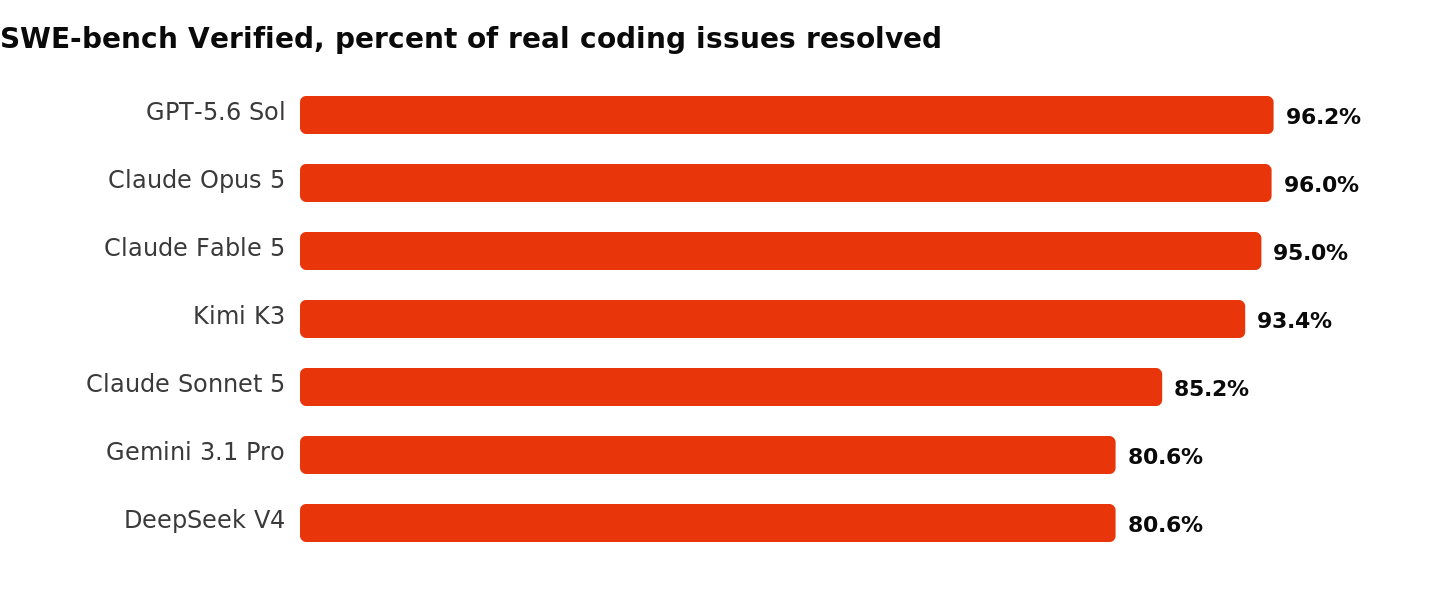
These are the models that actually write the code, ranked on the benchmarks that measure real software tasks. SWE-bench Verified tests whether a model can resolve real GitHub issues; SWE-bench Pro is the harder, more current version. Most Verified scores are reported by the model makers, though the independent Vals AI harness now re-runs the field, and the top three sit within about two points, so read the podium as a tie and weight SWE-bench Pro and cost. Prices are US dollars per million tokens, input / output, and reflect provider list prices on August 1, 2026. Full detail is in the methodology.
| Model | Maker | SWE-bench Verified | SWE-bench Pro | Context | Price in/out | Best for |
|---|---|---|---|---|---|---|
| Claude Opus 5 | Anthropic | 97.0% | Not disclosed | 1M | $5 / $25 | Frontier-class agentic coding at half Fable's price |
| GPT-5.6 Sol | OpenAI | 96.2% | 64.6% | 1.05M | $5 / $30 | Tool-heavy agentic coding, tops Coding Agent Index |
| Claude Fable 5 | Anthropic | 95.0% | 80.0% | 1M | $10 / $50 | Hardest tasks, the SWE-bench Pro leader among available models |
| Kimi K3 | Moonshot | 93.4% | Not disclosed | 1M | $3 / $15 | Near-frontier coding at a third of the price |
| Claude Sonnet 5 | Anthropic | 85.2% | 63.2% | 1M | $2 / $10 | Fast, cheap everyday coding workhorse |
| Gemini 3.1 Pro | 80.6% | 54.2% | 1M | $2 / $12 | Value coding with long context and multimodal | |
| DeepSeek V4 Pro 0813 | DeepSeek | 96.4% | 55.4% | 1M | $0.44 / $0.87 | Top open-weight coder, now 2nd overall on the Vals harness, self-hostable |
These are the raw engines that write the code; how each behaves day to day also depends on the tool wrapped around it, covered further down. A note on reading the table: the top three sit within about two points on SWE-bench Verified and most figures are vendor-reported, so weight the harder SWE-bench Pro and real cost per task, as explained in the methodology. For how these same models compare beyond coding, on price, context window and general benchmarks, see our full large language model comparison, which also includes an interactive cost calculator.
SWE-bench Verified scores for the leading models. The frontier is tightly packed at the top, the more meaningful separation now shows up on the harder SWE-bench Pro and in cost per task.
The model generates the code; the tool is where you work. Most tools let you choose among several models, so the two decisions are separate. Pricing is the entry paid plan; most have a free tier.
| Tool | Type | Models it runs | Price from | Best for |
|---|---|---|---|---|
| Cursor | AI code editor (desktop IDE) | Claude, GPT, Gemini (frontier) | Free, then $20/mo | The most popular AI-native IDE; strong agent plus autocomplete |
| GitHub Copilot | IDE extension | Claude Sonnet 5, GPT, Gemini and more | Free, then $10/mo | Deepest IDE and GitHub integration, and the widest reach |
| Claude Code | Terminal (CLI) agent | Claude Opus 5 and Sonnet 5 | Included with Claude Pro $20/mo | The leading terminal coding agent, tight Anthropic model integration |
| Windsurf | Agentic AI IDE | Claude, GPT and more | Free, then $20/mo | Agent-first IDE; folded into Devin Desktop in 2026 |
| Replit | Cloud IDE plus Agent (in browser) | Claude (primary) | Free, then $20/mo Core | Build and deploy full apps in the browser; best for beginners and prototypes |
Cursor is a standalone editor, a fork of VS Code rebuilt around AI. Its strength is the agent: it plans and executes changes across many files, runs commands, and fixes its own errors, while keeping fast inline autocomplete. It runs the frontier models from Anthropic, OpenAI and Google, and switched to credit-based pricing in 2026, with Auto mode unlimited and premium models drawing from a credit pool. It is the default choice for developers who want the most capable AI-first environment.
Copilot is an extension that lives inside the editors developers already use, VS Code, JetBrains, Visual Studio and Neovim, and inside GitHub itself. Its edge is integration and reach: pull requests, code review, the CLI, and inline completions that never consume credits. In 2026 it moved to token-based AI Credits and added agent modes. It runs Claude, GPT and Gemini, and at $10 a month for Pro it is the cheapest serious entry point.
Claude Code is a command-line agent from Anthropic. It works in the terminal, reads and edits your repository, runs tests and iterates, and it is tuned tightly to Claude's own models, Opus 5 and Sonnet 5. It is the strongest terminal-native agent, favoured by engineers who prefer the command line to an IDE. It comes with the Claude Pro and Max subscriptions rather than being sold separately.
Windsurf is an agentic IDE that in 2026 was folded into Cognition's Devin. It pioneered a flow-style agent that keeps context across a session, and it retired credit billing for daily and weekly quotas. With the Devin acquisition, its pricing and roadmap now run through Cognition, which also sells the more autonomous Devin agent for larger jobs.
Replit is a cloud IDE with a build-and-deploy agent, all in the browser with nothing to install. That makes it the easiest on-ramp for beginners and the fastest way to ship a working prototype or small app. It runs primarily on Claude models and meters usage credits on top of a subscription, which can add up on long builds, so it rewards clear, scoped requests.
Use the free interactive recommender below to find the best AI coding tool and model for your situation. Answer three questions, where you code, what matters most, and how you like to work, and it names a tool, a plan, and a model with the reasoning. It runs entirely in your browser, and its recommendations update whenever the benchmark and pricing data is refreshed. This is a live interactive tool: make a selection in each row and it returns a personalised pick of tool, plan and model, so it is the fastest way to reach an answer without reading the whole guide.
If you cannot use the interactive tool, here are the same recommendations in plain form:
| If you... | Use | With |
|---|---|---|
| want the strongest results in a desktop IDE | Cursor (Pro) | Claude Opus 5 or GPT-5.6 Sol |
| live in the terminal | Claude Code | Claude Opus 5 |
| want no setup and build in the browser | Replit | Claude, included |
| are centred on GitHub | GitHub Copilot | Claude Sonnet 5 or GPT |
| want the best value | Cursor or GitHub Copilot | Kimi K3 or Claude Sonnet 5 |
| want to start free | GitHub Copilot Free or Cursor Hobby | the models the free plan includes |
| need to self-host or minimise cost | any tool with custom models | DeepSeek V4 (open weight) |
If you want the best possible code and cost is secondary, Claude Opus 5 is the pick, frontier-class agentic coding at $5 / $25, half the price of Fable 5, which leads the harder SWE-bench Pro among generally available models. If you want near-frontier quality cheaply, Kimi K3 delivers most of the capability at $3 / $15, and Claude Sonnet 5 is the fast everyday workhorse. If cost dominates or you need to self-host, DeepSeek V4 is the lowest-cost capable open-weight coding model at under a dollar per million tokens, and it can be self-hosted. For long-context work across a big codebase, Gemini 3.1 Pro offers strong value with a large window.
Two shifts defined the year. The first is the move from autocomplete to agents. A year ago, AI mostly suggested the next line; now the leading tools take a whole task, plan it, edit across many files, run the tests, and fix their own mistakes, with the developer supervising rather than typing. This is agentic AI applied to software. That is why benchmarks like SWE-bench, which measure resolving real GitHub issues end to end, have become the yardstick that matters, and why the frontier models now clear roughly 95 percent of them, up from far lower a year earlier.
The second shift is price. Capability that cost a premium in early 2026 is now far cheaper: Claude Opus 5 matches frontier coding quality at half the price of Fable 5, open-weight models like DeepSeek V4 resolve most real issues for cents per task, and small, fast models handle everyday edits. The result is that the interesting question is no longer only which model is smartest, but which setup gives you the most useful code for your budget and your workflow. That is the question this guide is built to answer.
Model rankings use SWE-bench Verified and the harder SWE-bench Pro, cross-checked against the independent Vals AI harness and the Morph leaderboards. We prioritise SWE-bench because it measures resolving real GitHub issues rather than isolated puzzles like HumanEval or LiveCodeBench, though DeepSeek V4's strength on LiveCodeBench and competitive programming shows that picture can differ. Tool pricing and model support come from each provider's own pages. All pricing reflects provider list prices on August 1, 2026, and changes frequently. Where a figure is not disclosed, we mark it rather than estimate.
The caveat that matters: the SWE-bench Verified numbers vendors quote are self-reported, and the big aggregators reflect that. On one widely cited leaderboard in mid-2026, all of its listed Verified scores were vendor-submitted rather than independently re-run. One lab does test independently: Vals AI re-runs the field on a single bash-only harness, and on that leaderboard, updated 31 July 2026, Claude Opus 5 leads at 97.0%, ahead of GPT-5.6 Sol at 96.2% and Fable 5 at 95.0%. The top three sit within about two points, so treat the podium as a tie and weight the harder SWE-bench Pro and real cost per task, where clearer gaps appear. OpenAI itself has moved to recommending SWE-bench Pro over Verified. The Santage verdicts above reflect this: they are our own judgement, not vendor marketing.