A large language model is the engine behind virtually every AI tool that has entered the mainstream in the past three years. ChatGPT, Claude, Gemini, Copilot, Perplexity: all of them run on large language models. And in 2026, this single technology sits at the center of a $10.57 billion market projected to reach $149.89 billion by 2035, expanding at a 34.44% compound annual growth rate, according to Precedence Research.
Yet most people still cannot clearly explain what a large language model actually is. This guide exists to fix that, for executives making billion-dollar deployment decisions, for policymakers drafting regulation, and for builders designing the next generation of AI systems.
- What they are: Neural networks trained on massive text datasets that predict the most likely next unit of text in a sequence
- Why they matter: The technology behind ChatGPT, Claude, Gemini, Copilot, and virtually every mainstream AI tool launched since 2022
- Market size: $10.57 billion in 2026, projected to reach $149.89 billion by 2035 at 34.44% CAGR (Precedence Research)
- Market leaders: Microsoft, OpenAI, Anthropic, Google, AWS, Cohere, and AI21 Labs control approximately 79% of the enterprise LLM market
- Enterprise adoption: Over 80% of enterprises expected to have deployed generative AI applications or APIs by 2026, up from less than 5% in 2023
- Core architecture: Built on the transformer neural network, introduced in the 2017 paper "Attention Is All You Need"
- Leading models in 2026: OpenAI's GPT-5.5 and GPT-5.6, Anthropic's Claude Opus 4.8 and Sonnet 5, Google's Gemini 3, xAI's Grok 4, and open-weight DeepSeek V4 and Qwen 3
- Cost collapse: The price of GPT-3.5-level performance fell more than 280 times between late 2022 and late 2024; capability that cost roughly $60 per million tokens in 2021 now costs under $0.10 (Stanford HAI, Epoch AI)
- The reasoning shift: The frontier moved from raw scale to reasoning, with models spending extra compute to think step by step and now matching or beating human experts on PhD-level science and competition mathematics (Stanford HAI, 2026 AI Index)
- Primary limitations: Hallucinations, static training knowledge, and compute cost remain unresolved challenges
What is a large language model?
A large language model (LLM) is a neural network trained on massive datasets of text that can understand, generate, and reason about human language by predicting the most likely next unit of text in a sequence.
In simpler terms, an LLM reads patterns across trillions of words and learns to produce language that is coherent, contextually relevant, and often indistinguishable from human writing. What separates "large" language models from earlier natural language systems is scale. Modern frontier models have hundreds of billions to trillions of parameters, trained on datasets that span the indexable internet, digitised books, code repositories, and academic literature.
How do large language models work?
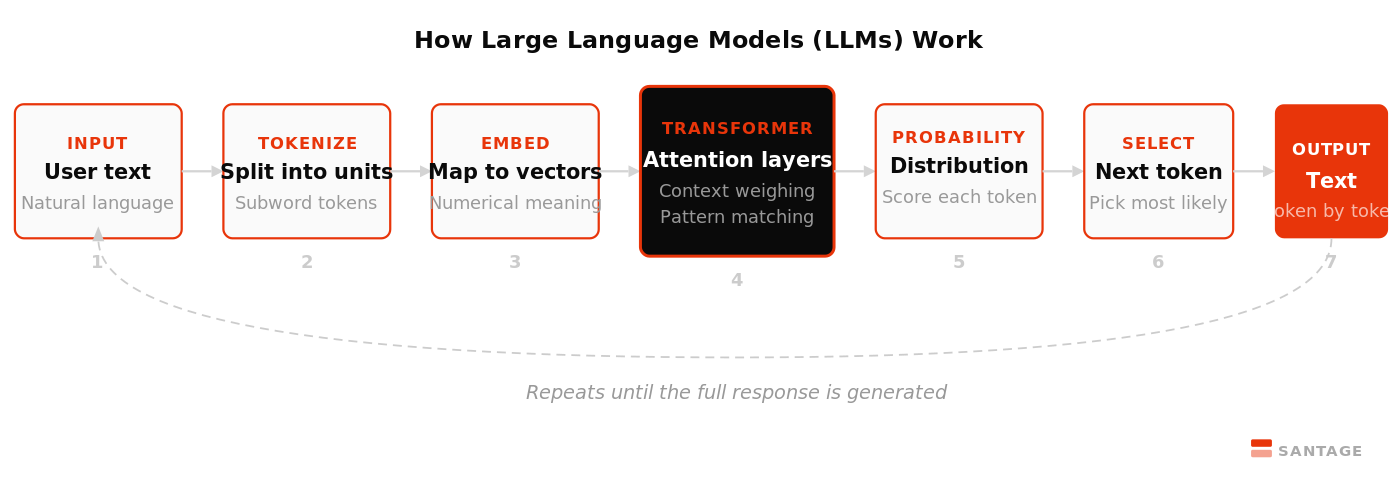
At a core level, large language models work by predicting the next token in a sequence based on learned probability distributions.
The full pipeline runs as a loop, turning your words into numbers, weighing context, and predicting one token at a time until the response is complete:
Here is what happens at each stage:
- Tokenization: Your input is broken into smaller units called tokens. A token is roughly three-quarters of a word. The word "artificial" might become two tokens, "art" and "ificial."
- Embedding: Each token is converted into a numerical vector, an array of numbers that captures its meaning in mathematical space. This is where embeddings enter the picture. Words with similar meanings end up with similar vectors.
- Transformer processing: The vectors pass through multiple layers of a transformer architecture. Each layer uses an attention mechanism that lets the model weigh which parts of the input matter most when generating the next token. This is the architectural breakthrough introduced in the 2017 Google research paper Attention Is All You Need.
- Probability distribution: The model outputs a probability for every possible next token across its vocabulary of roughly 50,000 to 200,000 tokens.
- Token selection: The model picks a token based on that probability distribution, appends it to the output, and repeats the entire process until the response is complete.
The core idea behind LLMs
LLMs do not understand language. They model it.
This is the single most important thing to grasp about current AI systems. When Claude writes you an eloquent essay, it is not comprehending your request the way a human would. It is executing an extremely sophisticated statistical prediction, trained on patterns across nearly every piece of text it could access. The fact that this process produces outputs that appear intelligent is one of the most surprising findings of modern computer science.
Not everyone accepts the sharp line between modeling and understanding. Ilya Sutskever, co-founder and former chief scientist of OpenAI, has argued that accurate prediction is itself a form of understanding.
How are large language models trained?
A frontier model is built in two broad phases, and understanding them explains most of what an LLM can and cannot do.
The first phase is pre-training. The model is shown enormous volumes of text, trillions of tokens drawn from the web, books, code, and academic writing, and given one deceptively simple task: predict the next token. There are no labels marking which statements are true. The model simply learns the statistical structure of language by trying to continue text, billions of times, adjusting its parameters after each attempt. Pre-training is where the raw capability and the raw cost live. Training a frontier model requires months of computation on tens of thousands of GPUs and can cost hundreds of millions of dollars in a single run.
The second phase is post-training, which turns a raw text predictor into a usable assistant. Supervised fine-tuning shows the model high-quality examples of the behavior we want. Then reinforcement learning from human feedback, or RLHF, has people rank competing responses so the model learns which answers are more helpful, harmless, and honest. This alignment step is what makes a model refuse harmful requests and follow instructions, but it is imperfect. OpenAI's own 2025 research shows that because evaluations reward confident answers over admissions of uncertainty, post-training can inadvertently teach models to guess, which is a root cause of hallucination.
The most important recent change is a third stage: large-scale reinforcement learning on reasoning. Rather than only imitating human text, models are now rewarded for reaching correct answers on verifiable problems in math, code, and science, which teaches them to generate long internal chains of thought before responding. This is the shift from pure scale to reasoning, and it is why the 2026 frontier looks so different from the models of 2023.
How do LLMs differ from related concepts?
| Concept | Difference |
|---|---|
| LLM vs AI | AI is the broad field. LLMs are one specific type of AI model focused on language |
| LLM vs Chatbot | LLMs are the underlying technology. Chatbots like ChatGPT are consumer applications built on top |
| LLM vs Traditional NLP | Traditional NLP used hand-coded rules. LLMs learn from data |
| LLM vs AGI | LLMs are narrow, domain-specific models. AGI would generalize across any cognitive task |
| LLM vs Search Engine | Search retrieves existing content. LLMs generate new content |
How do LLMs work with embeddings?
Embeddings are the numerical representations of text that LLMs use internally. Every word, phrase, and concept an LLM processes is converted into an embedding, a vector in a high-dimensional space where similar meanings cluster together.
This matters because embeddings are not just an internal implementation detail. They are also the mechanism by which LLMs are connected to external knowledge sources. When you see an LLM remember your company's internal documents or cite a recent research paper, embeddings are the bridge that makes this possible.
How do LLMs use RAG?
One of the most significant deployment patterns for LLMs in 2026 is retrieval-augmented generation, or RAG. Rather than relying solely on the static knowledge encoded during training, a RAG-enabled LLM retrieves relevant information from external sources at the time of the query and uses that information to generate more accurate, current, and grounded responses.
This architecture has become so dominant that retrieval-augmented generation models now account for 38.41% of the enterprise LLM market by revenue, according to research by Straits Research.
The workflow combines three components:
- An embedding model to convert queries into vectors
- A vector database to store and retrieve relevant documents
- An LLM to synthesise the final answer
What are the leading large language models in 2026?
The frontier is now a race among a handful of labs, split between closed models accessed through APIs and open-weight models that anyone can download and run. As of mid-2026, independent benchmarking from Artificial Analysis placed Anthropic's Claude Opus 4.8 at the top of its intelligence index, narrowly ahead of OpenAI's GPT-5.5, with the two labs trading the lead every few weeks.
| Developer | Flagship model (2026) | Weights | Notable strength |
|---|---|---|---|
| OpenAI | GPT-5.5 and GPT-5.6 | Closed | General reasoning, tool use, breadth |
| Anthropic | Claude Opus 4.8, Sonnet 5 | Closed | Coding and agentic workflows |
| Google DeepMind | Gemini 3 Pro | Closed | Multimodal, very long context windows |
| xAI | Grok 4 | Closed | Real-time data, reasoning |
| DeepSeek | DeepSeek V4 | Open weights | Frontier performance at low cost |
| Meta | Llama 5 | Open weights | On-premise and customizable deployment |
| Alibaba | Qwen 3 | Open weights | Leading open-source all-rounder |
Two shifts define this generation. The first is a collapse in cost. According to the Stanford HAI AI Index, the price of running a system at GPT-3.5 level fell more than 280 times between late 2022 and late 2024, and research from Epoch AI finds inference prices falling at a median of roughly 50 times per year across capability thresholds. Performance that cost about $60 per million tokens in 2021 now costs a few cents. The second shift is capability: the 2026 AI Index reports that models now match or exceed human experts on PhD-level science questions, competition mathematics, and multimodal reasoning, with coding benchmarks climbing from roughly 60% to near-parity with humans in a single year.
The open versus closed divide has become one of the industry's central strategic questions. Closed models from OpenAI, Anthropic, and Google still lead on the hardest reasoning tasks, but open-weight models from DeepSeek, Meta, and Alibaba now trail by months rather than years, and they let enterprises run models on their own infrastructure for privacy, control, and cost. These same models are the reasoning engines inside AI agents and multi-agent systems, which is where much of the 2026 competition is now playing out.
Why are large language models important?
The strategic importance of LLMs is no longer debatable. The data is clear.
- Market dominance: OpenAI's ChatGPT ecosystem reached approximately 501 million monthly users globally as of May 2025. Google Gemini follows with significant usage, with Claude and Perplexity capturing a growing share.
- Enterprise adoption: By 2026, over 80% of enterprises are expected to have deployed generative AI applications or APIs, up from less than 5% in 2023, according to Gartner and McKinsey.
- Infrastructure economics: Worldwide spending on generative AI is forecast to reach $644 billion in 2025, according to Gartner.
- Market concentration: Microsoft, OpenAI, Anthropic, Google, AWS, Cohere, and AI21 Labs together control approximately 79% of the enterprise LLM market.
What are the limitations of large language models?
For all their capability, LLMs have real, persistent limitations that every deployer must understand:
- Hallucinations: LLMs generate confident, plausible-sounding text that is sometimes factually incorrect or entirely fabricated. Mitigating hallucinations is the single largest area of applied AI research today, and it becomes more dangerous when an LLM drives an agent that can take real actions on a false belief.
- Static knowledge: An LLM's knowledge is frozen at the time of its last training run. Without retrieval-augmented architectures, an LLM has no way to know about events that emerged after its training cutoff.
- Bias: LLMs learn from internet-scale text, which contains every bias present in human writing. The EU AI Act, effective February 2025, designates many LLM deployments as high-risk systems.
- Compute cost: Training frontier LLMs costs hundreds of millions of dollars. Inference costs are a core business constraint for every AI company.
- Safety and alignment: A significant majority of AI researchers believe current LLMs need stronger safety evaluations before deployment.
Where are large language models used in practice?
- Enterprise software: Oracle deployed OpenAI's GPT-5 across its SaaS portfolio in August 2025. Microsoft has integrated Copilot across Office. Salesforce's Einstein runs on LLMs.
- Healthcare: LLMs are used for clinical documentation, medical imaging analysis, and diagnostic support.
- Software development: GitHub Copilot, Cursor, and OpenAI's Codex have changed how software is written.
- Media and journalism: A majority of global newsrooms use generative AI, according to the Reuters Institute. Santage's editorial standards require human review of AI-assisted content.
- Government: Government adoption of LLMs has grown rapidly for document processing, citizen services, and policy analysis.
The future of large language models
The next chapter of LLM development will not be defined by making models larger. The defining contests of 2026 and beyond will be fought on four fronts.
- Efficiency: Nvidia's Blackwell platform cuts total cost of ownership by as much as 25 times compared to the prior generation.
- Specialization: Domain-specific LLMs are projected to grow at a CAGR exceeding 38% from 2025 to 2033.
- Reasoning: The o-series from OpenAI, Anthropic's extended-thinking Claude models, and Google's Gemini thinking modes mark a decisive shift toward models that spend extra compute reasoning through a problem before responding, trained with reinforcement learning on verifiable tasks.
- Agency: LLMs are becoming the cognitive engines of autonomous AI agents and multi-agent systems. Agent-to-agent communication is standardizing fast: Google's A2A protocol moved to neutral Linux Foundation governance in 2025 with more than 100 companies backing it, and orchestration has become its own engineering discipline.
What is certain is that the large language model, in some evolved form, will remain the dominant AI paradigm for the foreseeable future. Every serious AI company is building one, every major enterprise is deploying one, and every national government is now grappling with how to regulate them.
Frequently asked questions
Sources and further reading
- Vaswani, A. et al. Attention Is All You Need. Google Research, 2017. arxiv.org/abs/1706.03762
- Precedence Research. Large Language Model Market Size, Growth and Forecast 2025-2035. January 2026. precedenceresearch.com
- Gartner. Forecast Analysis: Generative AI Worldwide. 2025. gartner.com
- McKinsey & Company. The economic potential of generative AI. 2024. mckinsey.com
- Nvidia. Blackwell Architecture Technical Overview. 2024. nvidia.com
- European Commission. The EU Artificial Intelligence Act. Effective February 2025. digital-strategy.ec.europa.eu
- Stanford HAI. The 2026 AI Index Report. 2026. hai.stanford.edu
- Epoch AI. LLM inference prices have fallen rapidly but unequally across tasks. 2026. epoch.ai
- OpenAI. Why Language Models Hallucinate. September 2025. arxiv.org/abs/2509.04664
- Sutskever, I. in conversation with Dwarkesh Patel. Building AGI, Alignment, and Future Models. 2023. dwarkesh.com
- Artificial Analysis. Independent LLM Intelligence, Speed and Price Benchmarks. 2026. artificialanalysis.ai
- Sanderson, G. (3Blue1Brown). But what is a GPT? Visual intro to Transformers. 2024. youtube.com