In 2022, the release of ChatGPT made one thing clear to every enterprise in the world: large language models were going to change how work gets done. It also made a second thing clear. These models, for all their fluency, knew nothing about your company, could not access your proprietary data, were frozen at their training cutoff, and occasionally invented facts with confidence. The solution that emerged has a name: retrieval-augmented generation, or RAG.
By 2026, RAG has become the dominant architectural pattern for enterprise AI deployment. Research published by Straits Research shows that retrieval-augmented generation now accounts for 38.41% of enterprise LLM market revenue. This guide explains what RAG is, how it works, why it has become essential, and where it is heading.
- What it is: An AI architecture combining information retrieval with language model generation to produce grounded, accurate responses
- Why it matters: Solves the knowledge cutoff problem, reduces hallucinations, enables safe use of proprietary data, and provides auditable responses
- Market share: 38.41% of enterprise LLM market revenue as of 2025 (Straits Research)
- First introduced: 2020 research paper by Facebook AI Research, UCL, and NYU
- Core components: Embedding model, vector database, optional reranker, and large language model
- Primary use cases: Enterprise knowledge management, customer support, legal research, AI search engines, clinical decision support
- Leading frameworks: LangChain and LlamaIndex dominate open-source RAG tooling
What is retrieval-augmented generation?
Retrieval-augmented generation is an AI architecture that improves the accuracy, currency, and groundedness of large language model responses by retrieving relevant external information at the time of a query and using it to generate answers.
Rather than relying solely on the static knowledge encoded during model training, a RAG system actively retrieves relevant documents from a designated knowledge source, passes that retrieved information to the language model as context, and generates responses grounded in the retrieved material.
How does retrieval-augmented generation work?
A RAG system is built from three cooperating components operating in sequence:
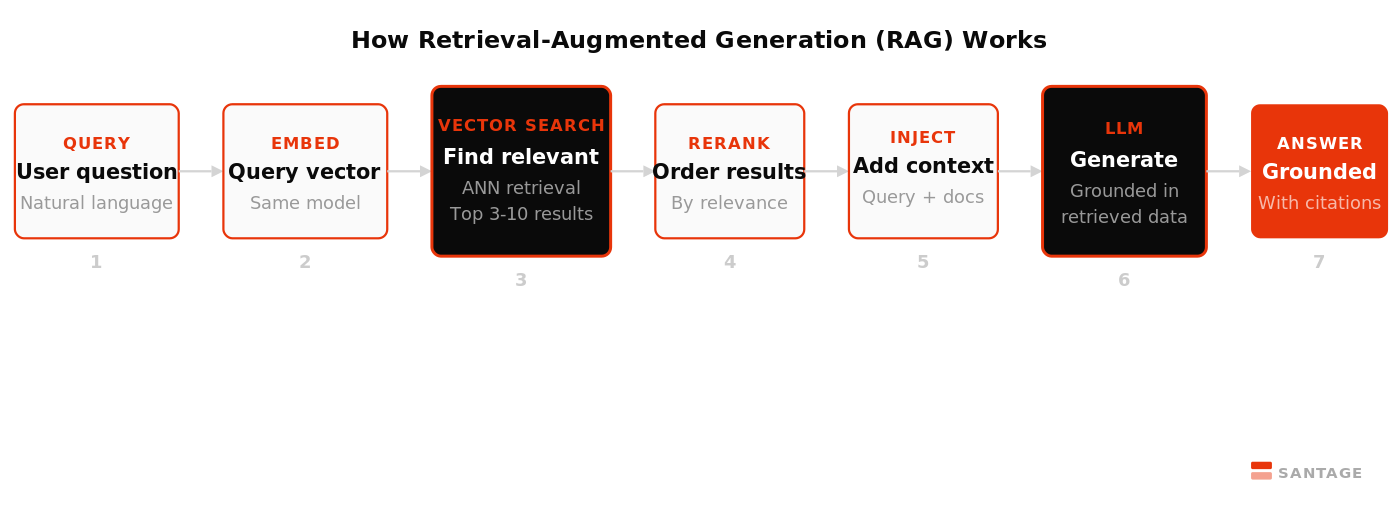
- User query: A user submits a question or instruction to the system.
- Query embedding: The query is converted into a vector using an embedding model, placing it in the same semantic space as the stored knowledge base.
- Vector database search: The query vector is compared against embeddings in a vector database. The system retrieves the most semantically relevant items, typically the top three to ten results.
- Reranking and filtering: Retrieved results are passed through a reranking model that orders them by relevance, and through metadata filters for constraints such as date, source authority, or access permissions.
- Context injection: The highest-ranked retrieved content is assembled into a prompt along with the original user query.
- LLM generation: The language model generates a response using both its pre-trained knowledge and the retrieved context, producing grounded, citation-backed answers.
- Response delivery: The generated response is returned to the user, typically with citations pointing back to the retrieved source documents.
The original technique was formalised in the 2020 research paper Retrieval-Augmented Generation for Knowledge-Intensive NLP Tasks from researchers at Facebook AI Research, University College London, and New York University.
The core idea behind RAG
RAG separates knowing from reasoning.
In a pure LLM system, knowledge and reasoning are entangled in the model's parameters. You cannot update what the model knows without retraining it. RAG separates these concerns. Reasoning stays in the model. Knowledge moves to a retrievable store. This separation is what makes AI deployable in real business contexts where knowledge changes daily and accuracy is verifiable.
How does RAG differ from related approaches?
| Concept | Difference |
|---|---|
| RAG vs Pure LLM | Pure LLMs rely on static training knowledge. RAG retrieves current external information at query time |
| RAG vs Fine-Tuning | Fine-tuning updates model behaviour through retraining. RAG updates knowledge without retraining |
| RAG vs Semantic Search | Semantic search returns relevant documents. RAG returns a synthesised answer using those documents |
| RAG vs Traditional Search | Traditional search uses keyword matching. RAG uses semantic similarity plus language generation |
| RAG vs Prompt Engineering | Prompt engineering refines how you ask. RAG refines what information the model can access |
Why is RAG important for modern AI systems?
- Solves the knowledge cutoff: RAG connects models to current information, whether that is yesterday's news, this morning's regulatory filing, or your team's latest documentation.
- Reduces hallucinations: Research from Stanford HAI and the UK AI Safety Institute consistently shows RAG-enabled systems produce fewer hallucinations on knowledge-intensive tasks.
- Enables proprietary data use: Enterprises cannot send sensitive documents to a foundation model for retraining, but they can host those documents in their own vector database and retrieve selectively.
- Provides auditable responses: Every RAG answer can be traced back to its source passages, essential for regulated industries.
McKinsey's 2024 research estimates generative AI could add $2.6 to $4.4 trillion in annual economic value globally, with knowledge-intensive enterprise applications representing the largest share. RAG is the architecture that makes capturing this value operationally possible. Bain & Company identifies RAG-enabled knowledge retrieval as the single most common enterprise AI use case in 2025.
What are the limitations of RAG?
- Retrieval quality determines output quality: If the retrieval layer returns irrelevant documents, the LLM generates responses grounded in wrong information.
- Latency accumulation: Every RAG query involves embedding, vector search, reranking, and LLM generation. These steps add latency.
- Chunking strategy matters: How documents are split into retrievable chunks significantly affects retrieval quality. This remains one of the most underappreciated engineering challenges.
- Context window constraints: Retrieving too much information can degrade model performance due to the "lost in the middle" phenomenon.
- Hallucination reduction, not elimination: RAG significantly reduces hallucinations but does not eliminate them. Models can still misinterpret retrieved information.
- Maintenance burden: A production RAG system has more moving parts than a pure LLM deployment. Embedding models, indexes, and document sources must all be maintained.
Where is RAG used in practice?
- Enterprise knowledge: Microsoft Copilot Studio, Google Workspace with Gemini, Notion AI, and Atlassian Intelligence all use RAG.
- Customer support: Zendesk, Intercom, and Salesforce deploy RAG for AI-driven support. BCG research indicates 30 to 50 percent improvements in first-contact resolution.
- Legal and compliance: Thomson Reuters, LexisNexis, and Harvey AI use RAG for citation-backed legal research.
- Healthcare: Clinical decision support and medical literature review increasingly rely on RAG. The Lancet notes RAG's role in reducing hallucinations to clinically acceptable levels.
- Financial services: Bloomberg Terminal and proprietary systems at JPMorgan and Goldman Sachs use RAG. PwC's 2025 AI Jobs Barometer identifies financial services as the fastest RAG deployment sector.
- AI search engines: Perplexity, You.com, and AI modes in Google Search and Microsoft Copilot are all RAG systems at their core.
- Software development: GitHub Copilot Enterprise and Cursor use RAG to ground code suggestions in an organisation's own codebase.
- Scientific research: RAG-enabled tools from Elicit, Scite, and Consensus help researchers synthesise findings across large bodies of literature.
The future of retrieval-augmented generation
- Agentic RAG: The simple "embed, retrieve, generate" pattern is evolving into systems that can decide what to retrieve, formulate sub-queries, and iterate. Research from DeepMind and Anthropic shows agentic retrieval substantially outperforms single-pass RAG on complex queries.
- Multimodal RAG: Retrieval is expanding beyond text to include images, video, audio, and structured data. Meta AI research has pushed multimodal retrieval from research into production.
- Knowledge graph integration: Hybrid systems combining vector search with knowledge graphs are emerging for enterprise deployments requiring both semantic and structural reasoning. Gartner identifies graph-enhanced RAG as a key trend.
- Compliance by default: The EU AI Act and sector-specific regulations are pushing RAG toward detailed provenance, citation tracking, and audit trails for every generated claim.
The organisations that build strong RAG capabilities are building a compounding advantage. Every document added to their retrieval corpus makes their AI systems more capable. Every query their agents resolve produces feedback that improves retrieval quality. RAG is not a feature. It is infrastructure, and the organisations that treat it as such will outpace those that do not.
Frequently asked questions
Sources and further reading
- Lewis, P. et al. Retrieval-Augmented Generation for Knowledge-Intensive NLP Tasks. Facebook AI Research, UCL, NYU, 2020. arxiv.org/abs/2005.11401
- McKinsey & Company. The economic potential of generative AI. 2024. mckinsey.com
- Stanford HAI. AI Index Report. hai.stanford.edu
- PwC. Global AI Jobs Barometer. 2025. pwc.com
- BCG. AI at Scale Research. bcg.com
- European Commission. The EU AI Act. 2025. digital-strategy.ec.europa.eu
- World Economic Forum. AI Governance and Future of Work. weforum.org
- The Lancet Digital Health. AI in medicine reviews. thelancet.com