If large language models are the reasoning engines of modern AI and retrieval-augmented generation connects them to real-world knowledge, AI agents are the layer that turns reasoning into action. They are software systems that do not just generate text but plan multi-step workflows, call external tools, adapt to unexpected results, and complete complex goals autonomously.
Despite their rapid rise, agents remain one of the most misunderstood concepts in AI. This guide explains what AI agents are, how they work, how they differ from chatbots and copilots, the types and benchmarks that define them, where they are deployed in the enterprise, and what limitations and risks they carry.
- What they are: Autonomous software systems that combine LLM reasoning with tool execution, memory, and feedback loops to complete multi-step tasks independently
- Market size: The global agentic AI market reached approximately $7.6 billion in 2025, projected to exceed $10.8 billion in 2026 at a 44% CAGR
- Flagship agent: Anthropic's Claude Code passed a $2.5 billion revenue run-rate by February 2026, among the fastest-scaling software products on record and proof that tool-using agents work in production (Reuters)
- Enterprise adoption: Gartner predicts 40% of enterprise applications will integrate task-specific AI agents by end of 2026, up from less than 5% in 2025
- Benchmark progress: OSWorld agent success rates jumped from 12% to 66.3% in a single year (2026 Stanford HAI AI Index)
- ROI: Organizations running agents in production report average ROI of 171%, roughly 3x higher than traditional automation (Deloitte 2026)
- Governance gap: Only one in five companies has a mature governance model for autonomous AI agents
- Core framework: The ReAct pattern (2022) established the reasoning-and-acting loop that underpins most modern agent architectures
What is an AI agent?
An AI agent is a software system that autonomously perceives its environment, reasons through complex objectives, takes actions using external tools, and learns from the outcomes of those actions. Unlike a chatbot that responds to a single question or a copilot that suggests next steps for a human to approve, an agent independently plans and executes multi-step workflows to achieve a defined goal.
The concept draws from decades of artificial intelligence research. Stuart Russell and Peter Norvig formalized the idea of a rational agent in their 1995 textbook Artificial Intelligence: A Modern Approach, defining it as any entity that perceives its environment through sensors and acts upon that environment through actuators. That foundational definition still holds, but the practical reality has changed dramatically. Modern AI agents are powered by large language models that can parse natural language instructions, decompose goals into subtasks, call APIs and tools, and iterate until the objective is met.
From a system-design perspective, agents sit at the top of the modern AI stack. They build on large language models for reasoning, embeddings and vector databases for knowledge retrieval, and retrieval-augmented generation for grounding responses in real data. What agents add to this stack is agency: the capacity to act on decisions, not merely generate text about them. They are intelligent wrappers around one or more AI models, connected to knowledge bases, execution layers, memory systems, and control logic.
How do AI agents work?
Modern AI agents are not a single algorithm. They are a control architecture built around an AI model, typically a large language model, and a set of connected subsystems. The canonical architecture follows what researchers call the agent loop: a repeating cycle of observation, reasoning, action, and reflection.
The agent loop
The most widely adopted framework for this loop is ReAct, introduced by Shunyu Yao and colleagues in their 2022 paper Synergizing Reasoning and Acting in Language Models (arXiv:2210.03629). ReAct prompts language models to interleave reasoning traces with task-specific actions, enabling the model to think about what it observes, decide what action to take, execute that action, observe the result, and then reason again. This interleaving of thought and action is what separates agents from static prompt-response systems.
The loop works as follows. The agent receives a goal, such as "find all overdue invoices from Q1, calculate total outstanding, and email the finance team a summary." It begins by reasoning about the goal, decomposing it into subtasks: query the accounting database, filter by date and status, compute the sum, draft an email, and send it. The agent then executes the first subtask by calling the appropriate tool, observes the result, and decides whether it needs to adjust its plan before proceeding to the next step.
Core components
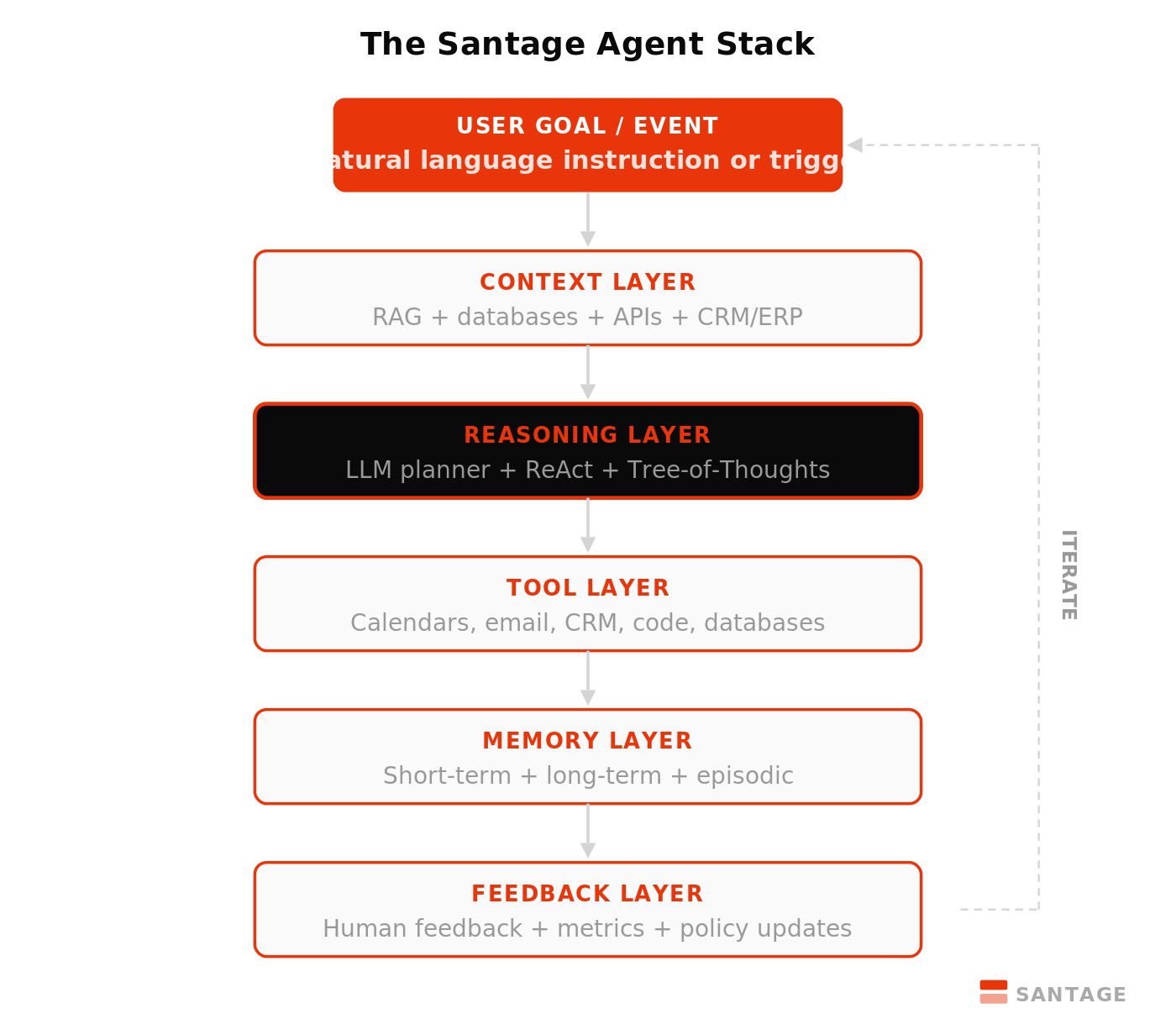
A production-grade agent architecture includes six layers working together.
The input and goal layer receives the user's objective or a system-triggered event. This may include constraints such as budgets, risk thresholds, allowed tools, or required human approval gates.
The perception and context layer retrieves relevant information using retrieval-augmented generation, structured database queries, CRM or ERP snapshots, and real-time API calls. This layer ensures the agent operates on current, grounded data rather than relying solely on the language model's training knowledge.
The reasoning and planning layer is the core of agency. The LLM planner decomposes the goal into an ordered sequence of subtasks. Techniques used here include ReAct for interleaved thinking and acting, Tree-of-Thoughts for exploring multiple reasoning paths, Plan-and-Execute for generating a complete plan before execution, and multi-agent orchestration for delegating subtasks to specialized agents.
The tooling and execution layer connects the agent to external systems through an API tool registry. Calendars, email clients, CRM platforms, code executors, databases, spreadsheets, and web browsers are all accessible through function-calling interfaces, typically defined using JSON schemas. Safeguards at this layer include parameter validation, rate limiting, and human approval flows for high-stakes actions.
The memory and state layer maintains context across the agent's operational lifecycle. Leading architectures distinguish between short-term memory (the current conversation and task state, typically held in the model's context window of 128,000 to 2 million tokens), long-term memory (historical patterns and knowledge stored in vector databases), and episodic memory (records of specific past interactions that inform future behavior).
The feedback and adaptation layer closes the loop. Human feedback, automated performance metrics such as task success rate and latency, and reinforcement-like learning signals refine the agent's planning heuristics, tool-selection policies, and validation thresholds over time.
How do AI agents compare to LLMs, RAG, and workflows?
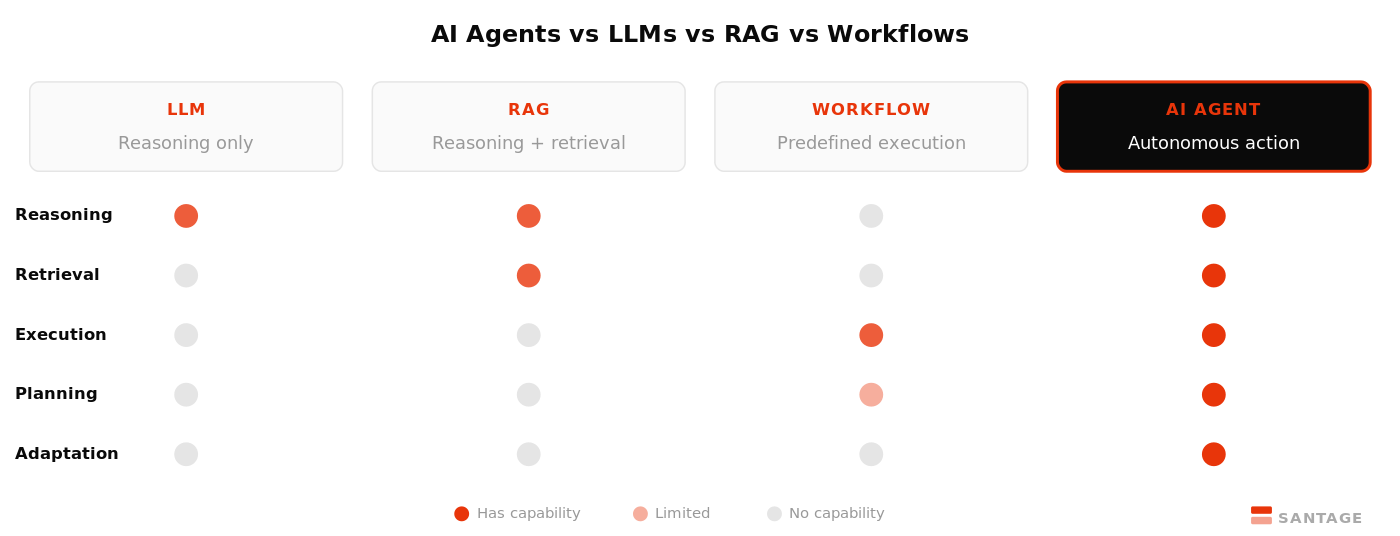
AI agents are frequently confused with the technologies they build upon. Understanding the distinction is critical for making sound architecture decisions.
A large language model is a reasoning engine. It takes input and produces output, typically text, based on probabilistic pattern recognition. An LLM alone cannot take actions, access external data in real time, or maintain state across interactions. It generates, but it does not do.
Retrieval-augmented generation adds a knowledge retrieval layer to the LLM. Before generating a response, a RAG system searches a knowledge base (using embeddings and vector databases) and provides relevant documents as context. This grounds the LLM's output in real data and reduces hallucination. But RAG is still a response system: query in, answer out, no autonomous follow-up.
A workflow automation system (such as Zapier, Make, or a traditional BPMN engine) executes predefined sequences of actions triggered by specific events. These are powerful for structured, repeating processes but brittle when conditions change. They cannot reason, adapt, or handle ambiguous situations.
An AI agent combines all three. It uses an LLM for reasoning, RAG for knowledge grounding, and tool-calling for action execution, but adds planning, memory, and feedback loops that enable autonomous, adaptive, multi-step operation. The agent decides what to retrieve, what to reason about, and what actions to take, adjusting its plan based on observed results.
What is the difference between AI agents, chatbots, and copilots?
The terms "agent," "chatbot," and "copilot" are frequently used interchangeably, but they describe fundamentally different levels of AI autonomy and capability.
A chatbot is a conversational interface that responds to user messages within a text window. It processes a single input, generates a single output, and waits for the next input. It cannot take actions outside the conversation, such as calling APIs, modifying databases, or triggering workflows.
A copilot sits inside an application or workflow and assists a human user by pulling context, drafting content, summarizing information, and suggesting next actions. The critical distinction is that a copilot does not act independently. It recommends, and the human decides and executes. Microsoft Copilot, GitHub Copilot, and similar tools represent this paradigm.
An AI agent plans, executes, iterates, and adapts autonomously across multiple steps. It can call APIs, read results, make decisions, handle exceptions, escalate when needed, and continue working until the goal is achieved or a policy boundary is reached. Where a copilot drafts an email for you to review and send, an agent drafts the email, checks the recipient's calendar, schedules a follow-up meeting, and updates the CRM record, all without waiting for human approval at each step (unless configured to do so).
| Dimension | Chatbot | Copilot | AI Agent |
|---|---|---|---|
| Autonomy | None. Responds only when prompted. | Low. Suggests actions for human approval. | High. Plans and executes independently. |
| Scope | Single-turn conversation | Single application or task | Multi-step, cross-system workflows |
| Tool access | None | Limited to host application | Broad: APIs, databases, code, email, web |
| Memory | Session only, often stateless | Application context | Short-term, long-term, and episodic |
| Adaptation | None | Minimal | Learns from feedback and outcomes |
| Human role | Full control at every step | Decision-maker, agent assists | Supervisor, agent executes |
| Best for | FAQ, simple Q&A | Drafting, summarizing, suggesting | End-to-end process automation |
What are the main types of AI agents?
The classical taxonomy of AI agents, established by Russell and Norvig, identifies five types based on increasing sophistication. Modern LLM-powered agents inherit this framework but extend it with capabilities such as natural language understanding, tool calling, and multi-agent collaboration. A practical, enterprise-aligned taxonomy includes six categories.
Reactive agents respond to current inputs without maintaining internal state or planning ahead. In LLM-based systems, these are single-step agents: they receive a query, call one tool, and return a result. FAQ chatbots backed by a knowledge base and simple data-retrieval bots fall into this category.
Model-based agents maintain an internal representation of the world, including user context, system state, and environmental conditions, and use this model to inform their actions. Customer support agents that track order history, past tickets, and company policies are a common example.
Goal-based agents are given an objective and explore potential action sequences to achieve it. The LLM generates a plan, then executes it through tool calls or sub-agent delegation. "Analyze Q1 performance and send a summary to the finance team" is a goal-based agent workflow.
Utility-based agents go beyond goal achievement to optimize for a utility function, such as cost, speed, risk, or accuracy. Routing agents that assign support tickets to the most qualified and cost-effective human agent within SLA constraints are a practical example.
Learning agents improve over time by incorporating feedback from users, environment signals, and performance metrics. Personal assistants that adapt to a user's communication preferences represent this category.
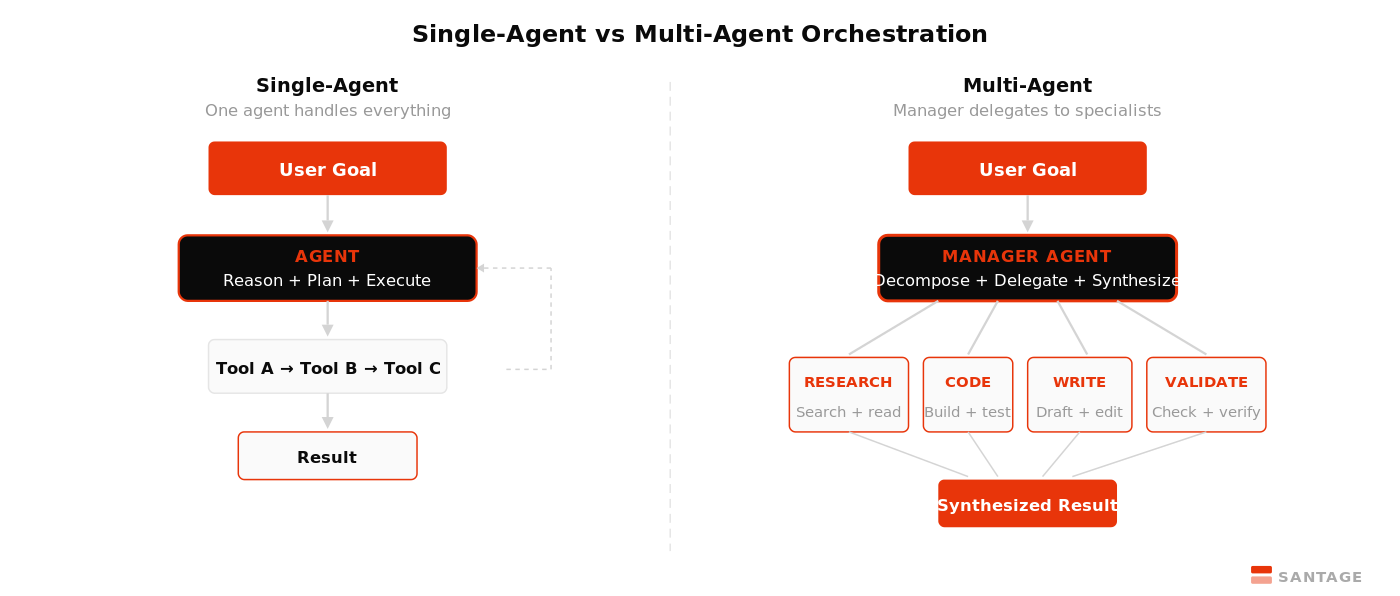
Multi-agent systems coordinate multiple specialized agents to achieve a shared or complex objective. A manager agent decomposes the overall goal, delegates subtasks to specialist agents (research, writing, coding, validation), and synthesizes their outputs. This pattern has become the dominant architecture for complex enterprise workflows in 2025 and 2026, with frameworks such as LangGraph, CrewAI, and Microsoft AutoGen providing the orchestration infrastructure.
| Agent Type | Planning | Learning | Complexity | Enterprise Example |
|---|---|---|---|---|
| Reactive | None | None | Low | FAQ lookup bot |
| Model-based | None | None | Medium | Customer support with context |
| Goal-based | Multi-step | None | Medium-High | Expense report processor |
| Utility-based | Optimized | None | High | SLA-aware ticket router |
| Learning | Adaptive | From feedback | High | Personalized sales assistant |
| Multi-agent | Delegated | Collective | Very High | End-to-end litigation support |
How are AI agent benchmarks measured?
Benchmarking AI agents is fundamentally different from benchmarking language models. Agent benchmarks must evaluate not just reasoning quality but also tool-calling accuracy, multi-step planning reliability, error recovery, and real-world task completion. Several benchmarks have emerged as industry standards.
| Benchmark | What It Measures | Top Score (May 2026) | Why It Matters |
|---|---|---|---|
| OSWorld | Autonomous computer tasks across real OS environments (Ubuntu, Windows, macOS) | 72.7% (Claude Opus 4.6) | Tests whether agents can use real software like humans do |
| SWE-bench Verified | Autonomous resolution of real GitHub issues in production codebases | 93.9% (Claude Mythos Preview) | Measures practical software engineering capability |
| TAU-bench | Multi-turn tool use in enterprise scenarios (retail, airline) | 89.2% (Claude Mythos Preview) | Tests policy adherence and reliable task completion in business workflows |
| OSWorld-Verified | Verified subset of OSWorld with stricter evaluation | 82.6% (Holo3-35B) | Reduces evaluation noise, provides more reliable capability signal |
| WebArena | Web browsing and interaction tasks across live websites | ~35% (best systems) | Tests navigation, form-filling, and multi-page workflows |
| SWE-bench Pro | Harder coding tasks designed to resist data contamination | ~46% (best systems) | Addresses benchmark leakage concerns in SWE-bench Verified |
No single agent dominates all benchmarks. Systems optimized for reasoning may lag on GUI interaction tasks, while agents optimized for computer use may underperform on complex coding challenges. This fragmentation reflects the reality that "agent capability" is not a single dimension but a portfolio of skills.
The Stanford HAI 2026 AI Index documented the most dramatic year-over-year improvements in agent benchmarks. OSWorld scores jumped from 12% to over 66% in aggregate. Cybersecurity challenge solve rates went from 15% unguided in 2024 to 93% in 2025. These gains are driving enterprise confidence, but the gap between benchmark performance and production reliability remains significant, particularly for long-horizon tasks.
Why are AI agents emerging now?
The concept of autonomous AI agents has existed in computer science for decades, but three converging forces have made them practically viable in 2025 and 2026.
LLM reasoning crossed the reliability threshold
The foundation models powering agents, including OpenAI's o3, Anthropic's Claude 4 family, and Google's Gemini 2.5 Pro, now demonstrate sufficient reasoning capability to plan multi-step workflows, handle exceptions, and recover from errors. On TAU-Bench, a benchmark for tool-augmented understanding, leading models achieve 85% or higher success rates. The 2026 Stanford HAI AI Index documented that AI agent success rates on real-world computer tasks (OSWorld) jumped from roughly 12% to 66.3% in a single year, while top frontier systems now approach human-level performance on subsets of SWE-bench Verified, with the leading system reaching a 93.9% resolve rate as of May 2026.
Agent infrastructure matured
The tooling required to build production agents reached maturity across 2025. Function-calling interfaces, standardized by OpenAI, Anthropic, and Google, gave models reliable mechanisms to invoke external tools. Agent development frameworks emerged and stabilized: LangGraph for stateful, graph-based workflows with built-in checkpointing; CrewAI for role-based multi-agent orchestration; Microsoft AutoGen for conversational agent teams; and the native agent SDKs released by Anthropic, OpenAI, and Google.
Critically, Agent Skills converged on an open standard. Three major AI labs, Anthropic, OpenAI, and Google DeepMind, independently settled on nearly the same JSON Schema-based format for describing agent capabilities. A skill definition written for Claude can be adapted for GPT-4o or Gemini in minutes. This interoperability has dramatically reduced the friction of building cross-platform agent systems.
Enterprise demand shifted from chat to action
Organizations moved from asking "Can AI answer questions?" to demanding "Can AI do the work?" According to Deloitte's 2026 State of AI in the Enterprise report, worker access to AI tools rose by 50% in 2025, and the number of companies with 40% or more AI projects in production is set to double within six months. McKinsey's research identifies a cohort of high performers, the approximately 6% of organizations where more than 5% of EBIT is attributable to AI, who are three times more advanced in agent deployment and consistently invest more than 20% of digital budgets in AI.
The economic logic is clear. Copilots scale linearly with headcount, since every copilot requires a human operator. Agents break this dependency. One agent workflow can handle thousands of concurrent tasks, making them the first AI paradigm that genuinely scales process throughput without proportionally scaling labor.
How are AI agents used in the enterprise?
AI agents are embedding into enterprise workflows across every major business function. The use cases below represent production deployments, not research prototypes, drawn from industry reports by Deloitte, Gartner, and McKinsey.
Customer operations
Tier-1 support agents now handle common transactions end-to-end: answering product questions, checking order status, processing returns, and escalating to human agents only for complex or sensitive issues. One major air carrier deployed agents to help customers rebook flights and reroute luggage, freeing human agents for cases requiring judgment and empathy. Post-interaction agents close tickets, update CRM records, and trigger satisfaction surveys automatically.
Finance and procurement
Finance teams use agents for expense monitoring, flagging policy violations in real time across thousands of transactions. Variance-analysis agents compare actual spending against forecasts and propose root causes. A financial services firm profiled by Deloitte built agentic workflows that capture meeting action items from video conferences, draft follow-up communications, and track completion.
Software development
Developer-focused agents represent one of the most advanced deployment categories. In production, these agents generate boilerplate code, refactor existing systems, run test suites, create pull requests, and manage CI/CD pipelines. GitHub Copilot Workspace agents can resolve approximately 30% of pull requests autonomously. Human code review remains essential for quality assurance and security.
If any single product settled the question of whether agents are real, it was Claude Code. Anthropic's coding agent does not just suggest code the way a copilot does. It plans a change, edits files across a repository, runs tests and shell commands in a loop, reads the results, and iterates until the task is done. That is the full agent loop applied to software engineering, and the market response was unprecedented.
Reuters reported that Claude Code's run-rate revenue passed $2.5 billion by February 2026 and that enterprise subscriptions quadrupled in the first weeks of the year, after the tool grew more than tenfold in the three months following its May 2025 full launch. Its trajectory also validates the nuance in Andrej Karpathy's warning above: while general human-replacement agents remain a decade out, agents that run tools in a loop on well-structured tasks like coding already work well enough to build a multi-billion-dollar business.
Sales and marketing
Deal-assistant agents enrich leads from CRM data and public sources, draft personalized outreach, book demonstrations, and schedule follow-ups. Campaign-optimization agents run A/B tests on creative variants, adjust channel budgets based on real-time performance, and surface top-performing content.
Healthcare and manufacturing
Scheduling agents manage appointment booking and reminders. Clinical-note agents transcribe and structure physician visit notes. Predictive-maintenance agents analyze sensor data from industrial equipment to flag component failures before they occur. Inventory-replenishment agents track stock levels, forecast demand, and trigger purchase orders. These deployments operate under strict regulatory constraints and typically require human-in-the-loop approval for critical decisions.
What are the leading agent frameworks and platforms?
The infrastructure for building AI agents has consolidated around a set of frameworks and platform-native SDKs, each optimized for different orchestration patterns.
LangGraph, developed by LangChain, uses a directed graph execution model where nodes represent functions and edges define conditional transitions between them. It excels at stateful, multi-step workflows that require checkpointing, human-in-the-loop approval gates, time-travel debugging, and complex branching logic.
CrewAI specializes in role-driven multi-agent orchestration. Each agent in a "crew" has a defined role, backstory, and set of tools. CrewAI has the lowest learning curve among major frameworks, requiring approximately 20 lines of code to define a working multi-agent system.
Microsoft AutoGen implements conversational agent teams where multiple agents interact through structured multi-turn conversations. A GroupChat mechanism determines which agent speaks next. AutoGen excels at offline, quality-sensitive workflows where thoroughness matters more than speed.
Platform-native SDKs from the major model providers have become production-grade. Anthropic's Claude Agent SDK gives agents the same tools, agent loop, and context management that power Claude Code, programmable in Python and TypeScript. OpenAI's Agents SDK provides structured handoffs between agents and multi-agent coordination primitives. Google's Agent Development Kit integrates with the Gemini model family and Google Cloud infrastructure.
What are the limitations and risks of AI agents?
Despite rapid progress, AI agents face significant technical limitations and operational risks that organizations must understand before deploying them at scale.
Planning failures on long horizons
AI agents perform well on tasks requiring fewer than ten steps, but reliability degrades on longer planning horizons. The 2026 International AI Safety Report notes that AI systems "can be derailed by simple errors during multi-step projects." Research on LLM-based agent hallucinations documents cascading failure patterns where a single error in an early step propagates downstream, compounding into increasingly incorrect outputs.
Hallucination in action
When agents hallucinate, the consequences extend beyond incorrect text to incorrect actions. An agent that hallucinates a database query may modify the wrong records. Research published in 2025 found that language models are 34% more likely to use high-confidence language such as "definitely" and "certainly" when generating incorrect information, meaning hallucinated agent actions may carry false confidence that makes them harder to catch.
Safety and governance gaps
Only one in five companies has a mature governance model for autonomous AI agents, according to Deloitte's 2026 enterprise AI survey. The 2026 International AI Safety Report identified risks including agents that can discover software vulnerabilities and write malicious code. Without proper guardrails, approval flows, and audit trails, agents operating at scale pose risks of unauthorized actions, data leakage, and compliance violations.
Cost and scalability
Agent inference is more expensive than single-call LLM usage because agents make multiple model calls per task. A single agent run may cost $0.05 to $0.50 in compute, and large-scale fleet deployments can reach $10,000 per day. Gartner's research indicates that more than 40% of agentic AI projects will fail by 2027, and the primary barriers are organizational, not technical.
What does the future of AI agents look like?
The trajectory of AI agent development points toward a fundamental shift in how organizations operate and how humans interact with software systems. It is worth pairing that optimism with a reality check from one of the field's most respected voices.
Near-term: 2026 to 2028
Gartner's prediction that 40% of enterprise applications will feature task-specific agents by the end of 2026 reflects the current adoption curve. In the near term, agent deployment will concentrate in domains with clear ROI: customer operations, software development, finance, and sales. Multi-agent orchestration will become standard for complex workflows, replacing the single-agent architectures that dominated early deployments. Agent governance frameworks will mature out of necessity.
Medium-term: 2028 to 2030
By the end of the decade, the agentic AI market is projected to reach $80 to $100 billion. Agent-to-agent communication protocols will standardize, enabling cross-organizational agent ecosystems where a procurement agent at one company negotiates directly with a sales agent at another. The distinction between "AI application" and "AI agent" will blur. McKinsey estimates that generative AI, with agentic systems as the primary delivery mechanism, could add $2.6 to $4.4 trillion annually to global GDP.
The open research frontier
Several fundamental questions remain unresolved. How can agents achieve reliable reasoning over thousands of steps? What are the optimal multi-agent topologies for large-scale coordination? How can safety be formally verified for autonomous agents operating in healthcare, finance, and critical infrastructure? And how can agent systems be made interpretable enough for regulatory compliance in high-stakes domains?
Think of an AI agent as a new hire with perfect memory, access to every tool in your organization, and the ability to work 24 hours a day. Like a new hire, it needs clear instructions, defined authority, escalation paths, and supervision, especially during onboarding. The more precisely you define its role, the better it performs. The agents that fail are the ones deployed without guardrails, just like employees given responsibility without accountability.
Frequently asked questions
Sources and further reading
- Yao, S. et al. ReAct: Synergizing Reasoning and Acting in Language Models. 2022. arxiv.org/abs/2210.03629
- Russell, S. and Norvig, P. Artificial Intelligence: A Modern Approach. Pearson, 1995 (4th edition 2020). pearson.com
- Stanford University Human-Centered AI Institute. The 2026 AI Index Report. 2026. hai.stanford.edu
- Gartner. Gartner Predicts 40% of Enterprise Apps Will Feature Task-Specific AI Agents by 2026. 2025. gartner.com
- Deloitte. The State of AI in the Enterprise, 2026 AI Report. 2026. deloitte.com
- McKinsey & Company. The State of AI: How Organizations Are Rewiring to Capture Value. 2025. mckinsey.com
- International AI Safety Report. International AI Safety Report 2026. 2026. internationalaisafetyreport.org
- Anthropic. Building Agents with the Claude Agent SDK. 2026. anthropic.com
- Reuters. Anthropic's annualized revenue reaches $14 billion as Claude Code run-rate passes $2.5 billion. February 2026. reuters.com
- Karpathy, A. in conversation with Dwarkesh Patel. AGI is still a decade away. October 2025. dwarkesh.com
- Chen, Y. et al. Agentic AI: Architectures, Taxonomies, and Evaluation of Large Language Model Agents. 2026. arxiv.org/abs/2601.12560
- Li, X. et al. AI Agent Systems: Architectures, Applications, and Evaluation. 2026. arxiv.org/abs/2601.01743
Santage is committed to journalistic accuracy and editorial independence. This guide is reviewed and updated regularly by Santage editors. AI tools were used in research and drafting. All claims, data, and sources were verified by the editorial team. For more details, read our Editorial Standards.