
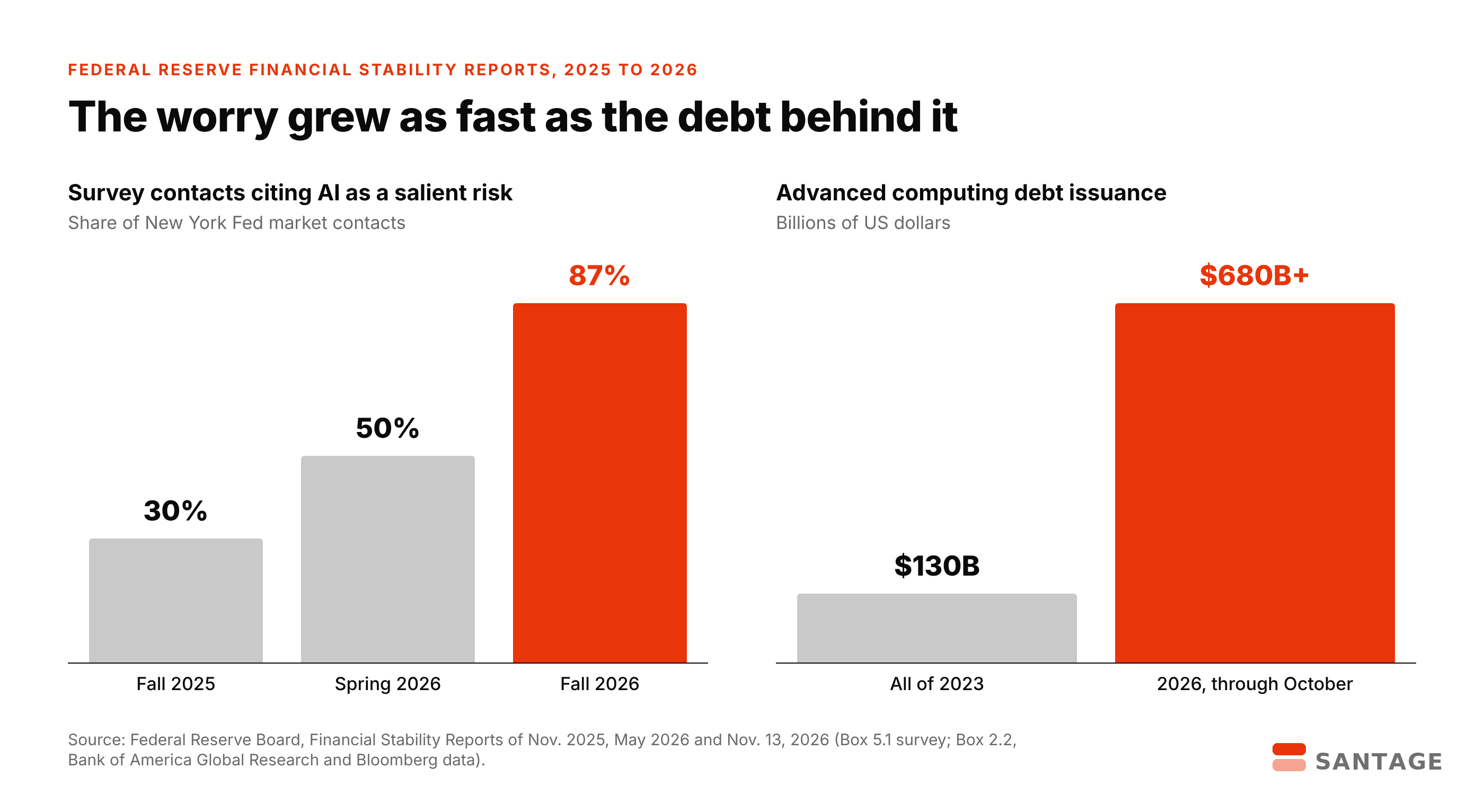
- AI was the top-cited risk in the Fed's fall survey of 23 market contacts, named by 87%, up from 50% in spring 2026 and 30% in fall 2025.
- Advanced computing debt issuance passed $680 billion by October 2026, about five times the $130 billion issued in all of 2023, and outstanding public debt tied to it tops $1.1 trillion.
- Not-yet-started leases and guarantees add more than $3 trillion of obligations, and the largest US banks have close to $1 trillion of exposure to the buildout's borrowers.
The Federal Reserve's November Financial Stability Report shows Wall Street's AI anxiety moving from stock prices into credit: 87% of the market contacts the New York Fed surveyed named AI as a risk to the financial system, and the report's own staff analysis finds that the debts, leases and guarantees behind the data center buildout now run into the trillions of dollars and are spreading to weaker borrowers.
The Fed's survey puts AI ahead of every traditional threat
The report, the Board's twice-yearly assessment of the US financial system, reflects information available as of October 28. Its Box 5.1 summarizes a survey run by New York Fed staff in September and October among 23 contacts at broker-dealers, banks, investment funds and advisory firms. Twenty of them named AI. The next most cited risk, a broad correction in risk assets, drew 52%, and respondents tied much of that to AI as well, pointing to uncertain returns on large capital spending, stretched valuations and circular financing.
Respondents split the AI concern into three parts: equity valuations that could fall if earnings disappoint, cyber risk from state actors or from frontier models themselves, and complex forms of AI-related financing. The Fed notes that the survey reflects respondents' views rather than the Board's. The Board's own summary still goes further than in past reports, describing equity valuations as high "partly driven by market enthusiasm for super intelligence," a term borrowed from the labs' own pitch for artificial superintelligence.
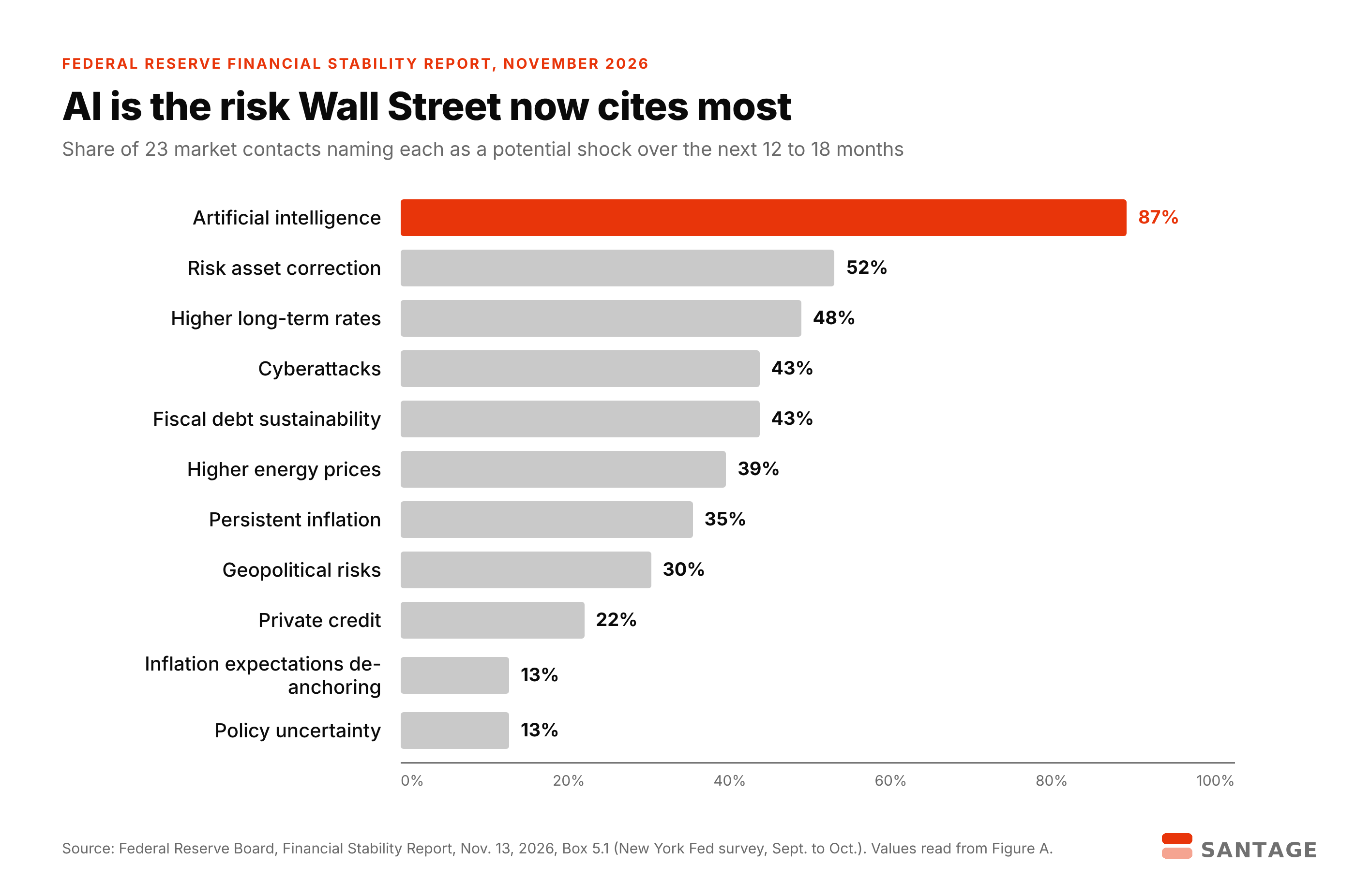
AI also feeds the fourth-ranked risk. Contacts who cited cyberattacks on market infrastructure said advances in AI are lowering the barrier to sophisticated attacks by state and non-state actors, and some pointed to unintended damage caused by frontier models themselves, a concern regulators have taken more seriously since labs began publishing their own incident reports. Mentions of AI, higher long-term rates and cyberattacks rose the most of any risk since the spring survey.
The report's sharper warning sits in the data center debt
The more consequential material is Box 2.2, "Leverage in the Data Center Buildout," which is the Fed's own analysis rather than a poll. Debt issued to finance advanced computing rose to more than $680 billion by October, and its share of investment-grade nonfinancial corporate issuance climbed from under 6% in 2023 to about 31% this year. The mix is changing as well, from mostly corporate bonds toward private debt, structured credit and project finance, which pushes part of the buildout into markets that are harder to see.
| $680B+ | Advanced computing debt issuance through October 2026 |
| $1.1T+ | Outstanding public debt tied to advanced computing |
| $3T+ | Undiscounted leases not yet started plus guarantees and contract commitments |
| ~$1T | Largest US bank holding companies' exposure to the buildout |
Guarantees from big tech now carry more weight than its bonds
The number most coverage has skipped is the one that sits off balance sheet. Across Amazon, Alphabet, Broadcom, Meta, Microsoft, Nvidia and Oracle, the Fed counts more than $1 trillion of data center leases that have not yet started and more than $2 trillion of take-or-pay contracts and residual value guarantees, and finds these obligations growing faster than debt. Hyperscalers sign long leases that let third-party developers borrow against them, while GPU makers guarantee the resale value of chips that smaller AI firms buy with borrowed money. Santage traced the early form of this pattern in September, when off-balance-sheet structures began carrying the buildout.
| Obligation | Size in the Fed's estimate | Who carries the risk |
|---|---|---|
| Advanced computing debt issued in 2026 | More than $680 billion | Bond funds, insurers, pensions |
| Leases not yet commenced | More than $1 trillion, undiscounted | Hyperscalers, if tenants walk away |
| Take-or-pay contracts and residual value guarantees | More than $2 trillion, undiscounted | Large tech firms and GPU makers |
| Subordinated debt and equity in special purpose entities | Not quantified | High-yield funds, life insurers, BDCs, private credit |
| Bank exposure to the buildout's borrowers | Close to $1 trillion | Largest US bank holding companies |
Source: Federal Reserve Board, Financial Stability Report, November 2026, Box 2.2. Lease and guarantee figures are undiscounted and not directly comparable with debt. Table: Santage.
The Fed reads this two ways. The strongest companies may absorb losses in a downturn and protect the rest of the system, yet their real exposure "may be substantially larger than suggested by their on-balance-sheet liabilities." Its warning on the network of lenders around them is the plainest line in the report.
"The complex interlinkages among firms engaged in the data center buildout, public credit markets, private lenders, and special purpose financing vehicles create vulnerabilities that necessitate close monitoring."
Federal Reserve Board, Financial Stability Report, November 2026
Big tech's guarantees to smaller AI borrowers now exceed its AI debt, so the strength of the largest balance sheets is quietly underwriting the weakest.
The next tests arrive within a week
Two events will show whether the survey's fear is priced or premature. Nvidia, whose residual value guarantees sit inside the Fed's $2 trillion figure, reports quarterly results on November 17 under an interim CEO, and Anthropic is scheduled to price its IPO at $70 to $78 a share the following day, the largest test yet of public appetite for AI valuations. The Fed's warning follows similar ones from the BIS on circular funding and the IMF on an AI market correction, so all three major watchdogs now describe the same financing loop.
The central bank stops short of predicting a bust, and the strongest borrowers in this cycle have far more cash than the telecom builders of the late 1990s, a comparison the Fed draws explicitly. What has changed is the shape of the AI infrastructure bet: a year ago it was mostly the equity of a few rich companies, and today it is a web of leases, guarantees and structured debt that reaches insurers, private credit funds and banks. Eighty-seven percent of the Fed's contacts are worried about AI, and the report's own numbers explain why that concern now belongs to the credit market as much as the stock market.
Santage is committed to independent, transparent journalism. This article is produced in accordance with Santage's Editorial Standards and aims to provide accurate and timely information. Readers are encouraged to verify information independently.