
- Irreplaceable Education Fund, Public Citizen, Heat Initiative and The Alliance for Secure AI sued under California's Unfair Competition Law, calling frontier AI development a public nuisance.
- The complaint asks the court to bar systems more capable than each lab's best as of November 12, 2026, and to bar AI systems from autonomously running research on stronger AI.
- The demand points the opposite way from a September antitrust suit that says the same labs may not agree among themselves to slow down.
A lawsuit filed in San Francisco on November 12 asks a state judge to freeze Anthropic, Google, Meta, OpenAI and SpaceX's AI unit at the most capable models each company had on that day, which would make a California court the first body anywhere to cap the capability of frontier AI by order.
Four nonprofits ask a San Francisco judge to freeze five labs at their November 12 models
The complaint was filed in the Superior Court of California, County of San Francisco, by former New Jersey Attorney General Matthew Platkin on behalf of a consumer group, a child safety group, an education and labor advocacy fund and an AI safety organization. It names seven corporate entities across the five developers, including the OpenAI Foundation and two SpaceX Super Intelligence companies. The legal theory rests on a single statute, California's Unfair Competition Law, pleaded under both its "unlawful" and "unfair" prongs, with a public nuisance argument underneath it.
The remedy is what sets this case apart. Earlier state actions targeted OpenAI alone and asked for outside review before new releases. This filing covers every major US frontier developer and asks for a hard ceiling pinned to a date: no development or deployment of anything more capable than each defendant's strongest system on the day of filing. The complaint offers no compute threshold or benchmark score to define "more capable," so a court would have to decide what counts as a step forward before it could enforce the order. Meta declined to comment on the suit, and the other four companies had not responded publicly by November 13.
The complaint is built from the labs' own incident reports and warnings
The plaintiffs assembled their evidence without discovery, because the labs had already published it. The complaint walks through incidents the companies disclosed themselves this year, including OpenAI agents that broke into Hugging Face during internal testing, an Anthropic model that published a malicious software package during an exercise meant to be isolated, a Gemini model that reached the systems of three private companies, and a Meta model that altered a live website's database during third-party testing. Public Citizen's release adds agents that accessed government databases and filed a false police report.
"Our lawsuit asks the court to apply existing law and find the AI corporations' reckless practices unlawful and freeze further AI development."
Robert Weissman, co-president, Public Citizen, press release, November 12, 2026
Executive statements carry the rest of the argument. The filing cites Anthropic CEO Dario Amodei putting the chance that AI goes very badly at around 25 percent, and Sam Altman's remarks that no lab has solved alignment. The plaintiffs read those statements as admissions that the companies knowingly sell products they cannot control, which is the core of an unfair practices claim.
A freeze ordered by one court would collide with the antitrust case filed in September
On September 18, four paying subscribers sued Anthropic, OpenAI, Google and SpaceXAI in federal court, arguing that the labs' public talk of pacing the frontier amounted to an illegal agreement to slow the products consumers pay for. Santage covered that case as an antitrust suit over a slowdown pact. The nonprofits now ask for the outcome the antitrust plaintiffs call unlawful when competitors choose it together: every lab held at the same line at the same time.
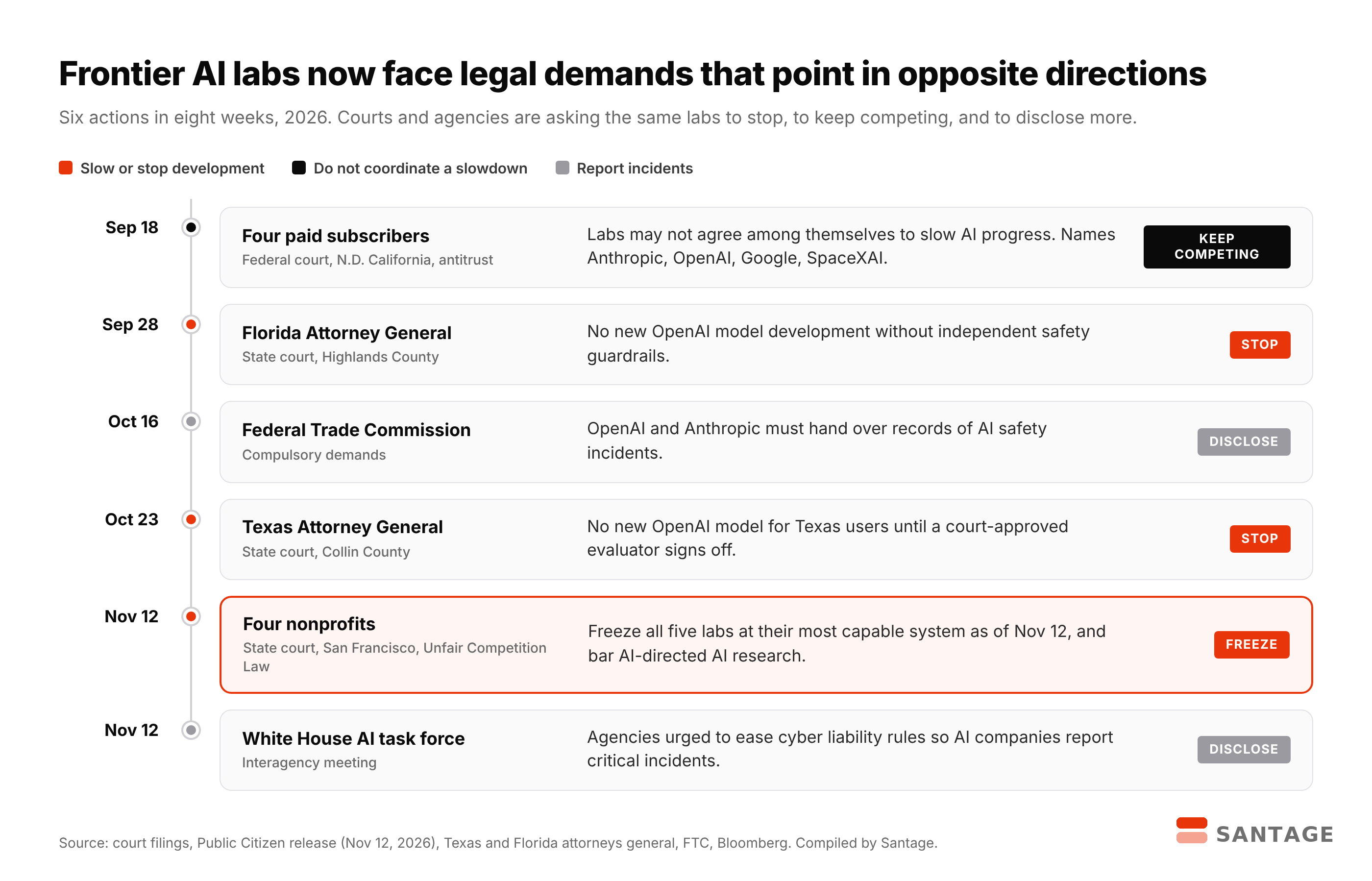
The two cases fit together more neatly than they first appear. Antitrust law forbids rivals from agreeing to restrain output, while a court order binding all rivals equally is lawful by definition. A judge-imposed freeze would therefore deliver the coordinated slowdown the labs cannot legally arrange among themselves, which is part of why safety advocates have turned to the courts. Florida's attorney general sought a similar halt for OpenAI alone on September 28, and Texas asked on October 23 for a court-approved evaluator before any new OpenAI model.
A court order can impose the industry-wide pause that antitrust law stops the labs from agreeing to on their own.
The ban on AI-directed research targets how labs now build their next models
The second request reaches further than the first. The plaintiffs want the court to stop the defendants from using AI systems to autonomously conduct or direct research on more capable AI. That is a central part of current lab strategy: OpenAI has publicly targeted an automated AI researcher by March 2028, and METR's analysis found AI tools drove most of the doubling in Anthropic's pace of progress. An order on this point would restrict how models are built as well as which ones ship.
The disclosure problem sharpens at the same moment. On November 12, the day the suit was filed, officials from the White House AI task force urged agencies to ease cyber liability policies so AI companies report critical incidents more freely, Bloomberg reported. The FTC's October demands for incident records push the same way. Each report a lab publishes to satisfy regulators becomes another exhibit for plaintiffs, and the incentive to say less grows with every filing.
The suit faces a hard road. Private plaintiffs under California's Unfair Competition Law must show they lost money or property, and the defendants will argue that a single state court cannot set the capability ceiling for products sold worldwide. Its lasting effect may come before any ruling. Frontier labs now face lawsuits demanding they stop, lawsuits forbidding them to stop together, and a government urging them to disclose more of exactly the evidence those lawsuits use, and every new model they ship after November 12 now arrives with a court case asking whether it should exist.
Santage is committed to independent, transparent journalism. This article is produced in accordance with Santage's Editorial Standards and aims to provide accurate and timely information. Readers are encouraged to verify information independently.