

- BIS Bulletin 137, published October 1, finds 55.2% of incoming investment into 1,246 AI firms came from other AI firms, and 46.4% of AI-to-AI deal value also involved a commercial supply relationship.
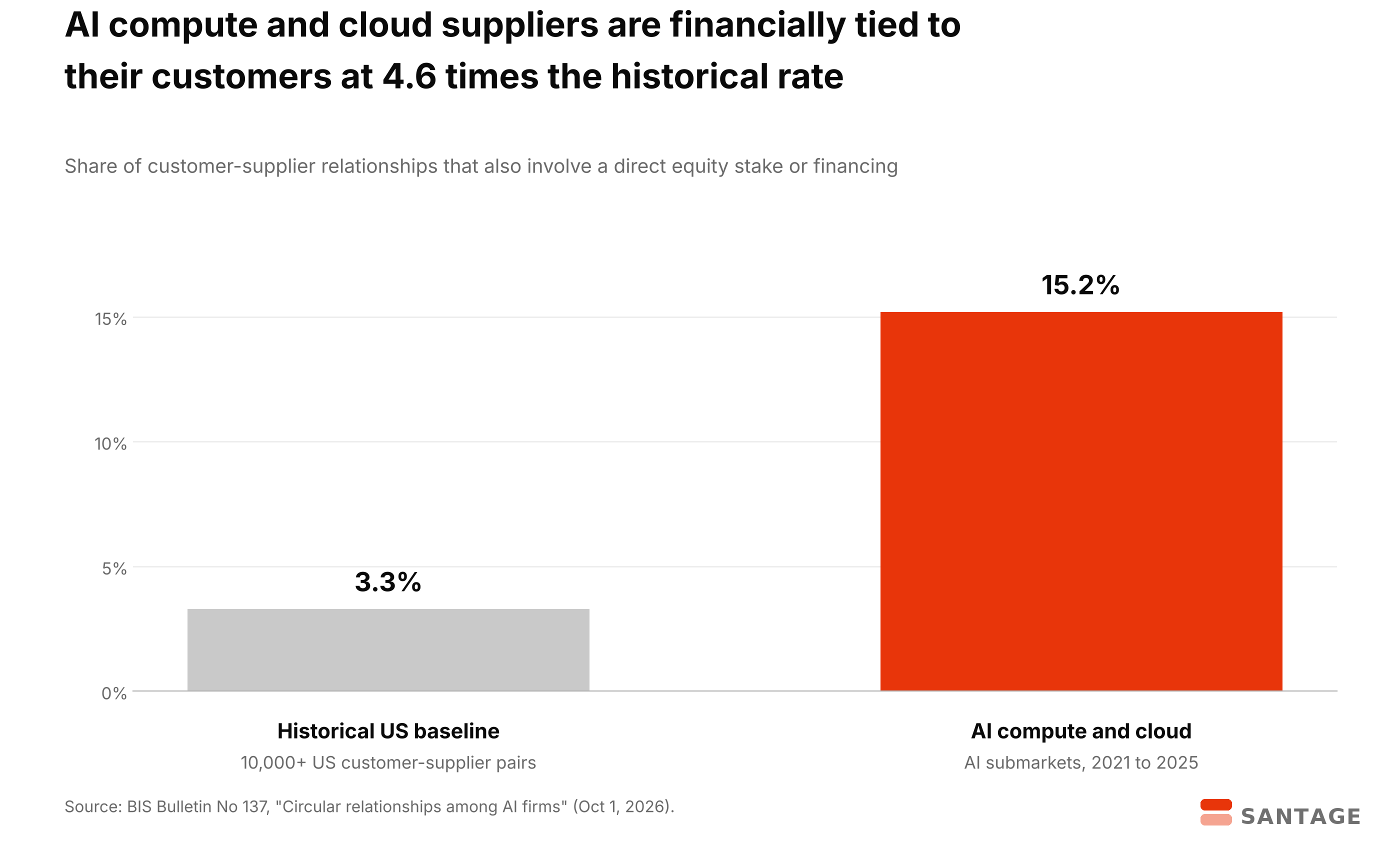
- Compute and cloud firms are financially tied to their customers in 15.2% of relationships, against a 3.3% baseline across more than 10,000 US customer-supplier pairs.
- The BIS warns that these loops make reported AI demand “partly endogenous” to the financing behind it, and points to Lucent and Nortel in the telecom bust as the precedent.
More than half of the money invested in AI companies between 2021 and 2025 came from other AI companies, and nearly half of that inside money by value came from firms that also sell to or buy from the company they funded, according to new research from the Bank for International Settlements, the Basel-based institution owned by the world's central banks.
The BIS finds 55.2% of money flowing into AI firms comes from other AI firms
The bulletin, written by BIS economists Jon Frost, Rudraksh Kansal, Kumar Rishabh, Vatsala Shreeti and Leanne Si Ying Zhang, maps 1,246 AI companies across five layers of the supply chain: compute, infrastructure, data tools, models and applications. The authors matched PitchBook deal records against FactSet data on who buys from whom, then checked the links by hand, which lets the study see something ordinary funding tallies miss, namely whether an investor is also a vendor or a customer of the company it backs.
The headline result runs in both directions. AI firms sent 28.7% of their outgoing deal value into other AI firms, and on the receiving side 55.2% of all investment into AI firms came from inside the sector. For five years, the AI industry has supplied more of its own capital than every outside investor combined.
| Investment into AI firms from other AI firms | 55.2%, 2021 to 2025 |
| AI-to-AI deal value with a supply relationship | 46.4% (16.1% by deal count) |
| Circular deals where a supplier funds its customer | 64% |
| Circular investment from compute and infrastructure firms | 73% |
| AI firms mapped | 1,246 across five supply-chain layers |
Nearly half of AI-to-AI deal value also buys the investor's own products
The gap between two numbers carries the finding. By count, only 16.1% of AI-to-AI deals involved a company investing in a supplier or a customer, but by value that share rises to 46.4%, which places circular financing in the largest transactions of the cycle. Almost two thirds of those circular deals ran from supplier to customer, and 73% of circular investment started in the compute and infrastructure layers, flowing down to model developers and application companies.
The bulletin names no individual deals, but the pattern fits agreements already on the public record. In September 2025, Nvidia announced plans to invest up to $100 billion in OpenAI as OpenAI deployed at least 10 gigawatts of Nvidia systems. Two months later, Microsoft and Nvidia committed up to $15 billion combined to Anthropic, which in turn committed to buy $30 billion of Azure compute. Anthropic's prospectus now lists about $518 billion in planned compute and infrastructure spending, as Santage reported when the filing revealed a $42 billion loss.
| Relationship type | How the money moves | Economic reason the BIS gives |
|---|---|---|
| Supplier finances customer | A chip or cloud firm invests in a model or app company that buys its products | Supplier knows the customer's usage and growth, and funding stabilizes demand for capital-heavy products |
| Customer finances supplier | A buyer takes equity in, or lends to, the maker of a scarce input | Locks in access to specialized chips or lithography equipment and a voice in strategy |
| Reciprocal flows | Both firms buy from and invest in each other | Customized data centers, chips and models create hold-up risk that contracts alone cannot cover |
Source: BIS Bulletin No 137, October 1, 2026. Table: Santage.
The BIS sees sound economics behind the loops and a measurement problem in the revenue line
The authors treat circular deals as rational. Suppliers often understand a customer's trajectory better than any outside investor, scarce inputs justify paying for priority access, and relationship-specific assets such as a foundation model trained for one chip, or a data center built for one tenant, are hard to protect with contracts alone. The trouble lies in what the arrangement does to the numbers markets use to judge the boom.
“Circular relationships make reported demand partly endogenous to firms' own financing decisions.”
BIS Bulletin No 137, “Circular relationships among AI firms”, October 1, 2026
When a chipmaker funds a lab that then spends the money on that chipmaker's hardware, the chipmaker books revenue and the lab books capacity, yet the end-user demand that would justify both is still a forecast. Investors exposed as shareholder and supplier at once also take the same shock twice, losing equity value and product revenue together if the customer stumbles.
Lucent and Nortel are the precedent the central bankers chose
The bulletin reaches back to the telecom buildout of the late 1990s, when equipment makers such as Lucent and Nortel lent money to network operators so they could keep buying equipment. The BIS describes how that ended: “when operators' own revenues failed to materialise or slowed, they could neither repay the loans nor sustain the equipment purchases.” Vendor sales and vendor loans collapsed together.
The BIS has put a number on a question every AI valuation now carries: how much of the industry's revenue is customers paying, and how much is suppliers paying themselves through a customer.
The bulletin adds that this is harder to monitor now than it was in telecom. Many of the companies involved are private, the deals mix cash with long-term purchase commitments and residual value guarantees that sit off balance sheets, and the counterparties span jurisdictions. Santage tracked one layer of that opacity in the roughly $300 billion of AI infrastructure debt held off Big Tech balance sheets.
Trillion-dollar AI valuations rest on revenue the market cannot separate
The timing gives the research its edge. OpenAI is seeking $30 billion at a $1.4 trillion valuation, Anthropic's filing targets more than $2 trillion, and both price in revenue growth that depends heavily on capacity paid for, in part, by the companies selling it. The BIS draws no policy conclusions, but its framing tells supervisors where to look: disclosure of who funds whom, cross-border coordination, and the contingent commitments that never show up as debt.
Circular financing is how the AI industry built its compute base faster than outside capital alone would allow, and the BIS data shows the practice is concentrated in exactly the deals that set the sector's valuations. Until investors can separate end-customer revenue from revenue a supplier financed, every AI demand figure carries a discount nobody has priced, and the central banks' own bank has now said so in writing.
Santage is committed to independent, transparent journalism. This article is produced in accordance with Santage's Editorial Standards and aims to provide accurate and timely information. Readers are encouraged to verify information independently.