
- The range puts the offering at $57.75 billion to $64.35 billion and a fully diluted value of roughly $1.26 trillion to $1.40 trillion, about 30% to 45% above the $965 billion Series H mark from May 2026.
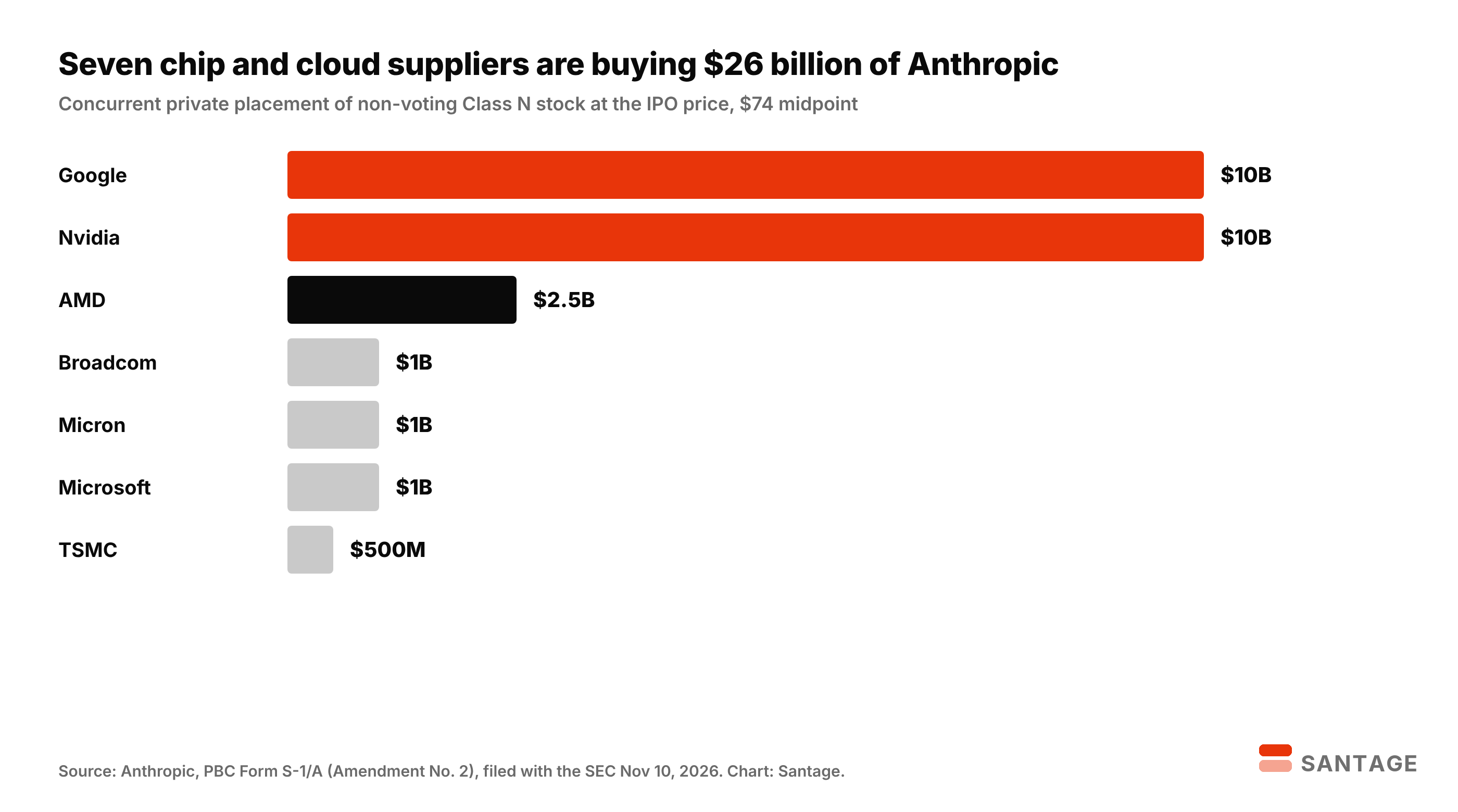
- Google and Nvidia are buying $10 billion each in a $26 billion concurrent placement with AMD, Broadcom, Micron, Microsoft and TSMC, while Anthropic carries $900.9 billion of committed spend, mostly compute.
- The public float is about 6% of the 13.1 billion shares outstanding after the deal, and about 3.6 billion shares can become sellable before the standard 180-day lock-up ends.
Anthropic launched its IPO roadshow on November 10 with a range of $70 to $78 for 825 million Class A shares, enough to raise up to $64.35 billion, and the amended filing behind it shows that seven of the companies selling it chips and cloud capacity have agreed to buy another $26 billion of its stock at the same price.
Anthropic is selling 825 million shares on Nasdaq under the ticker ANT
Of the 825 million shares, 801,351,354 come from Anthropic and 23,648,646 from existing holders, with underwriters holding a 30-day option on 123,750,000 more, according to Anthropic's roadshow announcement. Goldman Sachs and Morgan Stanley handle the prospectus. At the $74 midpoint, the company expects net proceeds of about $84.6 billion from the offering and the placement combined, for general corporate purposes that explicitly include compute and infrastructure.
The range is a marketing figure. The registration statement has yet to become effective, so no shares can be sold until the SEC signs off, and the final price and share count will be set after investors place orders during the roadshow. Anthropic has not announced a pricing date or a first trading day.
"The initial public offering price is expected to be between $70.00 and $78.00 per share."
Anthropic, Anthropic launches roadshow for proposed initial public offering, November 10, 2026
| $64.35B | Maximum IPO size at $78 a share |
| $26B | Concurrent placement from seven suppliers |
| $84.6B | Expected net proceeds at the $74 midpoint, offering plus placement |
Anthropic's suppliers are buying $26 billion of its stock
The placement is the detail that sets this IPO apart. Google and Nvidia take $10 billion each, AMD $2.5 billion, Broadcom, Micron and Microsoft $1 billion each, and TSMC $500 million, all in non-voting Class N shares at the IPO price, according to the amended S-1. Google's purchase funds part of an investment it had already committed. These are the same companies that rent, design, fabricate or supply memory for the AI infrastructure Anthropic runs on, and the filing puts Anthropic's aggregate committed spend at $900.9 billion, with $451.6 billion due before the end of 2030 and $70.7 billion in the next 12 months.
For suppliers, the logic is a hedge on their biggest customer. Each dollar of equity helps fund compute orders that flow back to them as revenue, and the stakes give them upside if the orders keep growing. For public buyers, it means a large share of the capital behind the stock comes from counterparties whose sales depend on Anthropic spending it, the same circular pattern behind Big Tech's $557 billion AI capex surge.
The cash cushion is large by any measure. The filing shows roughly $132 billion in cash and short-term investments before the offering. Add the expected $84.6 billion in net proceeds and Anthropic would hold about three times the $70.7 billion of commitments due over the next 12 months, which gives it room to keep signing compute contracts without returning to private markets.
Revenue growth slowed to 47% as investors cut the price talk
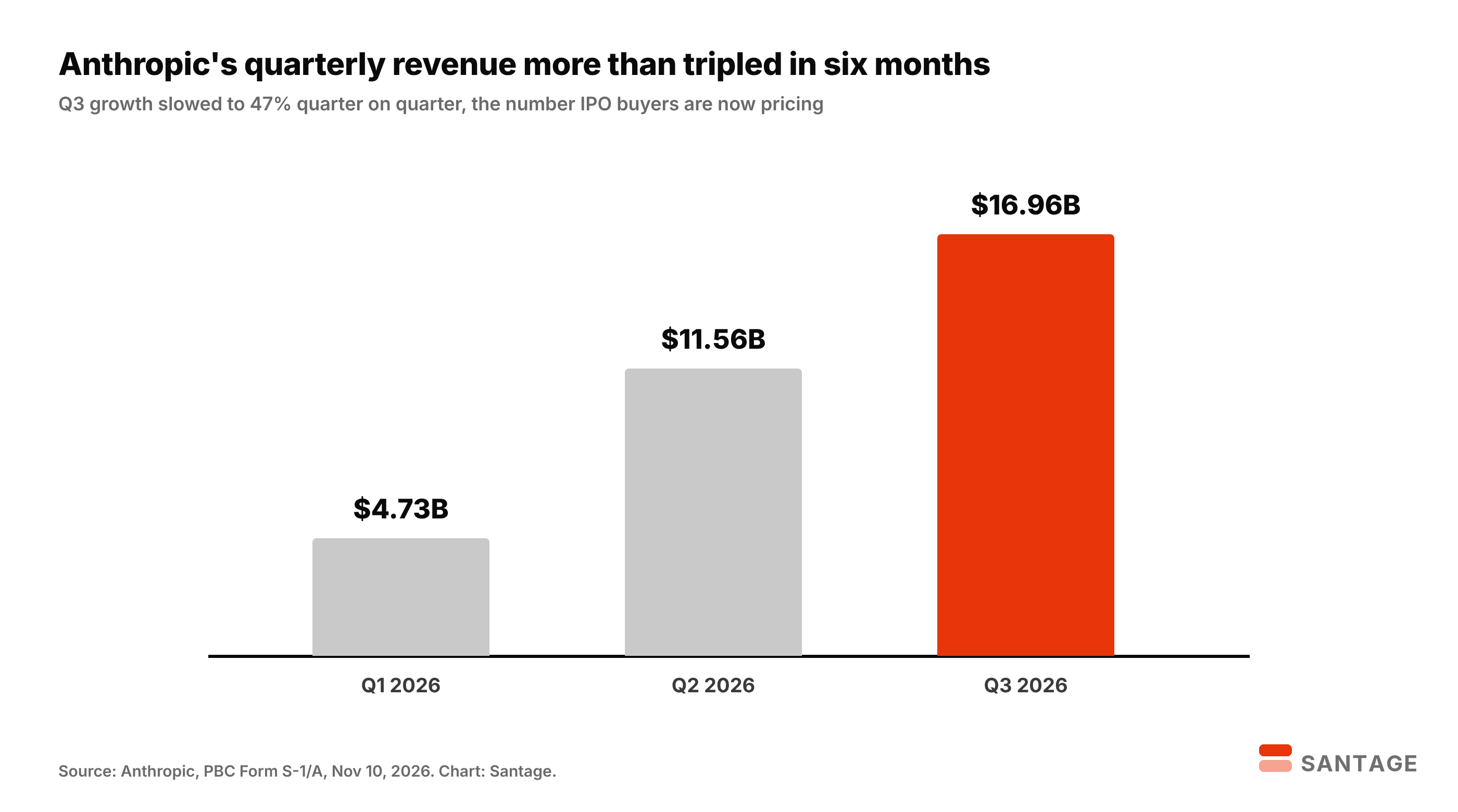
Third-quarter revenue reached $17.0 billion, up from $11.56 billion in the second quarter and $4.73 billion in the first, a figure close to the $16.8 billion Anthropic told investors in October. Quarter-on-quarter growth slowed to 47%, and the range arrives after AI chip stocks fell 12.3% and some backers talked of $2 trillion. At the top of the range, the fully diluted value is about 21 times annualised third-quarter revenue.
Losses remain the counterweight. The filing reports a nine-month net loss of about $104 billion, much of it tied to compute and stock-based compensation, and Anthropic expects about $14.2 billion of cumulative restricted stock unit expense to be recognised when the IPO completes at the assumed $74 price.
| Offering term | Detail |
|---|---|
| Price range | $70 to $78 per Class A share |
| Shares offered | 825,000,000 (801,351,354 primary, 23,648,646 secondary) |
| Over-allotment option | 123,750,000 shares, 30 days |
| Exchange and ticker | Nasdaq Global Select Market, ANT |
| Shares outstanding after deal | 13,086,672,593, all classes |
| Insider interest | Board members and affiliates indicated up to $303 million |
Source: Anthropic roadshow announcement and Form S-1/A, Nov 10, 2026.
The 6% float meets 3.6 billion shares that can unlock early
The number most coverage has missed is supply. The 825 million shares on sale equal about 6% of the 13.1 billion shares outstanding after the deal. Insiders face lock-ups of up to 180 days, and up to 365 days for co-founders and holders above 0.5%, yet the filing says about 3.6 billion shares in the 180-day group can become sellable earlier, including up to 10% of certain non-founder insiders' holdings from the first trading day. That is more than four times the IPO float. The placement shares carry no lock-up at all.
Three markers will tell investors how the deal is landing before the first trade: where the final price sits against the range, whether underwriters exercise the 123.75 million share option, and how quickly the early-release window opens for insiders once trading starts.
A thin float makes for a strong debut. A pool of early-release stock four times that float decides what happens after it.
Anthropic has built the largest AI listing yet on a structure where its suppliers fund part of the raise and its public float stays small, so the price on day one will say less about Claude's business than the first few months of trading, when early-release insider shares and unlocked supplier stakes test how much of that $1.4 trillion the public market will hold.
Santage is committed to independent, transparent journalism. This article is produced in accordance with Santage's Editorial Standards and aims to provide accurate and timely information. Readers are encouraged to verify information independently.