
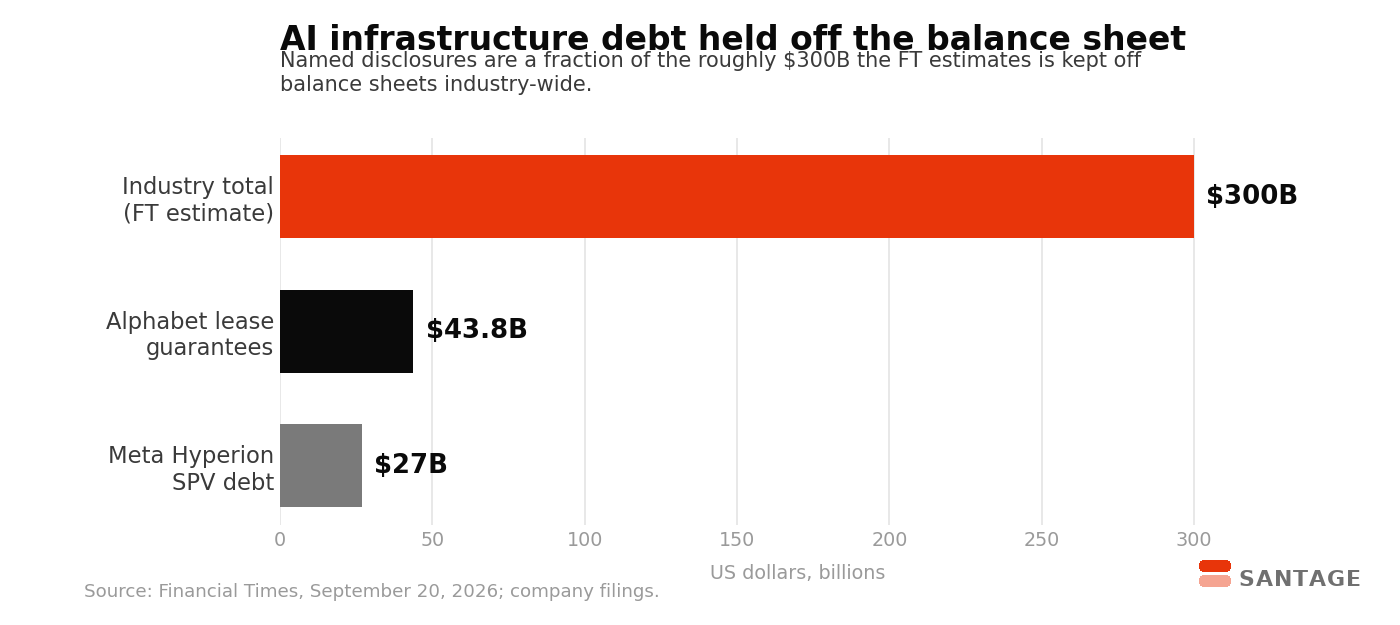
- A Financial Times investigation published September 20 found roughly $300 billion of AI infrastructure exposure held off the balance sheets of the largest technology companies.
- Alphabet's data-center lease guarantees rose from $16.9 billion to $43.8 billion in six months, with less than 2 percent of that recorded on its balance sheet.
- Meta's $50 billion Louisiana Hyperion project runs through a Delaware entity Meta owns 20 percent of, backed by about $28 billion in guarantees supporting $27 billion of debt raised from Pimco, BlackRock, and Apollo.
The AI buildout is being financed where the balance sheet cannot see it
The headline number in AI is capital expenditure, where 2026 guidance across the largest spenders already runs into the hundreds of billions. The Financial Times investigation points at a second number that does not show up the same way. Roughly $300 billion of AI infrastructure obligation is being carried off balance sheets across the industry, structured so that the debt funding data centers and chips does not appear as debt on the company that ultimately stands behind it.
Two mechanisms do the work. The first is the special purpose vehicle, a separate legal entity that holds the borrowing and owns the asset, so the parent reports an interest or a guarantee rather than a loan. The second is the residual value guarantee, in which the technology company promises to cover the future value of the asset. If the data center or the hardware is worth less than expected, the parent absorbs the shortfall, but that promise sits off the books until a payout becomes probable.
| ~$300 billion | AI infrastructure exposure held off balance sheets across Big Tech (FT estimate) |
| $16.9B to $43.8B | Alphabet data-center lease guarantees over six months, under 2% recorded on balance sheet |
| $50 billion | Meta's Louisiana Hyperion project, run through a Delaware SPV Meta owns 20% of |
| $28B / $27B | Meta's residual value guarantees and the SPV debt they support, from Pimco, BlackRock, Apollo |
How a residual value guarantee keeps real debt invisible
The Meta structure shows the pattern in full. The Louisiana Hyperion data center, a roughly $50 billion project, is financed through a Delaware vehicle in which Meta holds about 20 percent and the private capital firm Blue Owl holds the rest. Meta backs the arrangement with about $28 billion in residual value guarantees, which support around $27 billion of debt raised from Pimco, BlackRock, and Apollo. On Meta's own balance sheet, the project reads as a minority stake and a set of guarantees, not as tens of billions of borrowed dollars.
Alphabet's numbers show how fast the exposure is growing. Its data-center lease guarantees more than doubled in six months, from $16.9 billion to $43.8 billion, while less than 2 percent of that figure is recorded on the balance sheet. The same investigation identifies comparable structures at Oracle, Amazon, and Broadcom, and in the financing chain linking SoftBank and OpenAI. This is not one clever deal. It is a financing template the industry has adopted at scale.
Why this changes how to read a hyperscaler's leverage
For an investor, the practical consequence is that reported net debt understates the real obligation behind the AI buildout. A residual value guarantee is contingent, so it stays out of the leverage ratios that credit analysts and index funds rely on, right up to the moment the contingency triggers. The trigger is a fall in asset value, and AI hardware is the asset most exposed to exactly that. The prior wave of coverage focused on the raw scale of commitments, including the $1.67 trillion in leases and purchase commitments the top five spenders disclosed. The new detail is the machinery that keeps a large slice of it from ever entering the debt line.
The structure also concentrates risk in a way the headline number hides. Private credit firms like Blue Owl, Pimco, and Apollo now sit between the hyperscalers and their data centers, funded by insurance and pension money reaching for yield. That is the same private-capital layer that absorbed earlier AI infrastructure borrowing, from Broadcom's chip-linked debt to SoftBank's $11.87 billion loan against its OpenAI stake. The buildout is increasingly financed by lenders who are themselves off the balance sheets that regulators watch most closely.
The mismatch most coverage is missing
The reason these structures exist is a duration problem. AI hardware has a useful life of roughly four to six years, while the leases and financing that pay for the buildings around it run ten to fifteen. A company that put the full obligation on its balance sheet today would be recognizing debt against chips that may be obsolete before the lease ends. The residual value guarantee is the accounting bridge across that gap, and it works cleanly only if the assets hold their value.
That assumption is the whole game. As long as AI demand keeps GPUs and data centers scarce, the guarantees never pay out and the off-balance-sheet treatment looks conservative. If capability plateaus or a cheaper compute path emerges and used AI hardware loses value quickly, the guarantees convert into recognized losses across several of the largest companies at once, plus the private credit funds standing behind them.
Santage is committed to independent, transparent journalism. This article is produced in accordance with Santage's Editorial Standards and aims to provide accurate and timely information. Readers are encouraged to verify information independently.