

- Global trade grew 8.3% from 2023 to 2025, and trade in AI-related goods grew 29%; without AI products, the IMF says, total trade growth would have been 4.6%.
- Taiwan and Korea supply 62% of net trade in AI computing hardware, while China and the US took more than 75% of net imports in 2025 and 57% of new data centers since 2024.
- In the IMF's market-correction scenario, AI investment unwinds, US investment falls 5% and US GDP 0.8%, and Asian technology exporters see export prices drop 20%.
The International Monetary Fund now counts artificial intelligence as one of the two forces deciding the world economy, alongside the war-driven energy shock. Its October World Economic Outlook, released on October 13, projects global growth of 3.1% in 2026 and credits the AI investment and trade boom with offsetting much of the damage from higher oil and gas prices, while warning that the same boom has concentrated growth, and risk, in a handful of economies and companies.
AI trade added nearly 4 points to global trade growth since 2023
The Fund's chief economist, Silvana Tenreyro, put a number on the boom at her first press briefing in Bangkok. Global trade grew 8.3% cumulatively between 2023 and 2025, she said, while trade in AI-related goods grew 29%, and without those products total trade would have grown only 4.6%. The World Economic Outlook describes the AI build-out as a positive demand shock running against a negative supply shock from energy, with both pushing global inflation up to a projected 4.7% this year.
“AI has had a big role in global trade and growth. Just to give you a sense of magnitude, global trade grew between 2023 and 2025 by 8.3 percent cumulatively. Global trade in goods related to AI grew by 29 percent.”
Silvana Tenreyro, Economic Counsellor and Director of Research, IMF, WEO press briefing, October 13, 2026
Growth now depends on 32 economies, down from 54 in April
The headline number hides a sharper split. The IMF says 32 economies now account for 95% of global growth, against 54 economies in its April outlook, because the countries supplying the AI build-out keep getting upgraded while energy importers outside the technology value chain slip back. Korea's growth forecast rose to 3.3% for 2026, and the IMF's "other advanced economies" group, which includes Korea, Taiwan and Singapore, is projected to grow 4.2%, up from 3.1% last year, while the world as a whole slows from 3.5% to 3.1%.
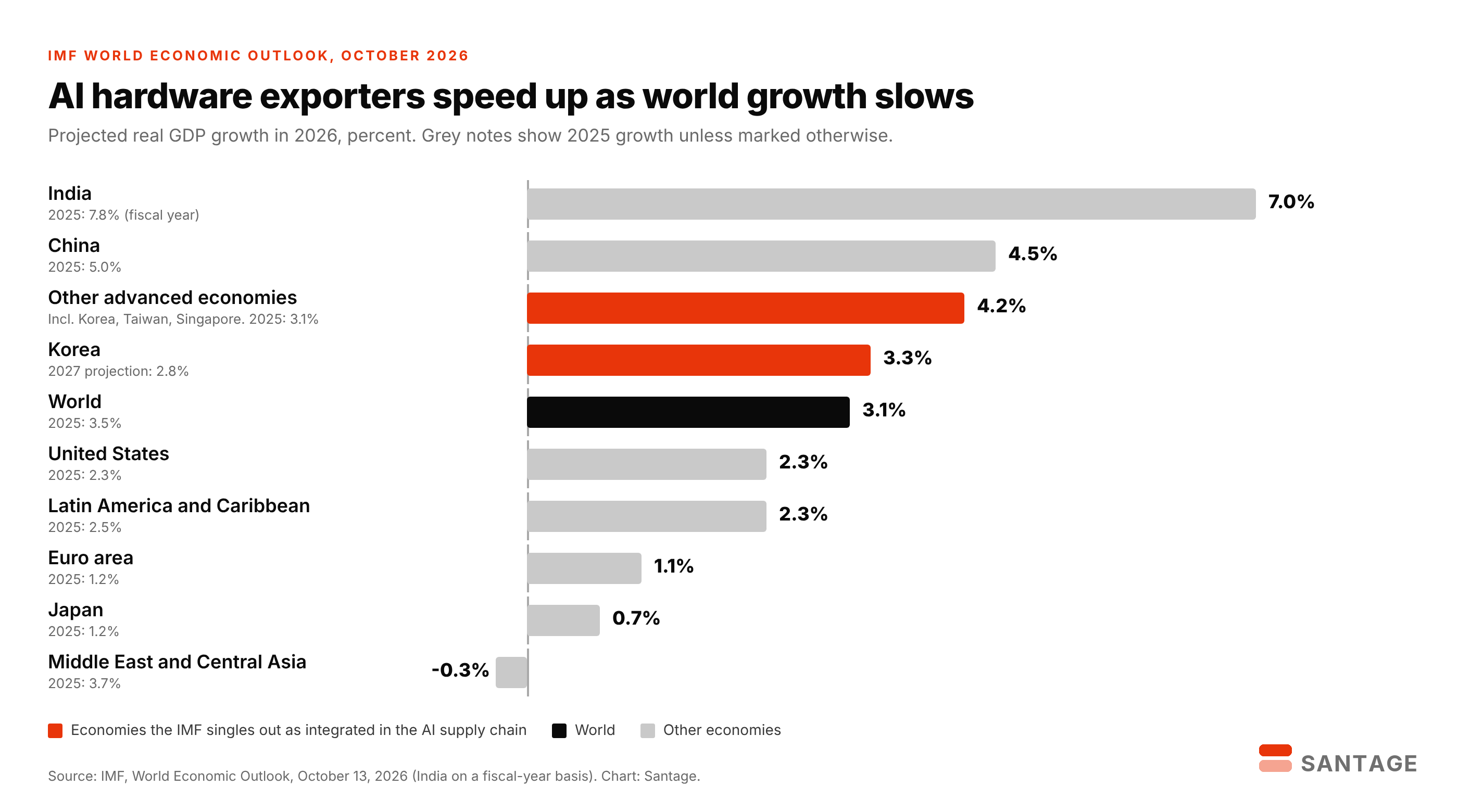
India stays the fastest-growing large economy at a projected 7.0% in both 2026 and 2027, with China at 4.5% this year and 4.0% next. The United States holds at 2.3%. The concentration shows up at the top of the supply chain as well: Taiwan and Korea source 62% of net trade in AI computing hardware, according to the report, and China and the US took more than three quarters of net imports of that hardware in 2025. Samsung's record quarter earlier this month is what that concentration looks like on a single company's books.
Tenreyro drew the regional map in plain terms at the briefing. Asia, she said, is the region where the AI component is strongest, and economies well integrated into the AI supply chain, naming Korea, Singapore, Vietnam, Malaysia and to some extent Thailand, received significant upward revisions even though most of them import their energy. Latin America sits on the other side of the line: the IMF trimmed its 2026 forecast for the region to 2.3%, and Tenreyro said AI has not been a strong driver there so far.
The IMF's downside case is an AI market correction centered on the US
The Fund's baseline assumes the AI boom fades gradually. Its Box 1.2 then models what happens if it runs hotter or breaks, and the asymmetry is the most useful number in the report for anyone pricing AI assets.
| IMF scenario | What happens to AI investment | Modeled effect |
|---|---|---|
| A: Strong payoffs | Build-out runs larger, mainly in the US and China, and productivity gains arrive early | World GDP 0.6% higher by 2029; US GDP 1.3% higher by 2031 |
| C: Market correction | Expected productivity gains fail to appear and AI investment unwinds | US investment down 5% and US GDP down 0.8%; global GDP down up to 0.4% directly, with a further 0.6% from wealth and financial effects and 0.3% from bond-market spillovers |
| C: Asia spillover | Lower US demand for imported AI hardware | Asian technology exporters' export prices fall 20%; Asia's GDP about 0.5% lower by 2029 |
Source: IMF, World Economic Outlook, October 2026, Chapter 1, Box 1.2. Scenario C assumes US equities fall 20% in 2026 and 15% elsewhere. Table: Santage.
The Global Financial Stability Report published alongside it names the trigger it fears most: leverage. Hyperscalers are borrowing more, investors are borrowing to buy AI stocks, and the IMF's review of 14 circular deals between AI firms since 2023 found about $300 billion of equity and $650 billion of debt exchanged for $1.4 trillion in future revenue commitments.
| Circular AI deals reviewed since 2023 | 14 |
| Equity invested in those deals | About $300 billion |
| Debt raised in those deals | About $650 billion |
| Future revenue commitments they rest on | $1.4 trillion |
That finding lines up with the central bankers' BIS, which reported earlier this month that 55% of AI funding comes from other AI firms, and with the debt piling up off balance sheets behind data-center construction. Two of the world's main financial watchdogs now describe the same loop: AI companies financing each other's demand, with borrowed money underneath.
Productivity is the number the IMF still cannot find
The baseline assumes no economy-wide productivity lift from AI at all, because adoption across most sectors remains limited. The report notes a gap between experiments showing large gains on specific tasks and the modest effects visible in national data. That leaves the current boom resting on spending rather than proven output, which is why the IMF treats it as a demand shock that raises inflation and interest rates.
For investors and governments, the October outlook turns AI from a technology story into a macroeconomic exposure that can be measured country by country. Korea, Taiwan and their suppliers are being paid for the build-out today, the US carries most of the investment and most of the downside, and the IMF's own scenarios show that if expected productivity fails to arrive, Asia's chip exporters take a 20% hit to export prices from a decision made in American boardrooms.
Santage is committed to independent, transparent journalism. This article is produced in accordance with Santage's Editorial Standards and aims to provide accurate and timely information. Readers are encouraged to verify information independently.