

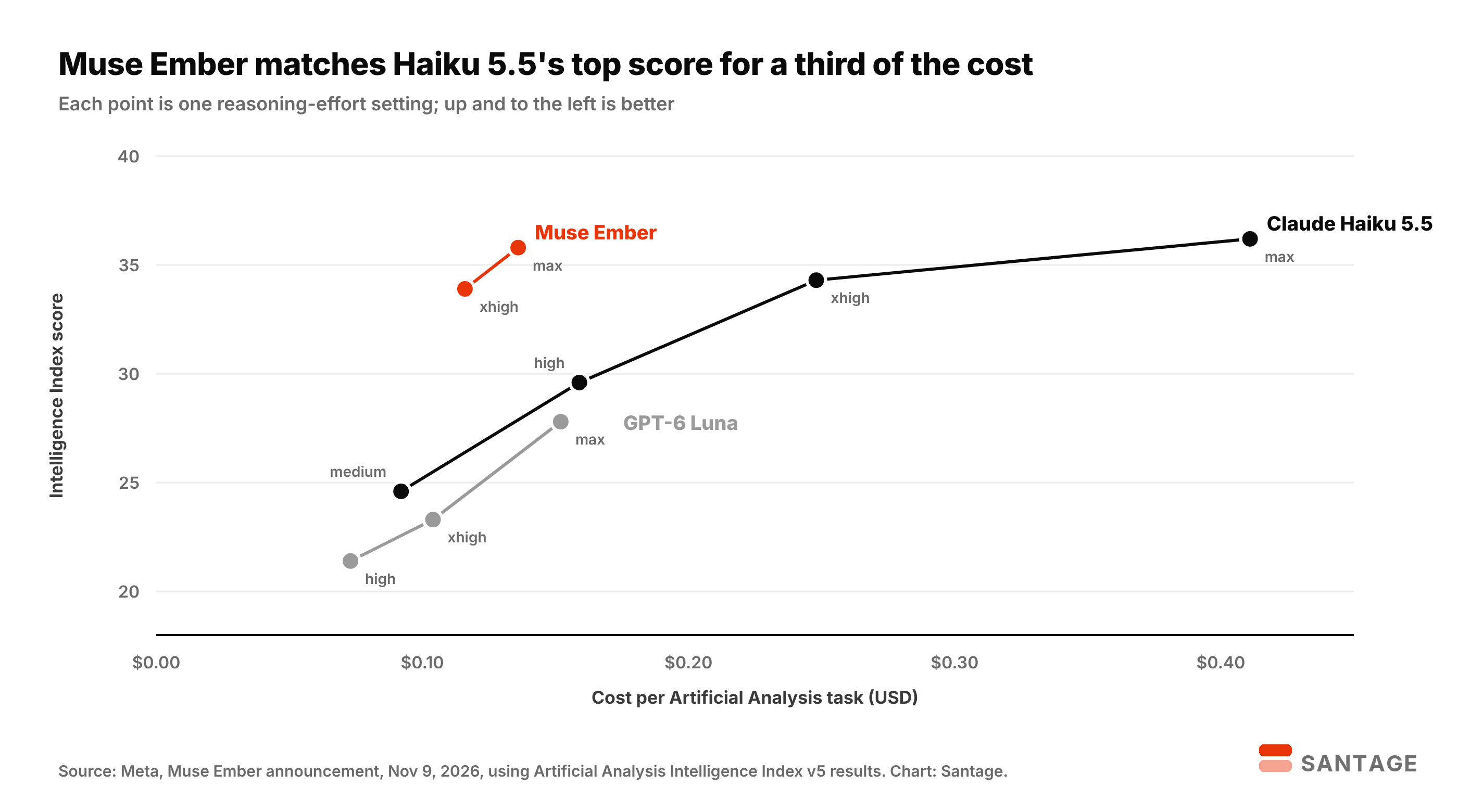
- Muse Ember costs about $0.14 per Artificial Analysis task at max reasoning against $0.41 for Claude Haiku 5.5, at the same $0.10 per million input tokens and $0.50 per million output tokens list price.
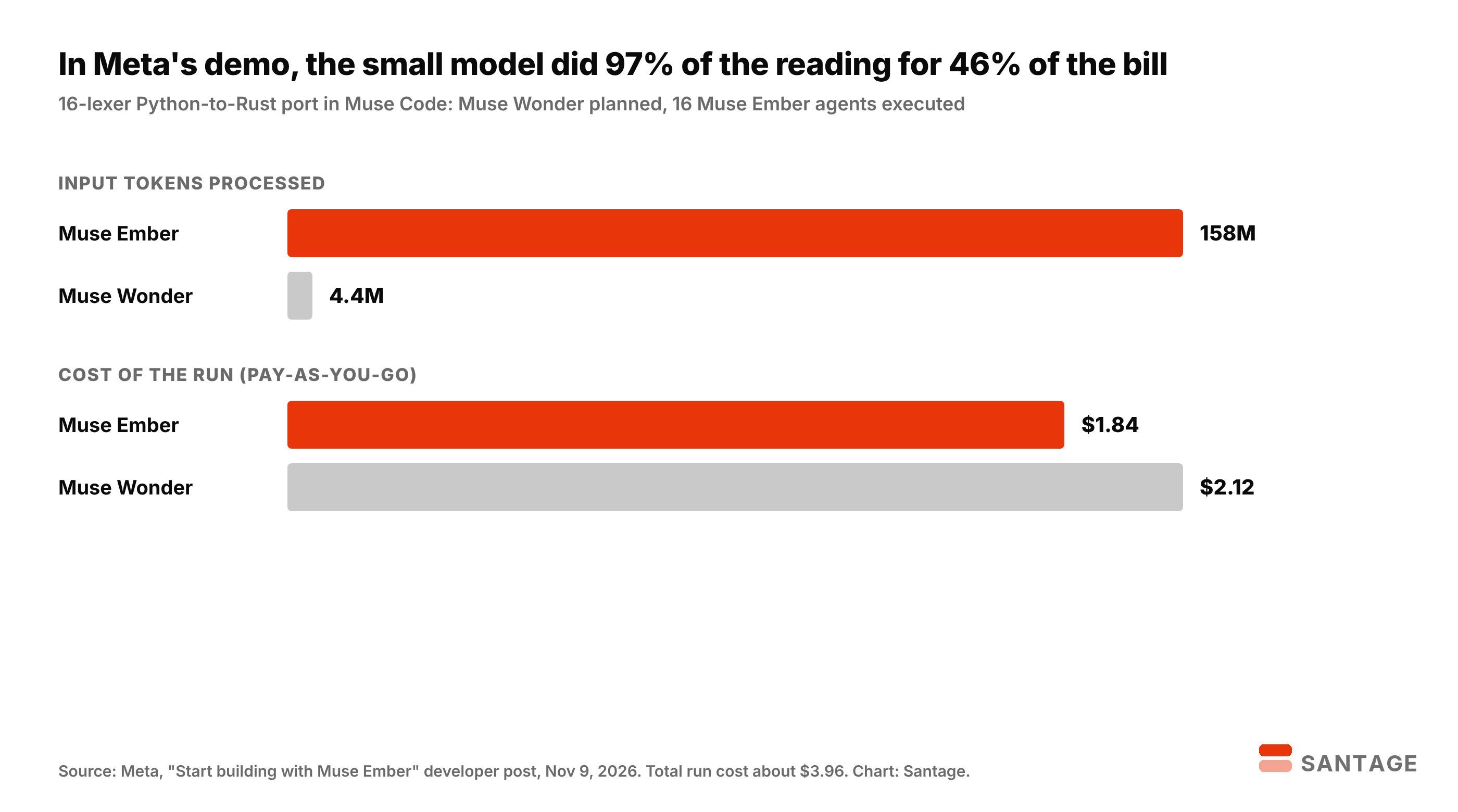
- In Meta's Python-to-Rust demo, Muse Ember handled 158 million input tokens to the Muse Wonder planner's 4.4 million, and the whole run cost about $3.96.
- Identical token prices across Meta, Anthropic and OpenAI move the small-model contest to tokens consumed per task, the number that sets what an agent costs to run.
Meta's Muse Ember, released on November 9, scores the same 36 on the Artificial Analysis Intelligence Index as Claude Haiku 5.5 at its highest setting for about a third of the cost per task, and Meta's own demonstration shows why that matters more than any benchmark: in a multi-agent coding run, the small model processed 97% of the tokens while accounting for less than half of the bill.
Meta's Muse Ember scores 36 on the Intelligence Index for $0.14 a task
Muse Ember is the fourth model in Meta Superintelligence Labs' Muse family and its smallest, built for what Meta calls the work agents repeat all day: tool calls, coding subtasks, routing, extraction and long-document parsing. It takes text, images, audio and video, holds a 1 million token context window with up to 512,000 output tokens, and is available on the Meta Model API and in Muse Code as muse-ember-1.0, as well as on Google Cloud and Oracle Cloud.
According to Meta's announcement, Ember at max reasoning reached 35.8 on the index at $0.136 per task. Claude Haiku 5.5 needs its max setting and $0.411 per task to reach 36.2, and GPT-6 Luna peaks at 27.8. Meta reports the strongest gaps on agent and coding tests: 46 against 37 for Haiku on the Coding Agent Index and 40.9% against 39.2% on Terminal-Bench 4.0.
| Benchmark (max reasoning) | Muse Ember | Claude Haiku 5.5 | GPT-6 Luna |
|---|---|---|---|
| Artificial Analysis Intelligence Index | 36 | 36 | 28 |
| Cost per index task | $0.14 | $0.41 | $0.15 |
| Coding Agent Index | 46 | 37 | 31 |
| Terminal-Bench 4.0 | 40.9% | 39.2% | 16.4% |
| FrontierCode 2.0 (mergeable code) | 27.2% | 34.9% | 25.2% |
| OSWorld 2.1 (partial credit) | 69.5% | 68.9% | 50.5% |
Source: Meta, Nov 9, 2026. Artificial Analysis results plus Meta internal evaluations; Terminal-Bench uses each model's best published harness.
Identical token prices turn cost per task into the real price war
The list prices tell almost nothing. Ember charges $0.10 per million input tokens and $0.50 per million output tokens, the same rates as Claude Haiku 5.5 at its October launch and GPT-6 Luna. The threefold cost difference comes from how many tokens each model spends to finish a task, which is why Meta led its announcement with cost per task and why buyers comparing price sheets will keep picking the wrong model.
Reasoning effort explains most of it. Every model in this class can think longer for a better answer, and each extra step is billed as output tokens. Meta reports Ember reaching 33.9 on the index at its xhigh setting for $0.116 a task, already above every GPT-6 Luna setting, so a team can trade a couple of points of score for another 15% off the bill. For a workload of 10,000 agent subtasks a day, the gap between $0.14 and $0.41 per task works out to roughly $2,750 a day, about $1 million a year, before any difference in accuracy.
That gap compounds in multi-agent systems, where a large planner hands bounded jobs to many small workers. Meta's developer post describes porting 16 Pygments lexers from Python to Rust with Muse Wonder planning and 16 Ember agents writing and testing code in parallel. All 16 ports matched Python on 383 test inputs and 62 held-out files.
"Muse Wonder plans, Muse Ember handles the volume."
Meta, Introducing Our Smallest, Most Efficient Model: Muse Ember, November 9, 2026
Meta found a tier it can win while trailing at the frontier
Meta's larger models have struggled for position. When it opened the weights of Muse Spark in October, Santage found it still trailed leading Chinese open models. Ember changes the battlefield. In agent workloads the executor tier carries most of the tokens, so the model that wins it captures most of the spend even when a rival's model does the planning. Meta also says Ember is the first model trained using Muse Wonder Full, which points to distillation from its frontier model as the route to cheap capability.
Speed points the same way. Executors sit inside loops where the planner waits on hundreds of sequential calls, so tail latency decides how long a whole job takes. In Meta's launch materials, Cloudflare chief technology officer Dane Knecht reports Ember running up to 30% faster at the tail than the comparable model it tested, and You.com measured a 95th-percentile response of 2.2 seconds on its coding tasks.
The model that does the planning gets the attention. The model that does the reading gets the invoice, and Meta has just priced itself to own the reading.
Builders should benchmark executors on cost per completed task
For teams running AI agents in production, the practical step is to measure the executor tier by cost per completed task inside their own harness, with list price as a secondary input. Haiku 5.5 still wins some slots and leads on FrontierCode, the test closest to code a reviewer would merge, 34.9% to 27.2%, so pull-request work may still favour Anthropic. Several headline scores are also Meta's internal evaluations, and Meta's own blog lists two different AutomationBench figures for Ember, so independent replication matters before a migration.
Security deserves equal weight. Executors read the untrusted material, the web pages, documents and tool outputs, where prompt injection hides. Meta says it evaluated Ember under its Superintelligence Scaling Framework, found it below the high-risk thresholds, and tested whether it resists instructions planted in tool outputs and asks for human input before high-impact actions, which are the checks buyers should repeat on their own data.
Muse Ember shows the agent economy splitting into two markets. Frontier labs will keep competing on the planner, where capability is scarce, while the executor tier becomes a contest over tokens per task, and Meta, priced identically to Anthropic and OpenAI, has made efficiency per task the number every rival must now answer.
Santage is committed to independent, transparent journalism. This article is produced in accordance with Santage's Editorial Standards and aims to provide accurate and timely information. Readers are encouraged to verify information independently.