The real contest in artificial intelligence is shifting from better answers to better control. The moment a model can browse, write, run code, call APIs, and remember what it did five steps ago, the interesting question is no longer whether it can answer but whether it can coordinate. That coordination problem is orchestration, and it has become the defining engineering challenge of the agent era.
A single clever agent is a demo. A system that can run twenty coordinated agent actions across research, drafting, review, and approval without losing the thread is a product. This guide explains what AI agent orchestration is, how a production orchestration stack is built, the canonical patterns practitioners use, how agents share memory and govern tool use, the failure modes that break orchestrated systems, and where the field is heading.
- Market context: The AI agents market reached roughly $8 billion in 2026 and is projected to grow at a 43.5% CAGR to $294.66 billion by 2035, with orchestration emerging as the layer where that value is captured
- Error control: Independent, non-orchestrated agent topologies amplify errors 17.2 times relative to a single agent; adding centralized orchestration as a validation checkpoint cuts that amplification to 4.4 times
- Architecture matters more than model: Multi-agent orchestration beats single-agent baselines by 80 to 90% on parallelizable tasks but degrades by up to 70% on strictly sequential tasks
- Adoption: 80% of Fortune 500 companies were running active AI agents as of February 2026, with observability and governance as the primary operational constraints
- Five patterns: Microsoft's 2026 architecture guidance formalizes sequential, concurrent, group chat, handoff, and magentic orchestration
- Trajectory: Gartner projects autonomous multi-agent systems will handle 15% of day-to-day enterprise decisions by 2028, up from less than 1% in 2023
- Primary failure mode: Not model incompetence but control-plane failure, meaning loops, drift, and conflicting outputs
What is AI agent orchestration?
AI agent orchestration is the control layer that turns isolated agent capability into a dependable workflow. It decomposes a goal into tasks, routes those tasks to agents or tools, manages memory and state across the run, applies governance and escalation rules, and assembles the individual outputs into a single coherent result.
It helps to hold three definitions at once. In business terms, orchestration is how you convert raw agent capability into a repeatable workflow with governance, escalation, and auditability. In engineering terms, it is the task ledger, routing policy, retry logic, memory rules, and observability stack that keep autonomous work from becoming chaos. In architectural terms, it is the distinction between agency and control: the agent is the thing that acts, and the orchestrator is the control system around the acting.
The Santage definition ties these together. AI agent orchestration is an orchestration fabric that converts isolated agent skills into dependable, auditable workflows by combining four functions: planning, routing, memory arbitration, and tool governance. Remove any one and the system degrades predictably. Without planning, work has no structure. Without routing, tasks reach the wrong agent. Without memory arbitration, assumptions drift. Without tool governance, actions become unsafe.
The critical conceptual move is separating orchestration from agency. An agent can be brilliant in isolation and still produce an unreliable system, because reliability is a property of the control plane, not the model. This is why teams that ask for better agents often discover the leverage was in a better orchestration layer all along.
Orchestration sits one level above the components it coordinates. The table below places it against the adjacent concepts it is most often confused with, which is also how readers and answer engines should distinguish the orchestrator architecture from the parts it manages.
| Concept | What it does | Best use | Main risk |
|---|---|---|---|
| LLM | Generates and reasons over text | Planning and synthesis | Hallucination |
| RAG | Retrieves external knowledge | Grounded answers | Stale or weak retrieval |
| Agent | Acts with tools and memory | Multi-step tasks | Uncontrolled execution |
| Orchestrator | Coordinates agents, tools, and memory | Complex, multi-step workflows | Routing and governance bugs |
Why does agent orchestration matter now?
Three things changed at roughly the same time. Models became meaningfully better planners, capable of decomposing a goal and maintaining a multi-step approach. Tool ecosystems became rich enough that an agent can browse, query databases, run code, and call internal systems in a single run. And enterprise buyers stopped asking for demos and started asking for workflows they could put into production with permissions, audit trails, and human approval.
Orchestration is the third wave in a clear progression, and seeing that arc explains why it matters now rather than earlier.
| Era | Core idea | Strength | Limit |
|---|---|---|---|
| Tool-calling | One model calls external APIs | Simple and fast | Breaks on long workflows |
| Manager-worker | One router delegates to specialists | Better task decomposition | Central bottleneck |
| Multi-agent orchestration | Many agents coordinate through policies, memory, and shared state | Scales to complex, cross-functional work | Harder to debug and govern |
The first wave was single-agent tool use: one model, one context window, and a few deterministic function calls. The second added routing and decomposition, where a supervisor split work across specialists or stages. The third, true orchestration, adds multiple agents, shared or partitioned memory, explicit task graphs, and governance around tool use and escalation. Each wave solved the previous wave's ceiling and inherited a harder control problem.
The scale of the shift is visible in the adoption data. As of February 2026, Microsoft reported that 80% of Fortune 500 companies were running active AI agents. The same research found the binding constraint was not the intelligence of those agents but the maturity of the control plane around them: observability, governance, and access control. That is the signature of a field where orchestration, not raw model quality, has become the limiting factor.
How does an orchestration system actually work?
A production orchestration stack usually resolves into five layers. Each solves a distinct problem, and each has a characteristic failure mode when it is missing or weak.
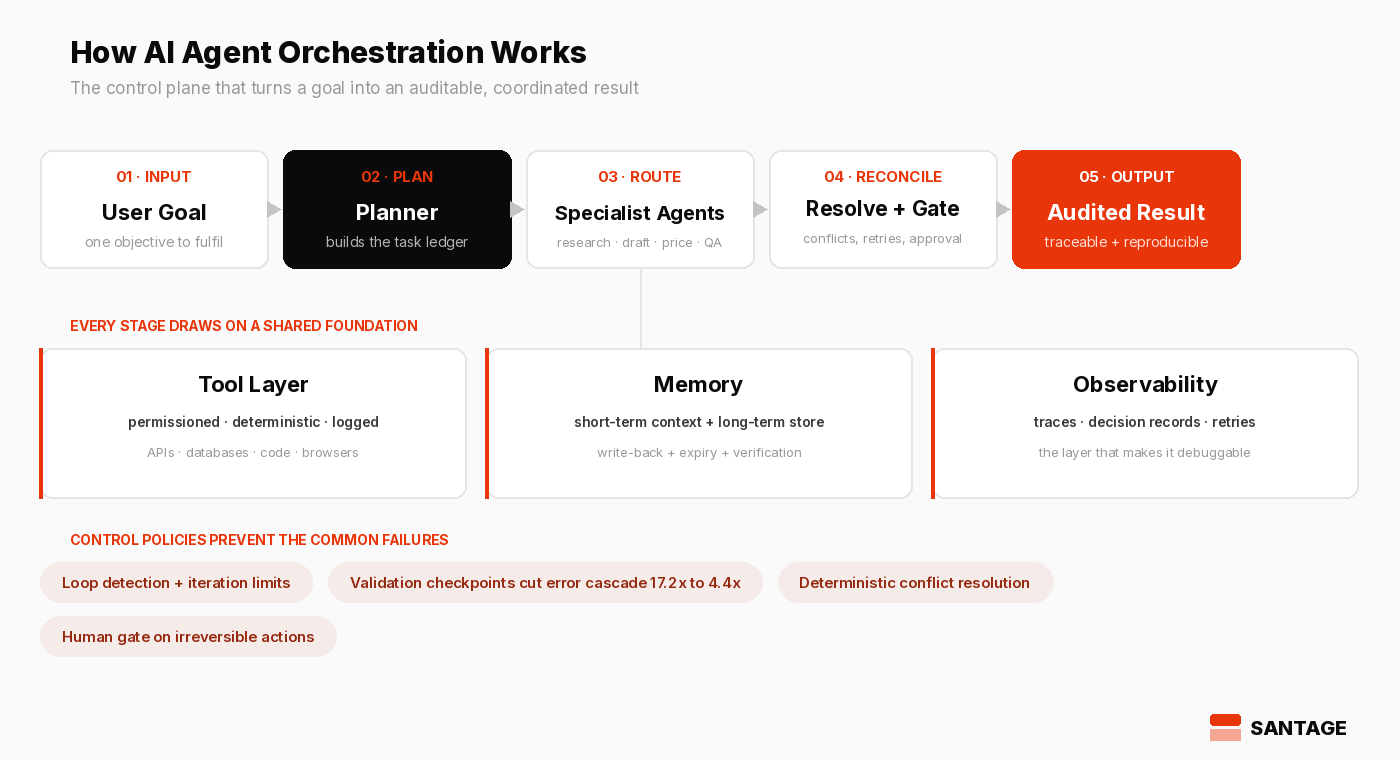
The first layer is the planner. It translates a user goal into a task graph: a set of subtasks with explicit dependencies, resource budgets, and risk levels. In the most advanced pattern, the planner maintains a living task ledger that it refines as the run progresses rather than committing to a fixed plan up front.
The second layer is the agent layer, where specialist agents handle narrow jobs. One researches, another writes copy, another prices, another checks quality. Specialization reduces prompt complexity, makes each unit independently testable, and lets each agent use the model and tools best suited to its task.
The third layer is the tool layer, which exposes APIs, databases, browsers, and internal systems through deterministic adapters. The design goal is that a tool call should behave predictably: same inputs, same permissions, same logged output. When tool calls are non-deterministic or unpermissioned, the whole system inherits that unreliability.
The fourth layer is memory, and it is more subtle than storage. Short-term memory holds the live task context; longer-term memory stores reusable facts, prior decisions, and retrieval indexes. The important insight is that memory is arbitration, not a database: the system must continuously decide what deserves persistence, what should be retrieved, and what should expire.
The fifth layer is observability: logs, traces, decision records, retry counters, and human override points. Once several agents interact in parallel, a system without this layer becomes impossible to debug, because there is no way to reconstruct which agent made which decision on what evidence.
The core tradeoff running through all five layers is speed versus control. Sequential orchestration is easy to debug but slow. Concurrent orchestration is fast but requires arbitration to reconcile parallel outputs. Hierarchical orchestration scales across domains but demands strict contracts between layers. The biggest hidden bottleneck is state coherence: every additional agent increases the chance that memory, assumptions, or tool outputs diverge before the final decision is assembled. Coordinating more agents is not the hard part. Keeping them coherent is.
What are the main agent orchestration patterns?
Orchestration patterns describe how agents are wired together. Microsoft's 2026 architecture guidance formalizes five, and they map cleanly onto the coordination requirements teams actually face.
- Sequential orchestration chains agents in a fixed, linear order, so each processes the output of the one before it. This is the pipeline, or prompt chaining. It suits multistage work with clear dependencies such as draft, review, polish. It is the easiest to debug and the slowest.
- Concurrent orchestration runs multiple agents on the same task at once, then combines their outputs. This is the fan-out, fan-in or scatter-gather pattern. Its risk is state contention when concurrent agents share mutable state.
- Group chat orchestration puts several agents into a shared conversation thread, coordinated by a chat manager that decides who speaks next. It suits brainstorming and structured quality gates such as maker-checker loops.
- Handoff orchestration lets each agent assess a task and decide whether to handle it or transfer it to a more appropriate agent. This is routing, triage, or dispatch, and it suits customer-facing systems where the correct owner is not known in advance.
- Magentic orchestration is designed for open-ended problems with no predetermined plan. A magentic manager agent builds a task ledger, developing goals and subgoals as the context evolves, then follows and tracks it to completion. It is the most flexible and the most expensive.
Underneath these patterns sits a structural taxonomy that determines governance.
| Type | Structure | Strength | Weakness |
|---|---|---|---|
| Centralized | One orchestrator controls all agents | Simple governance, clear audit | Single point of failure |
| Hierarchical | Orchestrator plus sub-orchestrators | Scales across domains | Coordination overhead |
| Decentralized | Agents coordinate peer-to-peer | Resilient, flexible | Hard to enforce global policy |
| Hybrid | Central policy, local autonomy | Practical for enterprise | More complex to design |
Centralized systems are best when the workflow is short and the cost of a mistake is high. Hierarchical systems work better when tasks span functions such as marketing, product, and legal. Decentralized systems are attractive for scale and resilience, but only if the team can tolerate protocol complexity and weaker global control. The empirical evidence favors structure: Google Research found that centralized orchestration cut error amplification from 17.2 times to 4.4 times relative to independent, uncoordinated agents, because the orchestrator acts as a validation checkpoint between handoffs.
How do AI agents share memory and state?
Memory is where orchestration quietly succeeds or fails. Agents share memory through a combination of short-term task context, which holds the live state of the current run, and longer-term retrieval storage, which holds reusable facts, prior decisions, and indexed knowledge. On top of those two stores sit the rules that make memory useful: write-back policies that decide what gets persisted, and expiry rules that decide what gets discarded.
The reason this matters is that agent memory is arbitration rather than storage. Every agent action generates candidate information. If everything is written back, the store fills with noise and retrieval degrades. If too little is written back, agents repeat work and lose continuity. A well-designed orchestrator treats each write as a decision: is this fact reusable, is it verified, and how long should it stay valid.
The failure mode to watch is drift. When long-term memory is written without verification, downstream agents retrieve and act on assumptions that were never true or are no longer current. Because agents pass work to one another, a single unverified memory can propagate across an entire run. This is why mature orchestration layers place verification checkpoints between memory writes and memory reads, and why they make expiry explicit rather than letting stale facts linger indefinitely.
The core idea behind agent memory
Short-term memory is cheap to hold and safe to forget. Long-term memory is expensive to get wrong, because it outlives the current task and shapes every future one.
The practical guidance is that short-term and long-term memory should never be treated as one undifferentiated pool. This connects orchestration directly to retrieval-augmented generation, which is the mechanism most systems use to turn a long-term store into grounded, retrievable context an agent can act on.
How does orchestration coordinate tools and actions?
If memory is where coherence is preserved, tools are where actions become real and therefore where governance matters most. A tool call is the moment an agent stops reasoning and starts changing the world, whether by writing to a database, sending an email, or moving money. Three properties make tool use safe: calls should be deterministic, so the same request behaves the same way; permissioned, so an agent can only invoke what its role allows; and logged, so every action leaves an audit record.
The standardization of tool integration has accelerated this. The Model Context Protocol, adopted across OpenAI, Microsoft, and Anthropic through 2025, has become the common interface for agent-to-tool communication. Built on JSON-RPC and modeled on the architecture of the Language Server Protocol, it standardizes how applications expose tools and context to models, so agents from different frameworks can share tools without bespoke integration. For communication between agents rather than between an agent and a tool, emerging standards such as the Agent-to-Agent protocol (A2A) and the Agent Communication Protocol (ACP) are early attempts to give orchestrated systems a portable way to negotiate and hand off work across vendor boundaries.
The governing principle for actions is reversibility. The more irreversible an action, the more it needs a policy gate and a human approval step before execution. Reading data is low risk and can run autonomously. Publishing a public page, changing a price, or sending a contract is high risk and should pass through an explicit gate.
What causes AI agent orchestration to fail?
The most important finding in production orchestration is that failures are usually control-plane failures, not model failures. The model is often competent at each individual step. The system fails in the coordination between steps.
- Looping: Agents hand work back and forth without converging, either because a routing policy has no termination condition or because two agents each believe the other should act. The mitigation is boring and effective: iteration limits and explicit loop detection.
- Error amplification: Agent A produces an output with a small error rate, agent B consumes it without verifying and compounds the error, agent C does the same. Google Research quantified this cascade at 17.2 times relative to a single agent, and showed centralized orchestration as a validation checkpoint reduced it to 4.4 times.
- Conflicting outputs: When multiple agents produce results that disagree, the system needs a deterministic policy to resolve the conflict rather than silently picking whichever agent wrote last.
- State and memory drift: Stale or unverified memory propagates through a run, so downstream agents act on assumptions that are no longer true.
- Long-tail tool failure: An external API times out or returns malformed data, and an agent without a retry and fallback policy treats the failure as a valid result.
There is a structural version of all of this worth naming: the governance-containment gap. Organizations are deploying agents faster than they are building the monitoring, logging, and human-oversight infrastructure to govern them. Coding agents, service bots, and autonomous workflows increasingly hold write access to enterprise systems, but the tooling to detect and contain unexpected behavior in real time is still immature. This is precisely why Microsoft found that observability and governance, not model quality, were the primary operational pain points for the 80% of the Fortune 500 already running agents.
How do you orchestrate a product launch with AI agents?
A product launch is an ideal orchestration case because it blends parallel and sequential work across functions: research, competitive intelligence, messaging, pricing, channel planning, asset generation, legal review, and post-launch monitoring. A good launch orchestrator splits those into phases without losing coherence, and the coherence is the whole point.
- Parallel research: An audience research agent gathers buyer pain points, objections, and channels while a competitive intelligence agent maps rival pricing, positioning, and gaps. These run concurrently because they do not depend on each other, so a fan-out, fan-in pattern fits.
- Sequential synthesis: A messaging agent turns the research into a core narrative, a pricing agent tests tiers against the competitive map, and a launch plan agent sequences dates, dependencies, and approvals. Each step depends on the previous one, so a pipeline with progressive refinement is appropriate.
- Production and control: A content agent generates landing pages, emails, and social variants; a review agent checks brand, compliance, and consistency as the checker in a maker-checker loop; and a legal review agent routes anything high risk to a human approval gate.
- Post-launch monitoring: A monitoring agent watches performance and triggers updates when conversion feedback warrants them.
The strategic insight is that a launch does not fail because content is missing. It fails when the orchestrator cannot preserve a single strategic truth across many outputs. If each agent optimizes locally, the pricing narrative, the landing-page copy, the legal posture, and the launch timing drift apart, and the launch reads as a committee product. The orchestrator's real job is global: to keep the pricing story, the messaging, the compliance posture, and the sequencing reinforcing one another.
The design rule that makes this safe is the same one that governs tool use. The parallel research phase is fully reversible and can run autonomously. The publish and pricing steps are irreversible and should pass through explicit approval gates with a complete audit trail. This is a natural application of a multi-agent system, coordinated by an orchestration layer that decides sequencing and enforces the gates.
How do you measure AI agent orchestration quality?
There is no single benchmark that captures orchestration quality end to end, and pretending otherwise is a common mistake. Task benchmarks such as SWE-Bench measure whether a model can complete a well-defined problem, but they say little about whether a system can complete a long-running, cross-functional workflow safely and reproducibly.
In practice, teams combine task benchmarks with orchestration-specific, control-plane metrics. Task completion rate measures whether the workflow finished. Tool-call correctness measures whether the actions taken were the right ones. Retry rate and loop frequency measure how much wasted work the coordination layer generated. Latency measures whether the orchestration overhead is acceptable. Together these describe the health of the control plane, which is where orchestrated systems actually break.
The most rigorous public analysis of how architecture affects these outcomes is Google Research's 2025 paper on scaling agent systems, which evaluated canonical topologies across multiple benchmarks and model families while holding tools, prompts, and token budgets constant to isolate the effect of orchestration structure from the effect of model quality. Its central finding reframes the measurement question. Multi-agent orchestration beat single-agent baselines by 80 to 90% on parallelizable tasks but degraded by up to 70% on strictly sequential ones. Architecture, not model choice, was the variable that determined success.
That is the practical takeaway. The useful question is not whether the model can answer, it is whether the system can complete the workflow safely and reproducibly. For orchestration, control-plane metrics matter at least as much as model metrics, and a system that scores well on a narrow benchmark can still fail in production when it meets long-running work, shifting goals, and conflicting outputs.
What are the limits and open questions in agent orchestration?
The honest limitations of orchestration fall into four categories. Technically, orchestrated systems still struggle with loops, conflicting outputs, stale memory, and long-tail tool failures. Commercially, orchestration adds real engineering overhead, so for a simple task a single-agent flow is often the better choice, and adding agents to a problem that does not need them just multiplies failure modes. Scientifically, the field lacks a universal benchmark for real-world orchestration performance. On governance, autonomous decisioning raises accountability and jurisdictional questions that vary by use case and geography, with frameworks such as the EU AI Act imposing requirements on high-risk agent functions that many current systems were not designed to meet.
The open research questions follow directly. How should orchestration quality be measured beyond simple task success. How should long-term memory be written, verified, and expired across agents so that drift is contained. What is the safest deterministic policy for resolving conflicting agent outputs. When should an orchestrator pause and hand control back to a human. And can cross-vendor agent protocols support reliable trust and auditability at the scale enterprises are now deploying.
The strategic picture behind these questions is a contest over which layer owns the value. Model labs such as OpenAI and Anthropic are pushing agents as programmable reasoning systems, competing to own the agent brain. Microsoft and the cloud vendors emphasize enterprise-grade patterns, governance, and developer integration, competing to own the orchestration surface. Data and workflow platforms package orchestration around business processes, where connector depth matters as much as model quality. The likely outcome is a stack that combines all three, but the durable advantage will come from control, observability, and interoperability rather than from raw reasoning alone.
Think of orchestration as the difference between a brilliant soloist and a conductor. The agents are the players. Orchestration is the conducting, and the conducting is what the audience actually hears.
AI agent orchestration is the difference between isolated model cleverness and operational reliability. The systems that win will not simply be the ones with the smartest agents. They will be the ones that can coordinate memory, tools, people, and policy without losing control.
Frequently asked questions
Sources and further reading
- Google Research. Towards a Science of Scaling Agent Systems. December 2025. arxiv.org
- Microsoft Azure Architecture Center. AI Agent Orchestration Patterns. February 2026. learn.microsoft.com
- Microsoft Security Blog. 80% of Fortune 500 Use Active AI Agents: Observability, Governance and Security Shape the New Frontier. February 2026. microsoft.com
- Anthropic Engineering. How We Built Our Multi-Agent Research System. 2025. anthropic.com
- Precedence Research. AI Agents Market Size to Hit USD 294.66 Billion by 2035. 2026. precedenceresearch.com
- arXiv. A Survey of Agent Interoperability Protocols: MCP, A2A, and ACP. May 2025. arxiv.org
- arXiv. Open Challenges in Multi-Agent Security. May 2025. arxiv.org
- Anthropic. Model Context Protocol Specification. 2025. modelcontextprotocol.io
- Stanford HAI. Artificial Intelligence Index Report. 2025. hai.stanford.edu