
- Muse Spark Open has 816 billion total and 42 billion active parameters, a 1 million token context window, and runs on two M5 Ultra Mac Studios with 512GB of memory each.
- On the Artificial Analysis Intelligence Index in Meta's own table it scores 39, behind GLM 5.3 at 45, Kimi K3 at 44 and Qwen3.8 at 40.
- It refused nearly all jailbreak attempts on Meta's adaptive StrongREJECT test, scoring 0.5 against 62.9 to 86.4 for the other open models Meta measured.
Meta's release of Muse Spark Open on October 15 gives the United States its strongest open-weight model, an 816-billion-parameter system that Meta says runs on two Apple Mac Studios, and Meta's own benchmark table shows that three Chinese open models still score higher on Artificial Analysis's widely tracked composite index. The release narrows the American gap in open weights without closing it, and the clearest lead Meta can claim is on safety refusals, a lead that matters most to enterprises deciding which weights they can safely host.
Muse Spark Open is an 816B model built to fit on two Mac Studios
Muse Spark Open is a mixture-of-experts model that activates 42 billion of its 816 billion parameters for each token, reads text, images, video and audio, and holds 1 million tokens of context. Meta Superintelligence Labs aimed it at coding and agentic work, and the launch post describes it as the first model in its class to run on a desktop: two M5 Ultra Mac Studios, each giving its GPU up to 512GB of unified memory, linked through Apple's MLX framework. On data center hardware the model card asks for at least 700GB of GPU memory in Nvidia's 4-bit NVFP4 format and 2TB at full BF16 precision.
The license is permissive for most users. The Muse Model License lets developers use, modify and fine-tune the weights for free, requires products to display "Built with Muse Spark Open," and asks only companies earning more than $20 million a year that resell the model as a hosted service to sign a separate agreement with Meta. Weights are on Hugging Face, Amazon SageMaker, Google Cloud and Microsoft Foundry on day one, with hosted access through seven inference providers including Groq, Together AI and OpenRouter.
Meta opened its previous generation three days after shipping Muse Wonder
The timing explains the strategy. On October 12 Meta introduced Muse Wonder and Muse Wonder Full, which it calls its most capable models, and kept them behind its own Model API and Muse Code subscription. Three days later it released the weights of the model one step behind. Meta followed the same pattern in August, when it opened the 30B Muse Glimmer as a distilled version of Spark, so the frontier stays closed and each superseded generation becomes the open model.
Microsoft made the opposite choice on the same day. Its AI division said it had finished pre-training MAI-Base-2, a 2.8-trillion-parameter model trained on 50 trillion tokens across 16,000 GB200 GPUs, claimed it outperforms every open-weight model it tested, and said the weights would go only to trusted partners through Foundry. Two of America's largest AI spenders now hold competing views on the same question: whether open weights build an ecosystem or give one away.
Meta's own benchmark table puts three Chinese open models ahead
Meta tagged its release "the most capable US open-weight model to date," and the qualifier carries the weight. In the comparison table Meta published, Zhipu's GLM 5.3, Moonshot's Kimi K3 and Alibaba's Qwen3.8 all outscore Muse Spark Open on the Artificial Analysis Intelligence Index, and the other American entries, Nvidia's Nemotron 3 Ultra and Reflection AI's Beam, trail well behind.
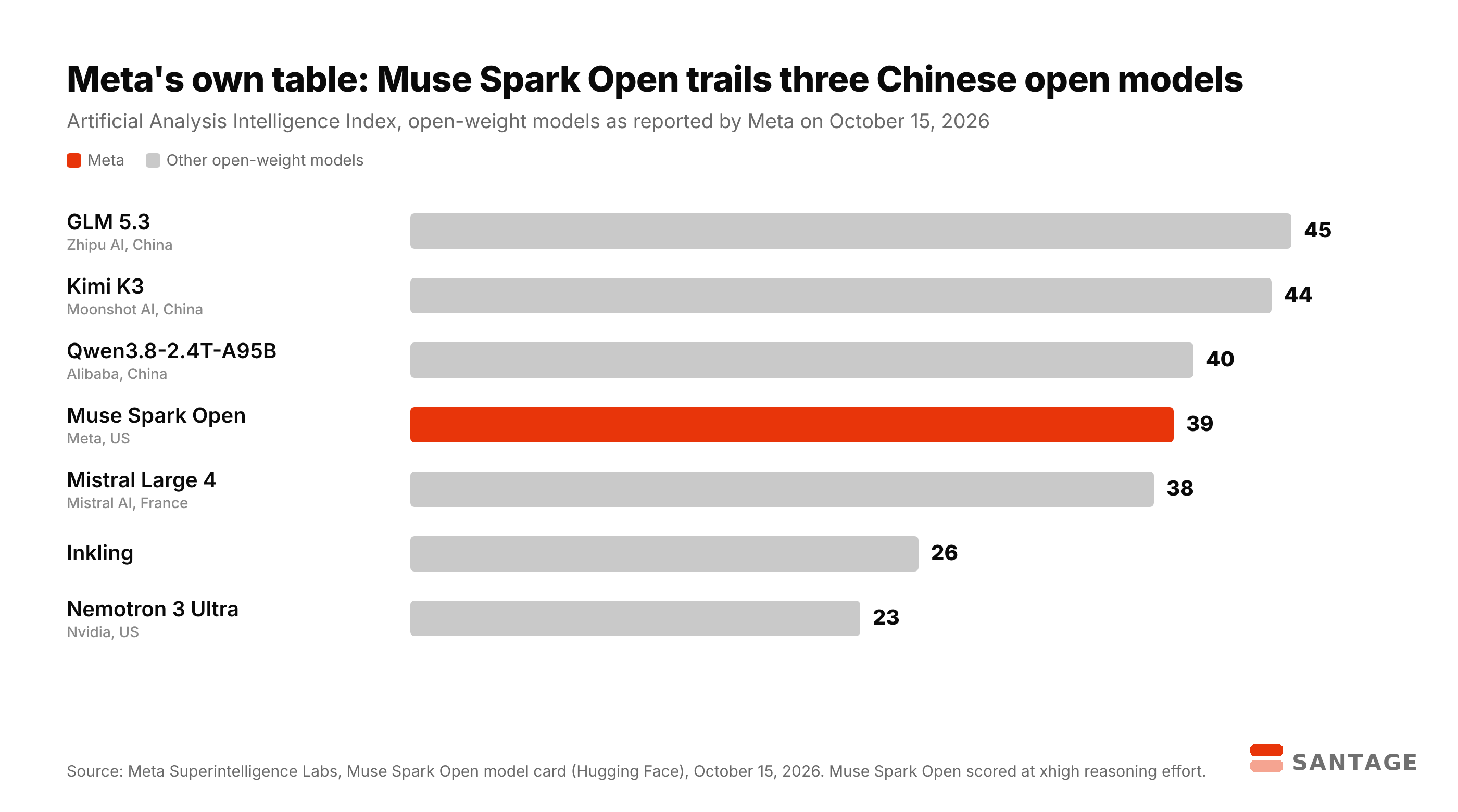
The picture splits by task. Muse Spark Open leads the table on tool use and hard reasoning, and falls behind on terminal coding and economically weighted work.
| Benchmark (Meta's table) | Muse Spark Open | Best rival score | Rival |
|---|---|---|---|
| MCP-Atlas (tool use) | 89.2 | 84.5 | Qwen3.8 |
| Humanity's Last Exam, Diamond, no tools | 26.1 | 22.2 | Kimi K3 |
| JobBench | 61.8 | 61.4 | GLM 5.3 |
| Terminal-Bench 2.1 | 76.4 | 85.0 | Kimi K3 |
| GDPval-AA v2 (Elo) | 1401 | 1653 | GLM 5.3 |
| StrongREJECT v2 adaptive (lower is safer) | 0.5 | 62.9 | GLM 5.3 |
Source: Muse Spark Open model card, Hugging Face, October 15, 2026. Muse Spark Open scored at xhigh reasoning effort. Table: Santage.
Refusal rates are the lead Meta can actually sell
The safety rows read like a different model class. Meta reports that Muse Spark Open refused 99.2% of jailbreaks on its internal cyber benchmark with no external safeguards, against 75.5% for Kimi K3 under the same setup, and refused more than 98% of harmful requests on SecureBio's biology test. Those numbers matter because open weights cannot be recalled, and Chinese open models have already been shown doing offensive work: Anthropic documented GLM-5.3 assembling a working exploit chain for $20.40 earlier this month.
For a bank, a hospital or a defense contractor choosing a model it will host itself, a six-point gap on a capability index costs less than a model that complies with attack requests.
That makes Muse Spark Open a procurement product. Many American enterprises and agencies cannot deploy Chinese-origin weights on internal systems, and until this release their best domestic open option on the same index scored 16 points lower. Meta's model card adds a caveat that buyers should take seriously: the safety results apply only to the released checkpoint, and fine-tuning can degrade them.
The next test for open weights arrives on October 27
Developers now have a credible American option for agent workloads, and the comparison set keeps moving. Mistral has committed to releasing its 1-trillion-parameter model weights on October 27, and Chinese labs have shipped new open versions every few weeks this year. Meta's habit of opening each model once its successor ships means Muse Spark Open will likely stay a generation behind Meta's best, which is the cost of a strategy that keeps the frontier proprietary.
Meta has built its case for the best American open model on safety. That case sells to enterprise buyers and does little for the open-source developers who pick models by leaderboard, and until an American lab opens a model that tops GLM and Kimi outright, China will keep setting the pace for the weights anyone can download.
Santage is committed to independent, transparent journalism. This article is produced in accordance with Santage's Editorial Standards and aims to provide accurate and timely information. Readers are encouraged to verify information independently.