
- Claude Haiku 5.5 costs $0.10 input and $0.50 output per million tokens for prompts up to 100,000 tokens, down from $1 and $5 for Haiku 4.5.
- Prompts above 100,000 tokens are billed at $0.50 and $2.50, five times the base rate, and an updated tokenizer uses slightly more tokens per task.
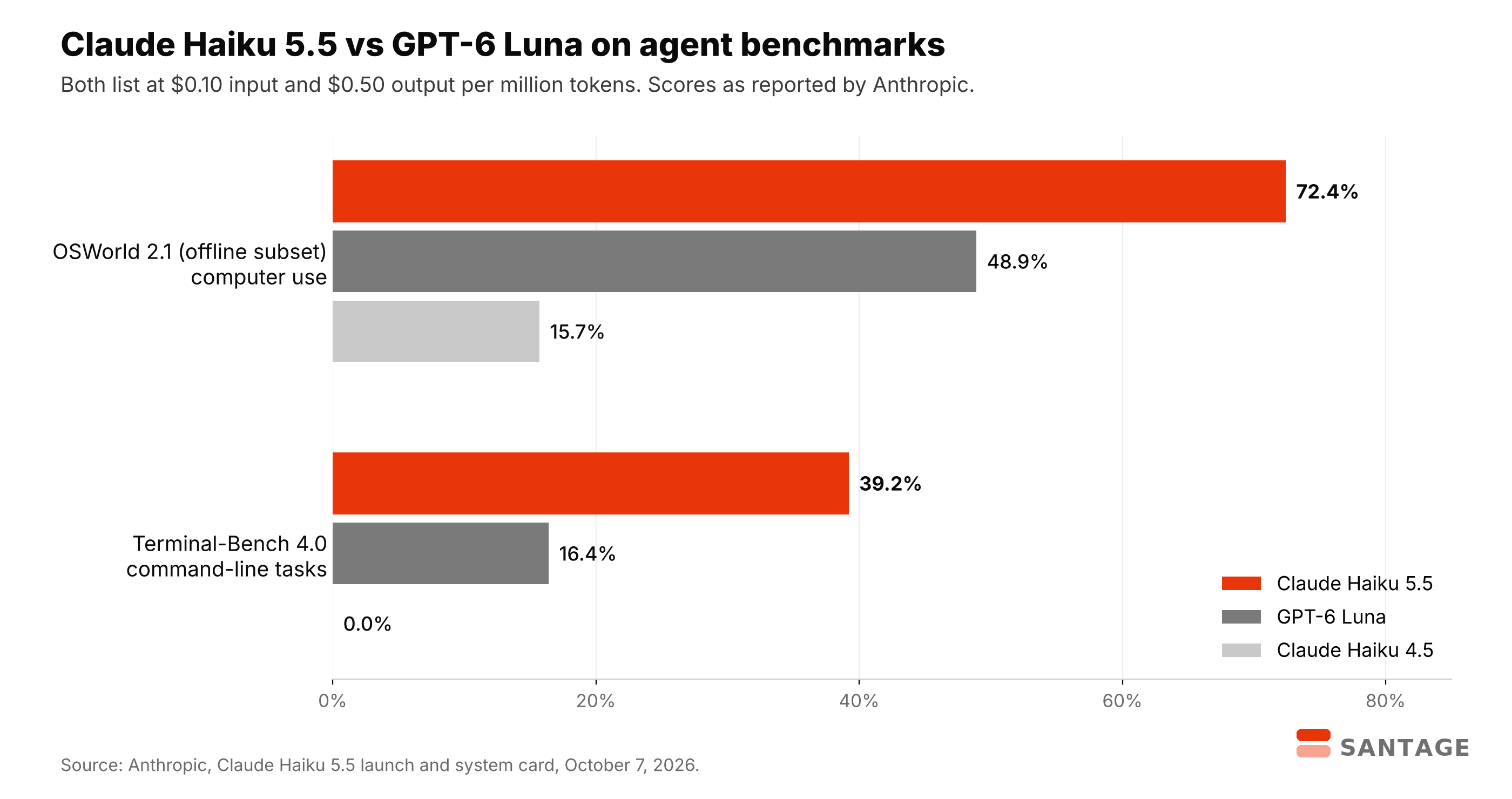
- Anthropic reports 72.4% on the OSWorld 2.1 computer-use subset, against 48.9% for GPT-6 Luna and 15.7% for Haiku 4.5.
Anthropic released Claude Haiku 5.5 on October 7 at $0.10 per million input tokens and $0.50 per million output tokens, a tenth of what Haiku 4.5 cost and exactly the list price OpenAI charges for GPT-6 Luna. The model is the first in the Haiku line with an adjustable effort setting, and Anthropic is pitching it as the default worker that larger Claude models hand tasks to inside AI agent pipelines.
Claude Haiku 5.5 prices short prompts at $0.10 and long prompts at five times that
Haiku 5.5 adds a price break tied to prompt length, which Haiku 4.5 did not have, while Sonnet 5.5 still bills its full context at one flat rate. Anthropic says prompts up to 100,000 tokens made up about 90% of requests to Haiku 4.5, so most existing traffic lands in the cheaper tier. Its launch post puts the list cut at 90% for short prompts and 50% for long ones, and estimates the average saving at about 75% once the updated tokenizer's extra tokens per task are counted.
| Price per million tokens | Haiku 5.5 (up to 100K) | Haiku 5.5 (over 100K) | Haiku 4.5 | GPT-6 Luna (up to 272K) |
|---|---|---|---|---|
| Input | $0.10 | $0.50 | $1.00 | $0.10 |
| Output | $0.50 | $2.50 | $5.00 | $0.50 |
| Cache read | $0.01 | $0.05 | $0.10 | $0.01 |
| Batch input / output | $0.05 / $0.25 | $0.25 / $1.25 | $0.50 / $2.50 | n/a |
Source: Anthropic, Claude Haiku 5.5 launch and Claude Platform pricing, October 7, 2026; OpenAI API list pricing for GPT-6 Luna.
The model is available now on the Claude Platform under the ID claude-haiku-5-5 and through Amazon Web Services, Google Cloud and Microsoft Azure. Anthropic paired the launch with a cut to Sonnet 5.5 cache reads, from $0.20 to $0.10 per million tokens, which it says makes Sonnet about 20% cheaper on most agentic work, and with monthly API credits of $100 for Max 5x, $200 for Max 20x and up to $500 pooled for Team subscribers.
Equal list prices move the small-model contest onto agent benchmarks
With OpenAI and Anthropic now charging identical short-prompt rates for their smallest models, buyers will compare them on what each can do per dollar. Anthropic's numbers favour Haiku on agent tasks, with 39.2% on Terminal-Bench 4.0 against 16.4% for Luna and a GDPval-AA v2.1 rating of 1620 against 1437. All of those scores are Anthropic's own and have yet to be reproduced by an independent lab. Pricing still splits on long inputs: Luna's higher tier starts above 272,000 tokens at $0.20 input, so a 150,000 token document costs less to process on Luna than on Haiku.
“While a bigger model builds the deck, a Haiku 5.5 subagent goes into the 10-K and pulls the segment revenue line the deck needs.”
Alex Wang, Applied AI, Rogo, quoted in Anthropic, Introducing Claude Haiku 5.5, October 7, 2026
The launch closes a three-week refresh of the whole Claude line, following Sonnet 5.5's release on September 28 and the same-day price cuts by Anthropic and OpenAI that came with Opus 5.5. Haiku 5.5 is designed to run underneath those models as a subagent that fetches, summarises and classifies while the larger model plans, and AlphaSense says one feature it tested on Haiku handles about 8 million calls a week. That division of labour makes the cheapest tier the one billed for the most tokens.
At $0.10 per million tokens, the smallest model in a stack stops being a budget fallback and becomes the part of the agent that does most of the reading.
Anthropic and OpenAI have now set the same price on the model that handles the most volume, and the 100,000 token threshold and tokenizer change mean each customer's actual saving will depend on how long its prompts run.
Santage is committed to independent, transparent journalism. This article is produced in accordance with Santage's Editorial Standards and aims to provide accurate and timely information. Readers are encouraged to verify information independently.