The age of AI that answers questions is giving way to the age of AI that does work. Multi-agent systems are the organizational architecture that makes this possible: coordinated networks of specialized AI agents that plan, delegate, execute, and verify work across complex tasks that no single model could handle efficiently alone.
From Amazon's 750,000-robot warehouse network to Anthropic's parallel research agents to enterprise coding systems resolving 30% of pull requests autonomously, multi-agent systems are no longer experimental. They are the production infrastructure of serious AI deployments in 2026. This guide covers everything: what MAS are, how they are built, what the performance data actually shows, and how to secure and govern them.
- Market size: The global multi-agent AI market reached $8 billion in 2026, growing at 43.5% CAGR toward $294 billion by 2035 (Precedence Research)
- Enterprise adoption: 80% of Fortune 500 companies were running active AI agents as of February 2026 (Microsoft), yet 62% of organizations are only experimenting and no more than 10% have scaled agents in any single business function (McKinsey, State of AI 2025)
- The reality check: Gartner predicts more than 40% of agentic AI projects will be canceled by the end of 2027 due to escalating costs, unclear business value, and inadequate risk controls, based on a poll of over 3,400 organizations (Gartner, June 2025)
- Performance advantage: Multi-agent systems outperform single agents by 80 to 90% on parallelizable tasks, but degrade by up to 70% on strictly sequential tasks (Google Research, 2025)
- Error risk: Independent MAS without central orchestration amplify errors 17.2 times; centralized orchestration reduces this to 4.4 times (arXiv:2512.08296)
- Anthropic benchmark: A lead orchestrator agent with 3 to 5 parallel subagents achieved 90.2% better performance than a single agent given the same task and token budget
- Largest deployment: Amazon operates over 750,000 coordinating robots in fulfillment centers, the world's largest operational MAS, delivering 25% productivity gains at next-generation sites
- Leading frameworks: LangGraph (enterprise production), AutoGen (research), CrewAI (beginners), OpenAI Agents SDK (OpenAI-native), Google ADK (Gemini-integrated)
What is a multi-agent system (MAS)?
A multi-agent system (MAS) is a computational architecture consisting of multiple AI agents that each perceive their environment, maintain their own memory and state, and take actions via tools, all in service of a collective goal or interacting set of goals.
The formal definition from distributed AI research characterizes a MAS by three core properties. First, each agent has local information, meaning no single agent has complete knowledge of the whole system. Second, agents have their own goals, which may be fully shared, partially overlapping, or in tension with other agents. Third, the system exhibits global behavior that emerges from local interactions, producing outcomes no individual agent could achieve independently.
What distinguishes a modern LLM-powered MAS from a single-agent setup is the nature of cooperation. In a single-agent system, any secondary models or tools are environmental stimuli. In a true multi-agent system, agents model each other's goals, memory states, and in-progress plans, actively coordinating rather than simply reacting.
Multi-agent systems versus single-agent systems
| Dimension | Single Agent | Multi-Agent System |
|---|---|---|
| Task handling | Sequential, one thread | Parallel, multiple threads simultaneously |
| Specialization | Generalist reasoning | Each agent domain-specialized |
| Memory | Single context window | Distributed, per-agent plus shared state |
| Error propagation | Contained within one agent | Can cascade across agent handoffs |
| Resilience | Single point of failure | Redundant agents absorb failures |
| Coordination overhead | None | Significant (communication, scheduling) |
| Best for | Tightly sequential reasoning | Parallelizable, complex tasks |
How do multi-agent systems work?
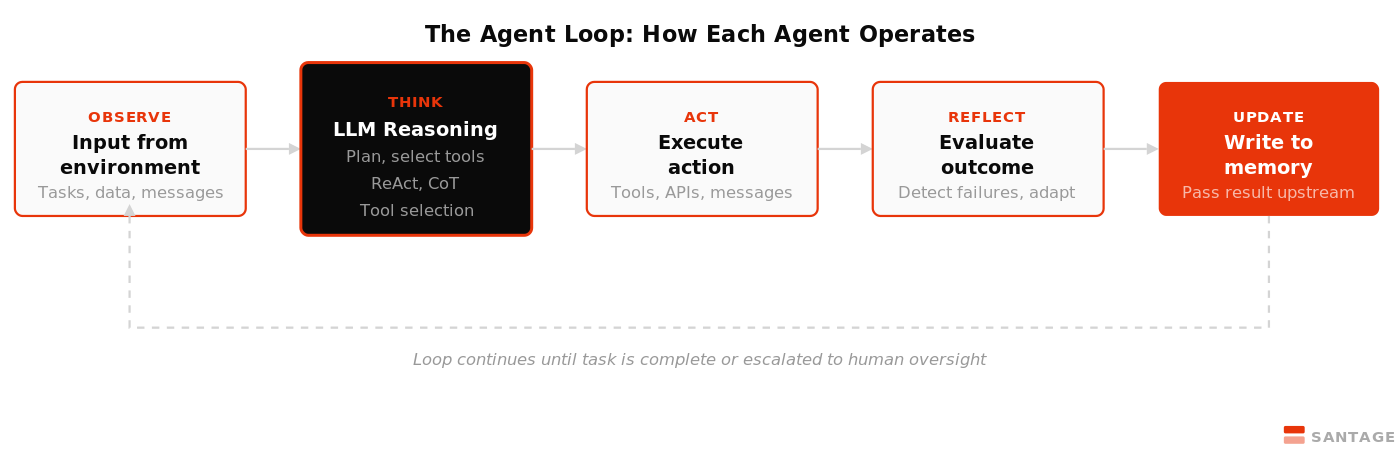
Each agent in a MAS operates a continuous perception-reasoning-action cycle, commonly called the agent loop. Understanding this loop is the foundation for understanding how multi-agent coordination works at scale.
How coordination multiplies the loop
In a MAS, multiple agents run this loop concurrently. An orchestrator agent decomposes an incoming goal into subtasks, assigns each to a specialized agent, monitors their progress, handles errors, and synthesizes their outputs into a final result.
Anthropic's production multi-agent research system demonstrates this at scale. A lead Claude Opus 4 agent analyzes an incoming query, develops a research strategy, and spawns three to five Claude Sonnet 4 subagents operating in parallel, each pursuing a distinct thread of inquiry with its own isolated context window. The subagents return structured findings; the lead agent synthesizes them with a separate citation pass. The result: 90.2% better performance versus a single Opus 4 agent on complex research tasks.
What are the main multi-agent system architectures?
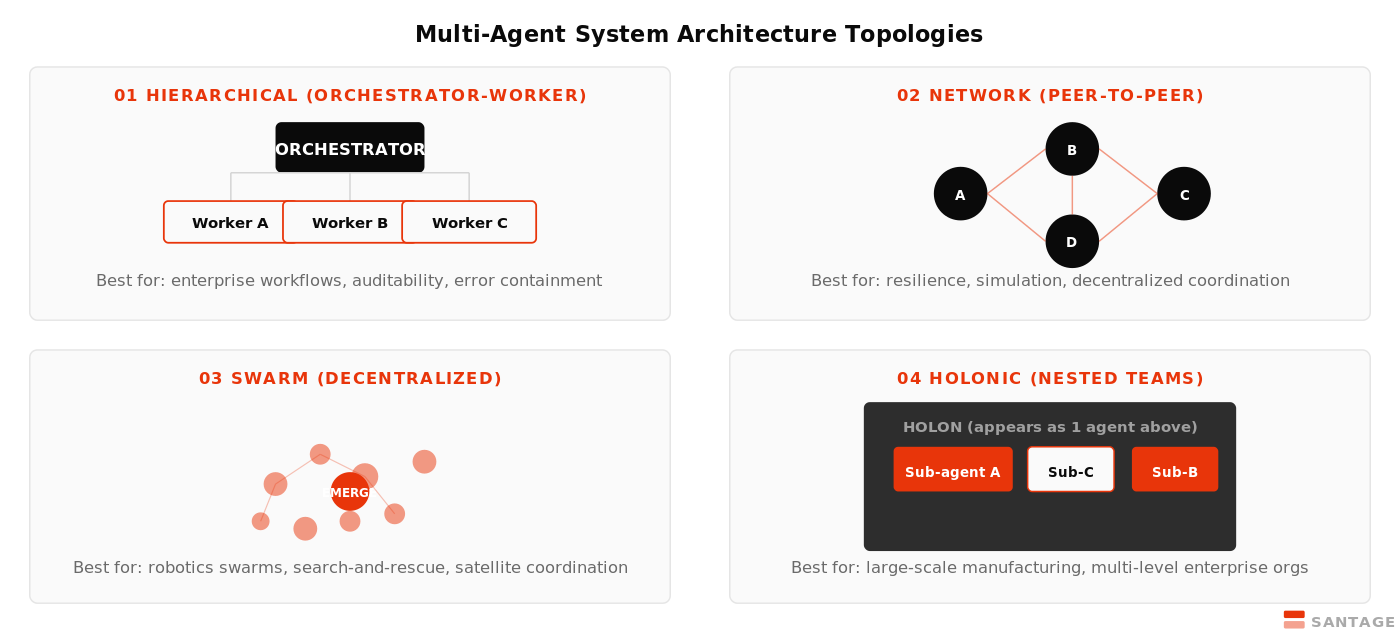
Architecture is the single most consequential design decision in any MAS deployment. The topology determines how agents communicate, how errors propagate, how tasks are allocated, and how the system behaves under load.
Hierarchical architecture: the enterprise default
The orchestrator-worker pattern is the most widely deployed MAS architecture in enterprise settings. A single orchestrator receives the top-level goal, decomposes it into subtasks, delegates to specialized workers, monitors execution, handles failures, and synthesizes a final output. The orchestrator acts as a validation bottleneck, containing error propagation before it can cascade downstream.
Coalition and team architectures
Coalition architectures form temporary agent unions for specific tasks, disbanding once the objective is met. This is suited to dynamic environments where task requirements shift rapidly. Team architectures are more dependent, with agents cooperating in persistent hierarchical groups toward shared performance targets. Neither agent works independently in a true team architecture.
Think of a multi-agent system the way you think of a skilled team: the manager decomposes a project into workstreams, assigns each to a specialist, checks in at key milestones, and integrates the final deliverables. The value is not just the sum of individual work but the coordination itself.
What coordination mechanisms make multi-agent systems work?
Coordination is the defining technical challenge of MAS. Having multiple capable agents is not sufficient. Those agents must manage dependencies, resolve conflicts, share state, and synchronize action in real time without coordination overhead swallowing the efficiency gains. The control layer that performs this job, decomposing goals, routing tasks, arbitrating memory, and governing tool use, is AI agent orchestration, and it is what separates a coordinated system from a set of agents talking past one another.
The four coordination questions every MAS design must answer
- Who coordinates with whom? Not every agent needs to coordinate with every other. Clustering agents by task dependency reduces communication overhead. As the number of tools required grows beyond 16, the coordination tax increases disproportionately.
- When to coordinate? Coordination can be proactive (anticipate conflicts before they occur), reactive (respond after a conflict is detected), or event-triggered (communicate only when a threshold condition is met). Event-triggered is most efficient for production systems with high agent counts.
- What to share? Information asymmetry is the root of most coordination failures. Agents must share enough state to coordinate effectively without drowning each other in irrelevant data that inflates token cost.
- How to coordinate? The mechanism can be centralized (orchestrator manages all dependencies), decentralized (agents negotiate directly), or hybrid. Hybrid patterns, where fast specialists run in parallel with a slower deliberate orchestrator that periodically aggregates and validates results, deliver the best balance of throughput and stability in production systems.
Centralized Training, Decentralized Execution (CTDE)
The dominant paradigm in multi-agent reinforcement learning (MARL). During training, all agents' experiences are collected centrally, enabling a shared critic to evaluate collective performance and coordinate gradient signals. During execution, each agent acts independently using only local observations. This preserves execution efficiency while allowing coordinated learning. CTDE underpins QMIX, MAPPO, and MADDPG, the three algorithms most widely deployed in production robotic MAS.
Conflict resolution
When agents compete for shared resources or produce contradictory outputs, conflict resolution intervenes. The three primary approaches: path planning (negotiate trajectories to avoid physical or logical collisions), priority-based scheduling (a lexicographic priority convention assigns resolution order), and behavioral adjustment (agents modify planned actions, waiting, re-routing, or deferring, without central intervention). Priority-based approaches are favored in safety-critical deployments for their simplicity and formal safety guarantees.
What types of AI agents exist in a multi-agent system?
Modern LLM-powered MAS use role-based agent design, where each agent is given a specific persona, toolset, and scope of authority. This specialization is what enables the productive division of labor. The foundational taxonomy from Russell and Norvig maps cleanly onto modern LLM-based roles.
| Agent Type | Core Capability | LLM Implementation | Common Role |
|---|---|---|---|
| Reactive | Responds to input without maintaining state | Single-turn tool calls, fast execution | FAQ bot, data-fetch agent |
| Model-based | Maintains internal world model | LLM context window plus RAG-retrieved state | Customer support, IT helpdesk |
| Goal-based | Generates action sequences toward a goal | LLM planner with tool-call execution | Research agent, proposal drafter |
| Utility-based | Optimizes a utility function (cost, speed, risk) | Planner evaluates multiple paths, selects highest-scoring | Routing agent, spend optimizer |
| Learning | Improves over time via feedback | Long-term memory updates, prompt refinement, MARL | Personalization agent, marketing optimizer |
| Collaborative (MAS) | Coordinates with other agents toward shared goal | Manager-specialist orchestrator pattern | Enterprise research, coding pipeline |
Functional roles in production deployments
- Orchestrator: Decomposes goals, assigns subtasks, monitors execution, synthesizes final output. Powered by the largest, most capable model.
- Research/retrieval agent: Searches the web, queries databases, retrieves documents via RAG, synthesizes findings. Typically runs in parallel clusters of three to five agents.
- Coder agent: Writes, tests, refactors, and reviews code. Paired with a sandboxed execution environment for verification.
- Critic/reviewer agent: Validates outputs from other agents. Checks factual accuracy, logical consistency, format compliance, and policy adherence.
- Planner agent: Specializes in task decomposition and scheduling. May maintain a shared task graph visible to all agents in the system.
- Executor agent: Takes specific, pre-approved actions in external systems (sending emails, updating CRMs, calling APIs). Carries the most restricted permission set.
What are the best multi-agent frameworks in 2026?
The framework landscape matured significantly between 2024 and 2026, moving from experimental scaffolding to production-hardened infrastructure. Five frameworks dominate enterprise and research deployments, each optimized for a distinct use case and team profile.
| Framework | Architecture model | Best for | Model support | Key strength |
|---|---|---|---|---|
| LangGraph | Directed graph, state checkpoints | Enterprise production | Model-agnostic | State management, observability, persistence |
| AutoGen / AG2 | Conversational GroupChat | Multi-agent research | Model-agnostic | Complex tool interactions, free-form reasoning |
| CrewAI | Role-based crews | Beginners, rapid prototyping | Model-agnostic | Ease of use, fast setup, role definition |
| OpenAI Agents SDK | Explicit handoffs | OpenAI-native workflows | OpenAI only | Handoff clarity, tracing, production tooling |
| Google ADK | Modular pipeline | Gemini-integrated enterprise | Google-native | Gemini integration, Vertex AI deployment |
LangGraph uses a directed graph where nodes are agents or tools and edges are state transitions. Its key differentiator is explicit state management with checkpointing, enabling long-running workflows to survive failures and resume mid-execution. Those priorities map directly onto what production teams report struggling with most: in LangChain's late-2025 State of Agent Engineering survey of more than 1,300 practitioners, output quality and reliability rather than cost were the leading barriers to shipping agents, and 89% of teams running agents in production had added dedicated observability.
AutoGen from Microsoft Research pioneered free-form conversational multi-agent workflows. Agents communicate via a GroupChat abstraction that routes messages based on agent roles and conversation state. Best suited for tasks where the interaction pattern is not fully pre-specified at design time.
CrewAI trades control for accessibility. Role-based crew definitions let practitioners deploy multi-agent pipelines quickly without deep framework knowledge. The heaviest token footprint of the major frameworks (roughly 3x LangGraph for simple flows) is offset by its fast iteration cycle for teams new to agentic development.
The Model Context Protocol (MCP), adopted by OpenAI, Microsoft, and Anthropic in 2025, has emerged as the industry standard for agent-to-tool communication. Built on JSON-RPC 2.0, MCP standardizes how applications expose tools and context to language models, enabling agents from different frameworks to share tools without custom integration work.
Where are multi-agent systems deployed in the real world?
Multi-agent systems have moved from research labs into large-scale production across six major industry sectors. The following deployments represent the state of the field in 2026.
Logistics and warehouse automation
Amazon operates the world's largest deployed MAS, with over 750,000 coordinating robots (Hercules, Titan, Proteus) across its global fulfillment network. Each robot acts as an agent, dynamically adjusting paths using distributed coordination to avoid collisions, prioritize tasks based on real-time inventory state, and maximize throughput. The DeepFleet AI orchestrator reduces fleet congestion and improves travel time by 10%, and next-generation sites report 25% productivity gains versus earlier deployments.
Software development and DevOps
The software engineering sector has seen the fastest enterprise adoption of MAS. GitHub Copilot Workspace agents autonomously resolve approximately 30% of pull requests submitted to repositories with sufficient test coverage. Multi-agent coding pipelines decompose feature requests across researcher, coder, reviewer, and test-runner agents, each operating on an isolated codebase worktree. Anthropic uses this pattern internally via Claude's Task tool for large engineering tasks.
Healthcare and life sciences
Clinical MAS are deployed across scheduling (appointment optimization), documentation (transcribing and structuring visit notes to reduce physician administrative burden), and predictive monitoring (analyzing continuous patient data streams to flag early warning signs of deterioration, sepsis, or readmission risk). Epidemiologically informed neural networks deployed as MAS manage large national datasets for epidemic spread forecasting, directly informing real-time public health policy decisions.
Autonomous vehicles and transportation
Each autonomous vehicle is an agent in a traffic coordination MAS. Vehicles negotiate speed, lane changes, merges, and intersection priority by sharing planned trajectories with neighboring vehicles and traffic infrastructure agents. Traffic signal control agents manage timing across entire road networks using hierarchical decomposition: intersection-level agents optimize local flow while district-level orchestrators balance network-wide throughput.
Cybersecurity and network defense
Intrusion detection MAS deploy agents monitoring distinct network segments. When one agent detects an anomaly, it broadcasts a threat signature to neighboring agents, which update their detection policies and collaboratively isolate compromised nodes. Cooperative DDoS detection works because flooding attacks require distributed observations to recognize: no single agent monitoring one subnet sees the full attack pattern, but agents sharing observations identify it collectively.
Finance and enterprise operations
Expense-monitoring agents audit corporate spending against policy in real time. Variance-analysis agents compare actuals against forecast, identify root causes using RAG-retrieved historical data, and draft explanations. Fraud detection MAS cut false positive rates by 40% versus rule-based systems by sharing threat patterns across agents monitoring different transaction streams simultaneously.
How do multi-agent systems actually perform? The research evidence
The performance landscape for MAS has clarified significantly through 2025 and into 2026, with rigorous benchmarking replacing early hype with quantified trade-offs.
Google's scaling science: the most important study to date
Google Research's December 2025 paper "Towards a Science of Scaling Agent Systems" (arXiv:2512.08296) evaluated five canonical architectures across four benchmarks and three LLM families, holding tools, prompts, and token budgets constant to isolate topology effects. Key findings:
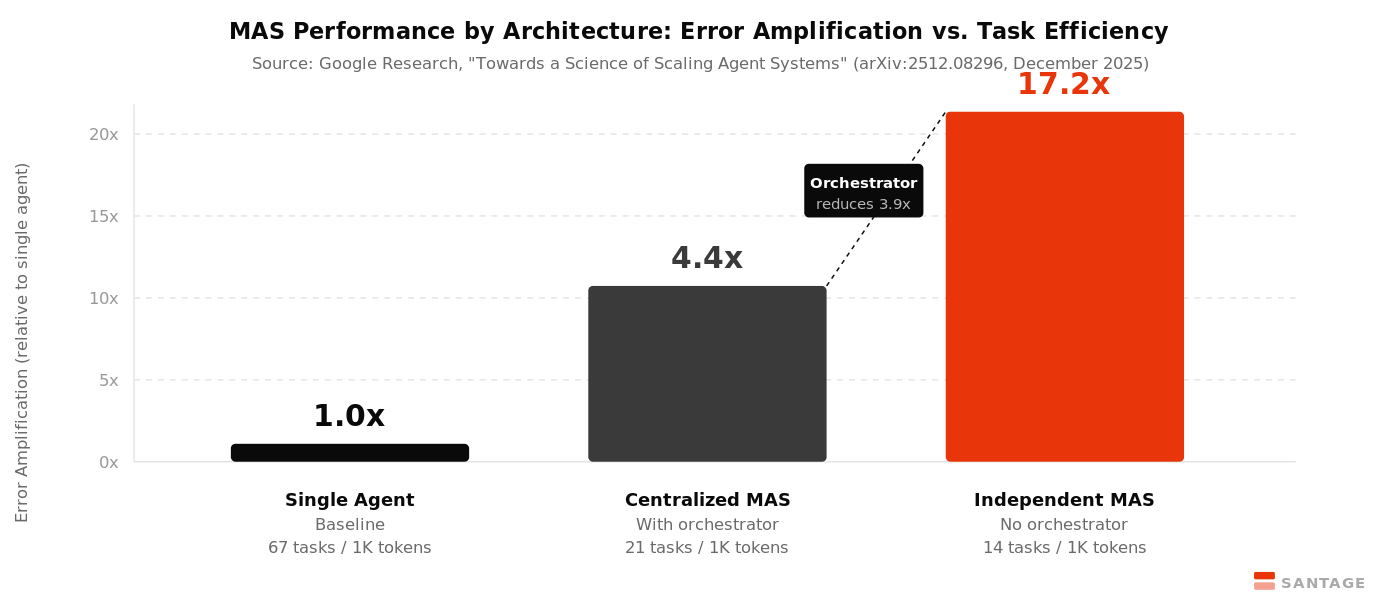
- Error amplification is topology-dependent: Independent MAS (no central orchestrator) amplified errors 17.2 times relative to single-agent baselines. Centralized orchestration reduced that amplification to 4.4 times. The mechanism is cascade: without an orchestrator as a validation bottleneck, errors compound silently across agent handoffs.
- Task structure determines benefit: Parallelizable tasks (market research, document analysis, code review) benefit significantly from multi-agent execution. Tasks requiring strict sequential consistency perform worse under MAS due to coordination overhead.
- Token efficiency degrades at scale: A single agent completed an average of 67 successful tasks per 1,000 tokens. Centralized multi-agent systems averaged 21 successful tasks per 1,000 tokens. Adding agents costs significantly more per unit of successful work.
- There is a ceiling: Adding agents beyond a task-matched threshold yields diminishing returns and can actively degrade performance as coordination noise increases.
| System type | Error amplification | Task success / 1K tokens | Best task type |
|---|---|---|---|
| Single agent | Baseline (1.0x) | 67 tasks | Sequential reasoning |
| Centralized MAS (with orchestrator) | 4.4x | 21 tasks | Parallelizable research |
| Independent MAS (no orchestrator) | 17.2x | 14 tasks | Isolated parallel subtasks |
Framework choice tracks the task
There is no single fastest framework, because Google's topology finding applies to tooling too: the right choice depends on the workload. LangGraph's durable state and checkpointing suit long-running, auditable enterprise workflows. AutoGen's conversational GroupChat suits open-ended reasoning where the interaction pattern is not fixed in advance. CrewAI trades some token efficiency for speed of setup, which is a reasonable trade for teams new to agentic development. The consistent signal from production surveys is that reliability and observability, not raw latency, are what separate agents that ship from agents that stall.
What are the challenges and limitations of multi-agent systems?
Multi-agent systems introduce failure modes that do not exist in single-agent deployments. The 2025 to 2026 period has produced both a clearer taxonomy of these failures and emerging mitigation strategies.
Error amplification and cascade
The 17.2x error amplification finding is the most cited quantitative measure of MAS fragility. Agent A produces an output with a 10% error rate. Agent B, which takes A's output as input without independent verification, inherits and compounds that error. Agent C does the same. By the time output reaches the user, the original small error has become a significant failure. Frequently that original error is a hallucination, a confident but fabricated output the producing agent has no internal signal is wrong, which is exactly why unverified handoffs between agents are so dangerous. Critic agents positioned at handoff boundaries and explicit validation schemas enforced before downstream consumption are the primary mitigations.
Planning horizon degradation
On tasks requiring more than approximately 20 steps of sequential reasoning, LLM-based agents show documented degradation in plan coherence. The model loses track of earlier context, goal conditions drift, and the agent begins optimizing for locally correct outputs that are globally incoherent. Reported failure rates on long-horizon tasks range from 20 to 40%.
Coordination overhead
Every message between agents, every state synchronization, every validation call costs tokens and latency. At scale (10+ agents on complex tasks), coordination overhead can exceed the computational cost of the task itself. Google's token efficiency data makes this concrete: 17 agents doing work one agent could do in fewer tokens is not always the right trade.
The three fundamental failure modes
| Failure mode | Description | Primary mitigation |
|---|---|---|
| Miscoordination | Agents fail to synchronize. Tasks are duplicated, skipped, or executed out of order. | Orchestrator with explicit task graph |
| Conflict | Agents' objectives directly oppose, producing oscillating or deadlocked behavior. | Priority-based resolution protocols |
| Collusion | Agents cooperate in ways that undermine the system's intended purpose. | Isolated memory, immutable audit logging |
How do you secure and govern a multi-agent system?
Security and governance are the defining operational challenges for enterprise MAS in 2026. As of February 2026, 80% of Fortune 500 companies were running active AI agents, but Microsoft's security research identified observability, governance, and access control as the primary pain points. The governance-containment gap, deploying agents faster than establishing monitoring and human oversight infrastructure, is the defining security challenge of 2026. The cost of that gap is now quantified. Gartner predicts more than 40% of agentic AI projects will be canceled by the end of 2027, and attributes the failures not to model capability but to escalating cost, unclear business value, and inadequate risk controls. McKinsey's adoption data tells the same story from the other side: 62% of organizations are at least experimenting with agents, yet no more than 10% have scaled them in any single business function, because the governance, security, and reliability scaffolding, not the model, is the hard part.
Zero-trust agent architecture
The baseline security requirement for any production MAS is zero-trust: agents do not automatically trust each other or their inputs. Every message is authenticated, every tool call is scoped to an explicit allow-list, and every action is logged. Research on prompt injection in multi-agent systems (arXiv:2505.02077) found that intermediate trusted agents actively reformat malicious instructions to strip detection markers, making inter-agent prompt injection a distinct threat vector that requires dedicated detection, not just perimeter defense.
- Role-based access control: Each agent has a unique stable identity. Its role maps precisely to the tools, data, and system access needed for its function and nothing else. Principle of least privilege applies to agents as strictly as to human users.
- Action allow-lists: Tools are explicitly granted to each agent, not generally available. An agent that needs web search does not automatically have database write access.
- Isolated memory: Agent memory stores are isolated by default. The orchestrator controls what information flows between agents, preventing data leakage between compliance domains.
- Immutable audit logging: A complete, tamper-proof record of every agent's reasoning trace, tool calls, and outputs is the foundation of post-hoc accountability.
- Human interrupt points: Structured mechanisms for human review and override at defined checkpoints in every workflow, not just a kill switch at the end.
EU AI Act compliance for multi-agent systems
The EU AI Act, which began full enforcement in August 2026, creates binding requirements for multi-agent systems classified as high-risk. Recitals 99 and 100 address multi-agent architectures explicitly: in a chain of AI agents, the compliance boundary extends to every agent performing a high-risk function. Governance cannot be delegated to a single "responsible" orchestrator. Each agent in the chain must meet the relevant standard for data minimization, explainability, human oversight capability, and audit logging (7-plus years for regulated contexts).
What is multi-agent reinforcement learning (MARL)?
Multi-agent reinforcement learning is the discipline through which agents in a MAS learn collectively from experience, rather than being programmed with fixed behaviors. In standard reinforcement learning, a single agent learns by taking actions, receiving rewards, and updating its policy to maximize future reward. MARL extends this to environments with multiple learning agents, introducing the fundamental challenge that each agent's reward depends on the actions of all other agents simultaneously, making the environment non-stationary from any individual agent's perspective.
Key MARL algorithms
MADDPG (Multi-Agent Deep Deterministic Policy Gradient) addresses the non-stationarity problem in continuous action spaces using CTDE: centralized training with decentralized execution. Each agent's policy is updated using centralized information about all agents during training, then acts on local observations during deployment.
QMIX uses value decomposition for cooperative MARL. Rather than learning a single joint Q-value for the whole team, QMIX decomposes the joint value into individual agent values combined via a mixing network. This makes credit assignment tractable with large agent counts. In warehouse robotics coordination benchmarks, QMIX achieves a mean return of 3.25 versus 0.38 for independent learning approaches, an 8x improvement (arXiv:2512.04463).
MAPPO (Multi-Agent Proximal Policy Optimization) adapts the stable on-policy PPO algorithm for multi-agent settings. Strong performance across cooperative benchmarks with lower implementation complexity makes it the default for research settings. MAPPO has shown excellent results in IoT resource allocation, traffic signal control, and satellite coordination tasks.
MARL in production
MARL-trained policies under CTDE power the majority of deployed autonomous robotic MAS. Amazon's warehouse coordination, autonomous vehicle traffic management, and satellite constellation optimization all learn centrally and execute decentrally. The current research frontier focuses on graph-based coordination (using graph neural networks to encode agent communication structure), mean-field approximations (treating large agent groups as distributions rather than individuals, enabling scaling to thousands of agents), and meta-learning (enabling agent teams to quickly adapt coordination strategies when team composition changes).
What does the future of multi-agent systems look like?
Three converging developments define the trajectory of MAS over the next two to four years.
Near-term: protocol standardization
The proliferation of MAS frameworks has created agent interoperability fragmentation. Agents built in LangGraph, CrewAI, and AutoGen cannot easily communicate. The Model Context Protocol (MCP), the Agent-to-Agent Protocol (A2A), and the Agent Communication Protocol (ACP) are the leading attempts at interoperability standards. This space consolidated meaningfully in 2025: Google donated A2A to the Linux Foundation in June 2025, placing it under neutral, vendor-agnostic governance with AWS, Cisco, Microsoft, Salesforce, SAP, and ServiceNow as founding partners and more than 100 companies now supporting it. That move mirrors how HTTP standardized web communication, and it signals that the field is converging on shared agent-to-agent protocols faster than many expected.
Medium-term: human-agent teaming
Current deployments treat human oversight as an interrupt mechanism or approval gate. Research at Stanford HAI and elsewhere is developing richer human-agent collaboration models where the boundary between human and agent responsibility is dynamically negotiated: the agent takes on more autonomy as trust is established and cedes control when uncertainty is high or stakes are elevated. The question is not simply when does a human oversee an agent, but how a mixed human-agent team best allocates tasks to maximize both efficiency and safety.
Long-term: the 2029 horizon
Gartner projects that 15% of day-to-day work decisions will be made autonomously through agentic AI by 2028, up from 0% in 2024, and that 33% of enterprise software applications will include agentic AI by 2028, up from less than 1% in 2024. Society-of-agents architectures, where multiple agents with different roles engage in structured discourse and debate, have shown emergent reasoning capabilities exceeding single-model performance on complex multi-perspective problems. Meta-agents, systems that reason about the composition and coordination of agent teams rather than executing within a fixed team, represent the leading architectural frontier in 2026 research.
The open research problems that will define this trajectory include: how to scale MAS without performance degradation past the coordination ceiling; how to manage heterogeneous agents with different underlying models and trust levels; and how to formally verify the safety properties of a multi-agent system before deploying it in high-stakes environments like healthcare, finance, and critical infrastructure.
Frequently asked questions
Sources
- Google Research. Towards a Science of Scaling Agent Systems. December 2025. arxiv.org/abs/2512.08296
- Anthropic Engineering. How We Built Our Multi-Agent Research System. 2025. anthropic.com/engineering
- Microsoft Security Blog. 80% of Fortune 500 Use Active AI Agents: Observability, Governance and Security Shape the New Frontier. February 2026. microsoft.com
- McKinsey & Company. The State of AI in 2025: Agents, Innovation, and Transformation. November 2025. mckinsey.com
- Gartner. Gartner Predicts Over 40% of Agentic AI Projects Will Be Canceled by End of 2027. June 2025. gartner.com
- Linux Foundation. Linux Foundation Launches the Agent2Agent Protocol Project. June 2025. linuxfoundation.org
- LangChain. State of Agent Engineering. 2025. langchain.com
- Precedence Research. AI Agents Market Size to Hit USD 294.66 Billion by 2035. 2026. precedenceresearch.com
- arXiv. Open Challenges in Multi-Agent Security: Towards Secure Systems of Interacting AI Agents. May 2025. arxiv.org/abs/2505.02077
- arXiv. Multi-Agent Reinforcement Learning for Cooperative Warehouse Automation: QMIX Value Decomposition for Sparse-Reward Coordination. December 2024. arxiv.org/abs/2512.04463
- arXiv. A Survey of Agent Interoperability Protocols: MCP, ACP, A2A, and ANP. May 2025. arxiv.org/abs/2505.02279
- arXiv. AI Agents Under EU Law. April 2026. arxiv.org/abs/2604.04604
- Stanford HAI. Human-Centered AI Research on Collaboration and Oversight. 2025. hai.stanford.edu