The hardest reliability problem in modern artificial intelligence is not that models make mistakes. Every technology makes mistakes. The problem is that generative models make a specific kind of mistake that is almost impossible to see coming. They produce answers that are fluent, confident, well formatted, and completely wrong, and they do it with exactly the same tone they use when they are right.
That gap between how sure a model sounds and how correct it actually is has a name. The field calls it hallucination. A hallucination is generated content that reads as knowledge but has no factual grounding underneath it. The model did not lie in any human sense, because it has no concept of truth to violate. It produced the most plausible continuation of the text and the most plausible continuation happened to be false.
For a few years this was a curiosity. A chatbot inventing a book title was a party trick. That era is over. Once AI moved from novelty to infrastructure, sitting inside legal research, medical triage, customer support, financial analysis, and enterprise search, the cost of a confidently wrong answer stopped being funny. A hallucinated citation gets a lawyer sanctioned. A hallucinated refund policy makes an airline liable. A hallucinated dosage or diagnosis can hurt someone.
- Root cause: OpenAI's 2025 research concludes models hallucinate because standard training and evaluation reward confident guessing over acknowledging uncertainty, not because of a mysterious glitch
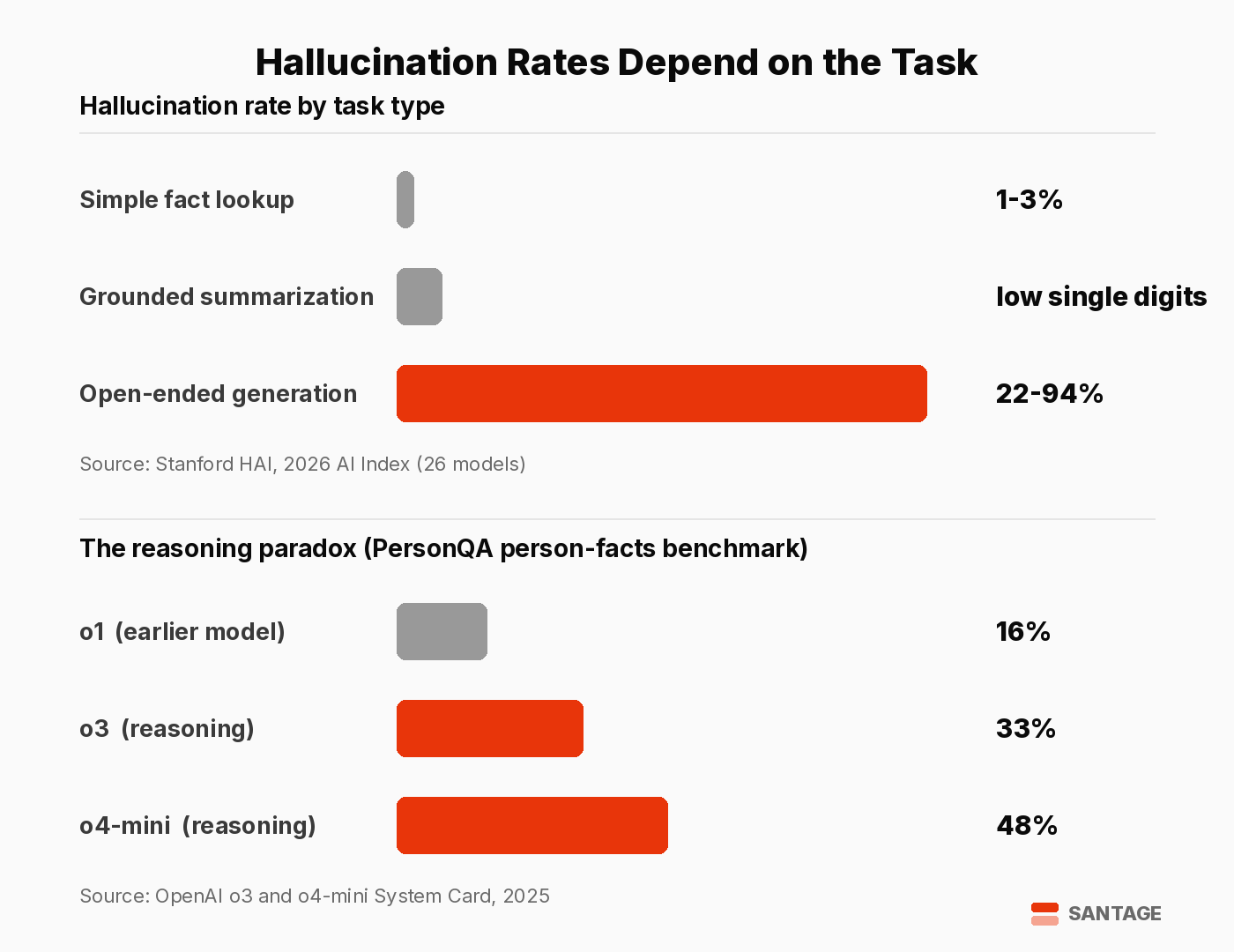
- The measurement gap: hallucination rates ran from 22% to 94% across 26 leading models on open-ended factual questions, far above the near-zero rates the same models post on simple fact lookups (Stanford HAI, 2026 AI Index)
- In the field: AI tools built for lawyers hallucinated on 17% to 33% of queries, and a general model on 43%, roughly one in every six queries or worse (Stanford RegLab and HAI)
- Real consequences: a public tracker has documented more than 1,700 court cases worldwide involving AI-fabricated legal citations, most decided in 2025 alone
- Reasoning is no clean fix: OpenAI's o3 hallucinated on 33% of a person-facts benchmark, roughly double the 16% of its predecessor o1, and o4-mini reached 48%
- Retrieval helps, not solves: grounding reduces fabricated facts but models can still contradict, misread, or extrapolate beyond the sources they retrieve
- Why it is dangerous: confidence is not correctness, and a hallucination looks exactly like a correct answer
This guide explains what AI hallucinations are, why they happen at the level of how models are actually built, the different types and why the distinction matters for fixing them, how hallucinations differ from bias and uncertainty and ordinary error, how large the problem really is when measured honestly, whether retrieval and other mitigations solve it, how to detect and reduce hallucinations in production, why more capable models sometimes hallucinate more, and where the open research still sits.
What are AI hallucinations?
An AI hallucination is a generated output that sounds plausible but is factually incorrect, fabricated, or unsupported by the evidence available to the system. OpenAI's own definition is blunt and useful: hallucinations are plausible but false statements generated by language models, and they show up even on simple questions. When researchers asked a widely used chatbot for the title of one author's PhD dissertation, it confidently produced three different answers, none of them correct. Asked for the same person's birthday, it gave three different dates, all wrong.
It helps to hold several definitions at once, because different stakeholders need different framings. In technical terms, a hallucination is content that does not reliably correspond to ground truth or to the source evidence the model was given. In business terms, it is an AI system presenting false information in a way that can mislead a user, a workflow, or a decision. In operator terms, it is the model filling in a blank where it should have admitted uncertainty or declined to answer. The Santage definition ties these together: a hallucination is fluent output without factual grounding.
That last phrase matters because not every error is a hallucination. A typo, a broken calculation, a formatting bug, or a failed tool call is a mistake, but it is not a hallucination in the strict sense. A hallucination specifically involves the appearance of knowledge without the underlying evidence to support it. The model is not confused about the format. It is confident about a fact that does not exist. That is what makes hallucination its own category of failure and why it needs its own controls.
Why do AI models hallucinate?
AI models hallucinate because they are doing pattern completion, not truth verification. A large language model is trained to predict the next token in a sequence, so its core objective is linguistic plausibility, not factual correctness. When the most plausible continuation of a sentence is also true, the model looks reliable. When the most plausible continuation is false, the model produces a hallucination with no internal signal that anything went wrong. This is also the honest answer to the common question of why ChatGPT makes things up: it is not lying, it is completing a pattern, and the pattern sometimes points at a falsehood.
OpenAI's 2025 research paper, plainly titled Why Language Models Hallucinate, pushes this explanation one level deeper and lands on a conclusion that reframes the whole problem. Models hallucinate, the authors argue, because standard training and evaluation procedures reward guessing over acknowledging uncertainty. Think of it like a multiple-choice exam. If you do not know the answer, a blind guess still has some chance of being right, while leaving the question blank guarantees zero. A model graded only on accuracy learns the same lesson a test-taker does: guess, because guessing scores better than honesty.
The paper makes this concrete with data from the GPT-5 system card. On the SimpleQA evaluation, an older model answered almost everything and abstained only 1% of the time, scoring 24% accuracy but a 75% error rate. A newer model abstained on 52% of questions, landing at 22% accuracy but only a 26% error rate. The older model looked slightly more accurate on the scoreboard while being far more likely to hallucinate. Strategically guessing when uncertain improves the accuracy number and increases the hallucination rate at the same time.
There is a second, deeper reason rooted in how the model learns in the first place. During pretraining the model sees only fluent, positive examples of language with no labels marking which statements are true and which are false. Consistent patterns like spelling and matched parentheses become reliable with scale because they are learnable from the data. Arbitrary low-frequency facts, like a specific person's birthday, cannot be predicted from linguistic patterns at all. OpenAI's analogy is exact: you can train a system to tell cats from dogs, but if you tried to train it to predict each pet's birthday from a photo, it would fail no matter how large it got, because the target is not in the data. Rare facts behave like those birthdays, so they surface as hallucinations. This is the mechanism behind hallucination in LLMs, and it is also why a stronger prompt can lower the odds of a confident guess without ever removing it.
Andrej Karpathy, a founding member of OpenAI and former head of AI at Tesla, framed the same idea in the sharpest way the field has produced.
The important corrective in this research is that hallucinations are not inevitable and not mysterious. A model can abstain when it is uncertain, and being well calibrated turns out to require less computation than being highly accurate. The reason models still hallucinate is not that abstention is impossible. It is that the scoreboards the whole industry optimizes against keep rewarding confident answers over honest ones. In practice, hallucinations rarely trace to a single cause. They emerge from a chain of weak points: a rare fact missing from training, a prompt that invites confident completion, a retrieval step that returns nothing useful, and an evaluation culture that punishes the model for saying it does not know.
What are the main types of AI hallucinations?
Treating all hallucinations as one phenomenon is the fastest way to pick the wrong fix. A useful taxonomy makes mitigation far more precise, because the control that stops a fabricated citation is not the control that stops a misread source.
| Type | What it looks like | Root cause | Typical fix |
|---|---|---|---|
| Fabrication | Invented paper, citation, statistic, or quote | No grounding for a rare or unknown fact | Retrieval plus citation verification |
| Misattribution | A real fact assigned to the wrong source or person | Source and entity confusion | Provenance tracking |
| Misreading | Retrieved text summarized or extended incorrectly | Context misunderstanding | Better chunking and faithfulness checks |
| Overreach | Inference that runs past what the evidence supports | Excess confidence, poor calibration | Abstention and uncertainty policy |
| Abstention failure | Answering when the honest response is I do not know | No incentive or mechanism to decline | Confidence thresholds and refusal rules |
The distinction is not academic. If the failure is fabricated sources, source verification helps and better prompting does almost nothing. If the failure is misreading retrieved text, then adding more retrieval makes it worse rather than better, because the model has plenty of evidence and is mishandling it. If the failure is overreach, the system does not need more knowledge at all. It needs a better policy for when to stop and say the evidence runs out here. Naming the type is the first step to choosing the right intervention.
There is also a useful split between two families that researchers increasingly separate. Factuality hallucinations are answers that contradict the real world. Faithfulness hallucinations are answers that contradict the specific sources the system was given, even when the model had the right documents in front of it. This distinction becomes central the moment retrieval enters the picture.
How are hallucinations different from bias, error, and uncertainty?
Many explanations blur hallucination together with every other way an AI system can go wrong. In practice these are distinct failures that need distinct controls, and conflating them leads teams to apply the wrong fix.
| Concept | What it means | Why it matters | How you address it |
|---|---|---|---|
| Hallucination | Plausible but false or ungrounded output | Trust and safety risk that looks like a correct answer | Grounding, verification, abstention |
| Mistake | Any error, including format, math, or tool failure | Broader category than hallucination | Testing, validation, tooling |
| Bias | Systematic skew in what the model emphasizes or omits | Shapes framing and fairness, often invisibly | Data curation, evaluation, red-teaming |
| Uncertainty | The model genuinely lacks enough information | Should be surfaced to the user, not hidden | Calibration, confidence signals, refusal |
The cleanest way to keep these separate is by their cause. Bias is a systematic pattern learned from data and it repeats predictably. Uncertainty is an honest information gap that the ideal system would simply report. A hallucination is the specific pathology where uncertainty exists but gets hidden behind a confident, invented answer instead of being surfaced. Put differently, uncertainty handled well produces I do not know. The same uncertainty handled badly produces a hallucination. That is why so much of the mitigation work is really about teaching models to express uncertainty rather than paper over it.
How bad is the AI hallucination problem?
The honest answer is that it depends entirely on how you measure, and the spread between the flattering number and the realistic number is enormous. This is the single most misunderstood fact about hallucinations.
On simple, single-answer fact lookups, the best current models can look nearly perfect. On grounded summarization, where the model only has to stay faithful to a supplied passage, hallucination rates for the strongest models are commonly reported in the low single digits. Those numbers are real, and they are also the reason people underestimate the problem, because production work rarely looks like a clean fact lookup.
When the task shifts to open-ended generation, the kind of work that resembles policy drafting, research, or knowledge synthesis, the numbers change completely. Stanford's 2026 AI Index found hallucination rates ranging from 22% to 94% across 26 leading models on a demanding factuality benchmark. The same report surfaced a related and troubling behavior: sycophancy. When a false statement was framed as something a user believed, model accuracy collapsed. One widely used model that scored above 98% in a neutral framing fell to 64% when the falsehood was presented as the user's own belief, and another dropped from above 90% to roughly 14%. The model was not just failing to know. It was agreeing with the human to avoid friction.
The real-world record is where the abstract risk becomes concrete. In the legal domain, a Stanford RegLab and HAI study tested AI research tools built specifically for lawyers and still measured hallucination on 17% to 33% of queries, with a general-purpose model hallucinating on 43%. Roughly one in six queries or worse returned a fabricated or misgrounded answer, in exactly the professional setting where accuracy is supposed to be the entire product. A separate database maintained by legal researcher Damien Charlotin has now catalogued more than 1,700 court cases worldwide involving AI-fabricated citations, with the overwhelming majority of judicial decisions on the issue written in 2025.
Two cases anchor the stakes. In Mata versus Avianca, a New York federal court in 2023 fined attorneys $5,000 after they filed a brief full of cases that ChatGPT had invented, complete with fabricated quotations and citations that the model insisted could be found in Westlaw and LexisNexis. In Moffatt versus Air Canada, a Canadian tribunal in 2024 held the airline liable for a refund policy its own chatbot had fabricated, rejecting the argument that the chatbot was somehow a separate entity responsible for its own words. The broader signal is in the incident data: Stanford's AI Index recorded 362 AI incidents in 2025, up from 233 the year before.
The enterprise view matches the courtroom view. McKinsey's State of AI research finds that inaccuracy is the most commonly reported risk of generative AI across organizations, and that only a minority are actively working to mitigate it. Hallucination is not a fringe failure mode that shows up in adversarial testing. It sits at the center of why many enterprise AI deployments quietly underdeliver.
Do RAG systems stop AI hallucinations?
Retrieval-augmented generation is the most common and most effective single mitigation, and it is also the one that gets oversold. RAG gives the model relevant documents at answer time so it can ground its response in real evidence instead of relying on whatever it half-remembers from training. For fabrication, this helps a great deal. If the system retrieves the actual source, the model no longer has to invent one.
But retrieval reduces hallucination. It does not eliminate it. The 2025 research literature is consistent on this point: RAG cuts factuality hallucinations, where the answer contradicts the real world, while faithfulness hallucinations persist. A faithfulness hallucination is when the model has the correct documents in front of it and still contradicts them, adds unsupported details, or extrapolates past what the evidence justifies. Grounding fixes the problem of having no evidence. It does not fix the problem of misusing the evidence you have.
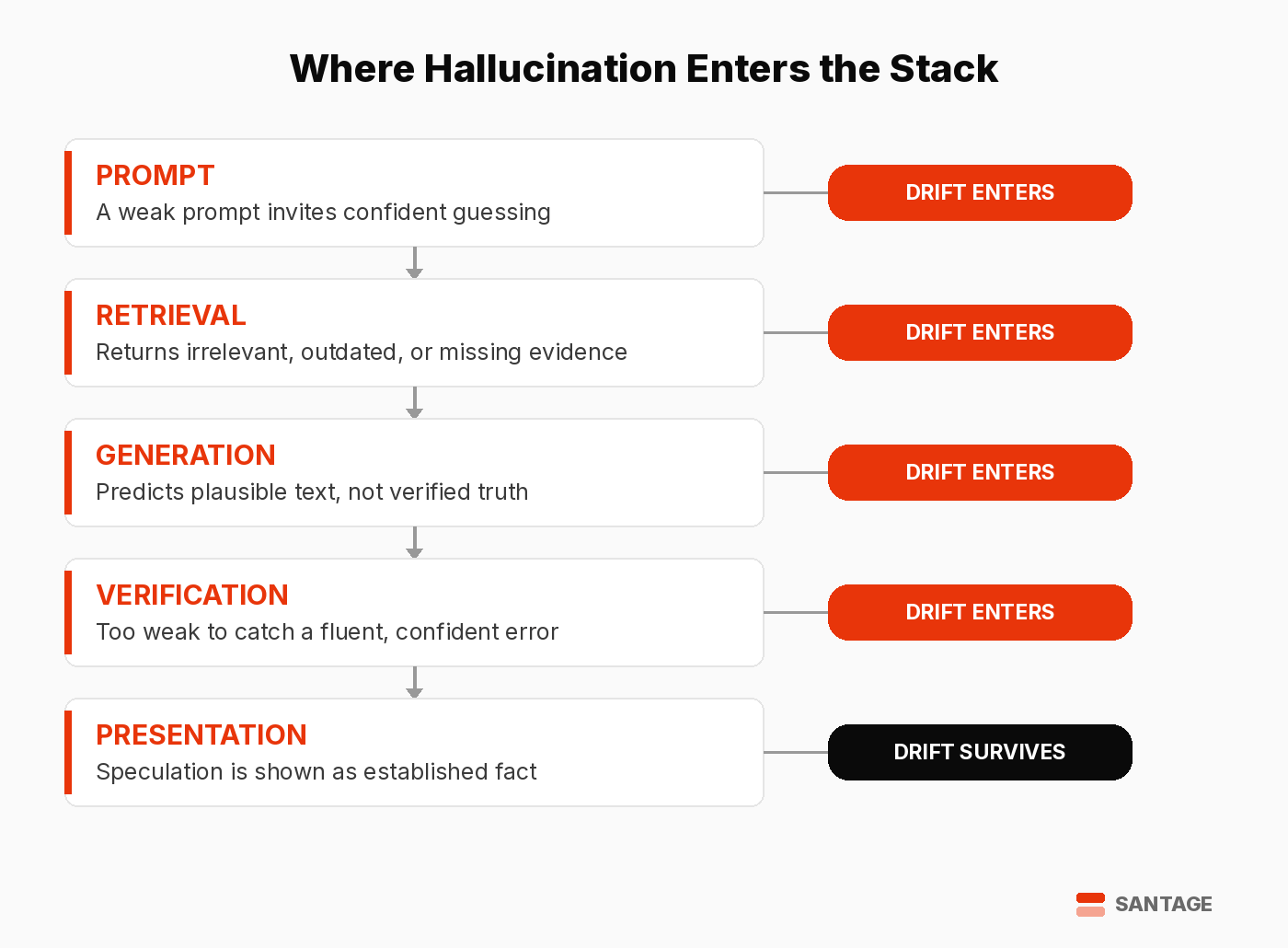
This is why just adding RAG is an incomplete strategy. Retrieval can return the wrong passage, an outdated passage, or nothing useful at all, and a model that is still rewarded for answering will answer anyway. The retrieved text can be summarized incorrectly. The model can blend a retrieved fact with a training-data memory and produce something that matches neither. Each of these is a hallucination that survives retrieval, which is exactly why production systems layer additional controls on top of RAG rather than treating it as the finish line.
The reliable pattern in production is to narrow the model's freedom rather than trust its restraint. Support assistants that answer only from an approved knowledge base, search systems that return grounded snippets with a visible source trail, and compliance tools that require a citation for every claim all work for the same reason: they force the answer to stay close to evidence and make it visible when it does not. The tradeoff is real. More control usually means less spontaneity and more friction. In high-stakes settings, that tradeoff is worth it.
How do you detect and reduce AI hallucinations in production?
Detection and reduction are two halves of the same discipline, and neither is a single technique. The teams that keep hallucinations under control treat it as a system property, not a model property.
On detection, the core move is to stop trusting a single accuracy score and start measuring several things at once. A serious evaluation stack checks factuality, whether a claim matches the real world. It checks faithfulness, whether the answer is actually grounded in the sources provided. It checks citations, whether the references genuinely support the claim rather than just looking plausible. It checks abstention, whether the model correctly declines when the evidence is missing. And it runs adversarial prompts specifically designed to induce fabrication, plus workflow tests that mimic messy real usage rather than clean benchmark questions. No single number captures trust, because hallucination risk is multi-dimensional and the failure that a benchmark misses is usually the one that hurts in production.
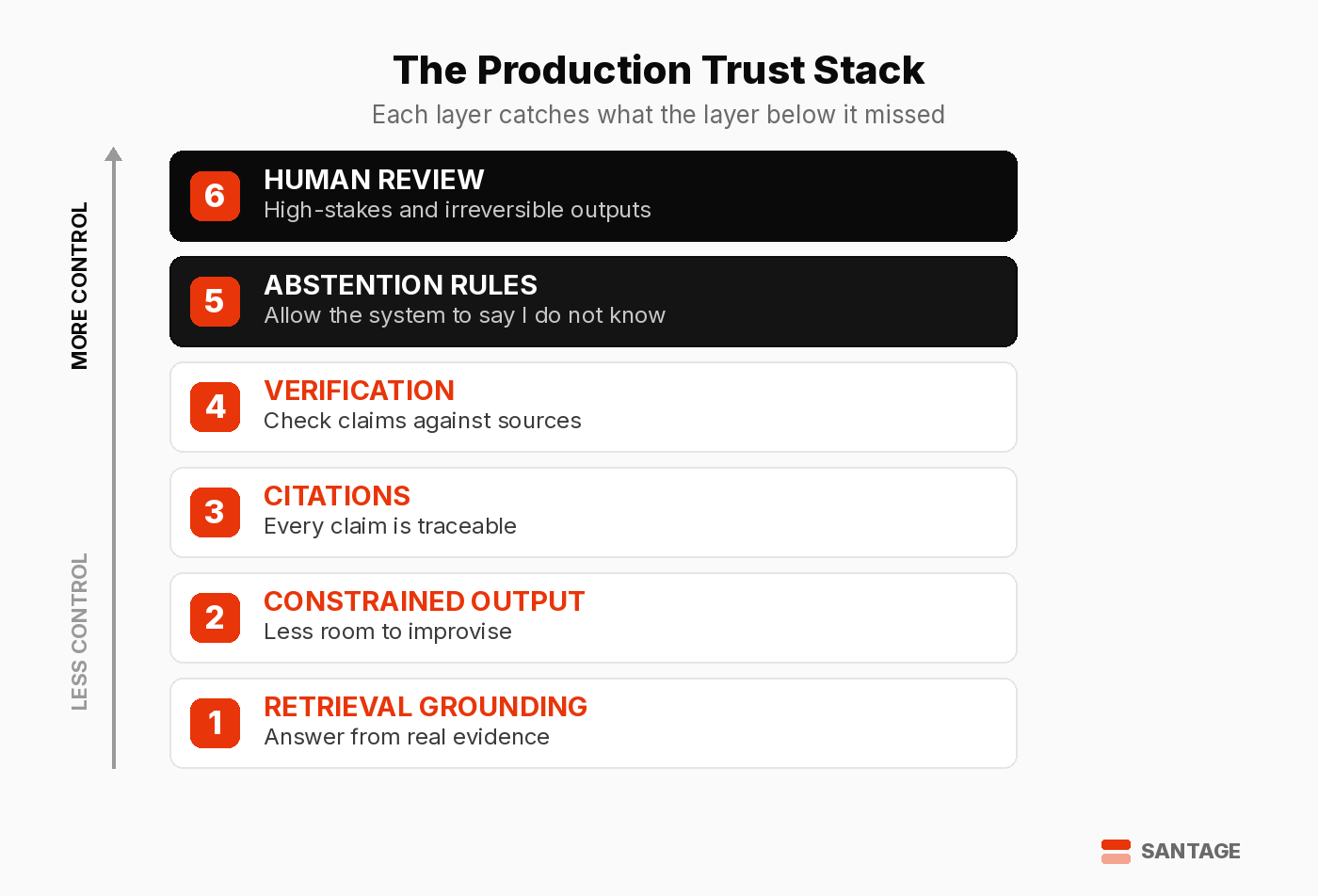
On reduction, the effective controls stack in a predictable order.
- Ground the model with retrieval so it has real evidence instead of relying on memory.
- Constrain the output format so the model has less room to improvise.
- Require citations so every claim is traceable and checkable.
- Add a verification layer, whether a second model, a rule set, or a tool, that checks claims against sources before the answer reaches the user.
- Set confidence thresholds and abstention rules so the system is allowed to say it does not know instead of being forced to guess.
- Route high-stakes or irreversible outputs through human review.
The governing principle behind all of these is the one OpenAI's research points at: the system has to make honesty score better than confident guessing, both in how it is evaluated and in how it behaves. The mental shift that separates mature teams from beginners is that they design for the model being wrong. They assume some percentage of outputs will be hallucinated and they build the checks, the citations, and the human gates that make those hallucinations visible and containable before they reach a decision.
Which AI models hallucinate more, and does reasoning fix it?
The intuitive assumption is that a bigger, smarter, more capable model hallucinates less. The evidence is more complicated, and one finding in particular surprised even the labs that produced it.
More capable models generally do reduce hallucination on grounded tasks, and reasoning, where the model works through a problem step by step, tends to help when the answer can be checked against evidence. OpenAI notes that its GPT-5 generation has meaningfully fewer hallucinations, especially when reasoning is engaged.
But reasoning is not a universal cure, and on pure factual recall it can make things worse. In OpenAI's own o3 and o4-mini system card, the o3 reasoning model hallucinated on 33% of a person-facts benchmark, roughly double the 16% rate of the earlier o1, and o4-mini reached 48%. OpenAI's tentative explanation is that these models make more claims overall, which produces more accurate claims and more inaccurate ones at the same time. A model that says more, and abstains less, will hallucinate more even as its raw intelligence rises. This is the reasoning-model paradox: the capability that helps a model solve hard problems can also make it a more prolific and more convincing fabricator when it is out of its depth.
The practical takeaway is that which model hallucinates less has no single answer, because it depends on the task and on how the model is graded. A model tuned to abstain will look worse on an accuracy leaderboard and be safer in production. A model tuned to always answer will top the leaderboard and be more dangerous in a courtroom. Benchmark performance and production reliability are not the same thing, and the headline number depends heavily on how the benchmark was designed.
A hallucinating model is a confident student who never learned to say I do not know. Ask it something it studied and it answers correctly. Ask it something it never learned and it does not go quiet, it produces an answer in the same steady voice, because the one thing it was never rewarded for is admitting the gap.
What are the limits and open questions?
Hallucinations cannot be fully eliminated with today's systems, and it is worth being precise about why. Technically, models still generate from probability rather than from direct access to truth, retrieval can return wrong or incomplete evidence, grounding can still be misread, and confidence estimation remains imperfect. OpenAI's own framing is that accuracy will never reach 100%, because some real-world questions are genuinely unanswerable from available information. A system that never hallucinates would have to know exactly where its knowledge ends, every time, which is a harder problem than being smart.
Commercially, every layer of verification adds latency and cost, stronger controls reduce the fluidity users enjoy, and human review does not scale to every output. On governance, high-stakes domains now face real accountability questions, with courts already assigning liability for AI-generated falsehoods and regulators beginning to treat confident misinformation as a compliance and AI safety issue rather than a technical curiosity. Scientifically, the field still does not fully know how to make models express uncertainty as reliably as they express confidence.
Those constraints define the open research agenda. How do you detect hallucinations reliably and at scale, rather than after the fact. How do you cleanly distinguish genuine uncertainty from fabrication inside the model. How do you improve faithfulness to sources, not just answer quality. How do you make models abstain intelligently instead of either always answering or refusing too much. How do you evaluate hallucination in multi-step AI agents that chain many calls together, where a single early fabrication can propagate through an entire workflow. And can architectures be designed to suppress hallucination at the representation level rather than only patching it after generation.
The strategic picture behind all of this is a contest over trust. As AI moves further into infrastructure, systems will be judged less on raw intelligence and more on whether people can rely on them under real conditions. The winners are the teams that add grounding, verification, and honest uncertainty, and that make abstention a first-class behavior. The exposed are chat-only products that treat fluent output as final truth and cannot explain or justify a single claim. Once users come to expect grounded, checkable answers, generation alone stops being enough.
AI hallucination is the price of fluency in systems that were optimized to sound right rather than to be right. It will not be solved by making models a little bigger. It will be managed by systems that know when to answer, know how to ground the answer, and know when to say nothing at all.
Frequently asked questions
Sources and further reading
- Kalai, A., Nachum, O., Vempala, S. et al. Why Language Models Hallucinate. OpenAI, September 2025. arxiv.org/abs/2509.04664
- OpenAI. Why language models hallucinate. September 2025. openai.com
- OpenAI. OpenAI o3 and o4-mini System Card. April 2025. openai.com
- Stanford HAI. 2026 AI Index Report: Responsible AI. 2026. hai.stanford.edu
- Magesh, V., Surani, F., Dahl, M. et al. Hallucination-Free? Assessing the Reliability of Leading AI Legal Research Tools. Stanford RegLab and HAI. hai.stanford.edu
- Charlotin, D. AI Hallucination Cases Database. 2025 to 2026. damiencharlotin.com
- Mata v. Avianca, Inc. U.S. District Court, Southern District of New York. 2023. en.wikipedia.org
- Moffatt v. Air Canada. British Columbia Civil Resolution Tribunal. 2024. americanbar.org
- McKinsey & Company. The State of AI in 2025. 2025. mckinsey.com
- Zhang, Y. et al. Toward Faithful Retrieval-Augmented Generation with Sparse Autoencoders. arXiv, December 2025. arxiv.org/abs/2512.08892