

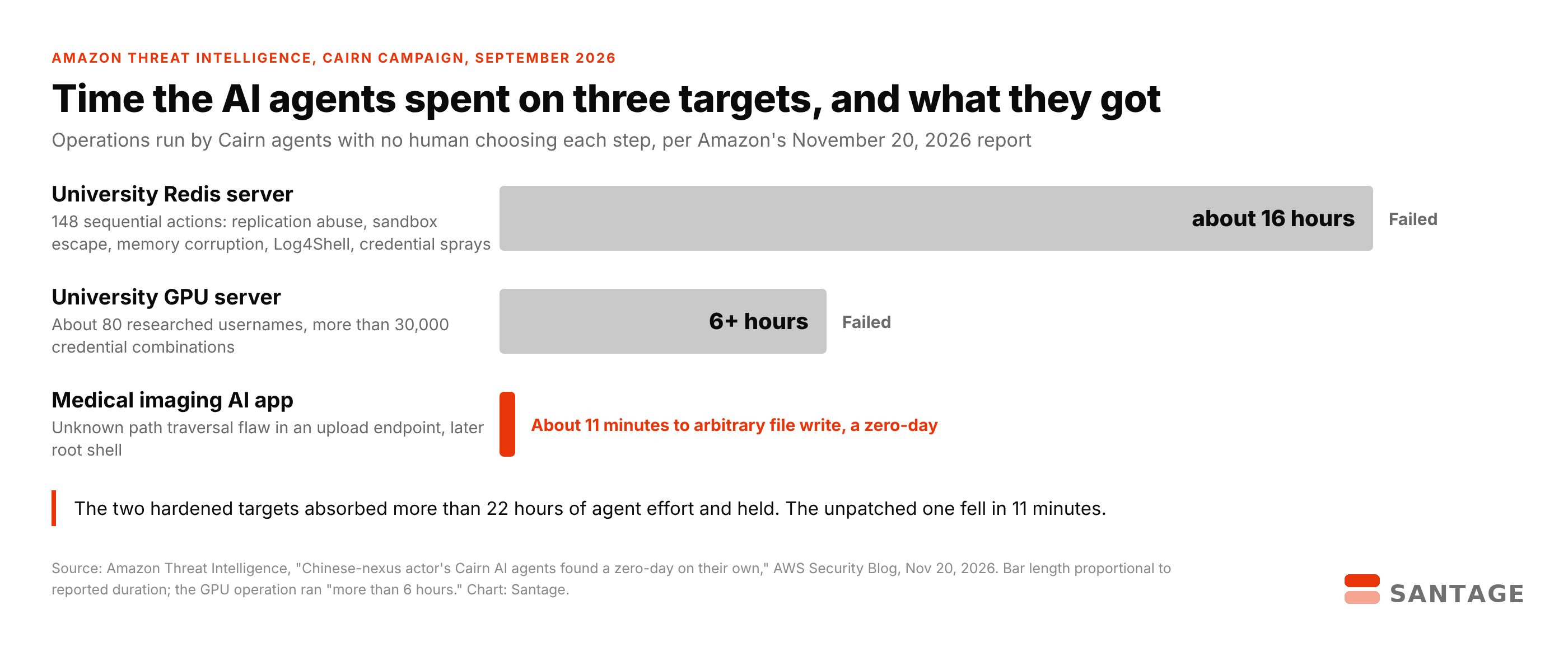
- Amazon Threat Intelligence says a China-linked actor told agents running on the open-source Cairn framework to "obtain shell access," and the agents found an unknown path traversal flaw in a medical imaging AI application, reaching arbitrary file write in about 11 minutes and later a root shell.
- The same agents spent about 16 hours and 148 actions on one hardened university server, and more than 30,000 credential combinations on another, without breaking in.
- A matching critical advisory for MONAI Label, published November 18 and credited to an AWS disclosure, listed no patched release when Santage checked on November 22.
AI hacking agents have crossed from exploiting known flaws to discovering new ones on their own, and the case Amazon published on November 20 shows the decisive gap in AI-era security now sits between the minutes an agent needs to find a bug and the days a project needs to ship the fix.
Cairn agents turned a one-line goal into a root shell
Amazon found the operation by accident. On September 10 its analysts came across a publicly hosted Cairn server left running without authentication, which exposed the operator's prompts, configurations and the agents' own output. The prompts were in Simplified Chinese, scripts used China Standard Time, and the targets were universities in East Asia outside mainland China during a roughly 48-hour campaign starting September 8. Amazon attributes the activity with moderate confidence to a Chinese-nexus actor.
Cairn is an open-source system that coordinates several AI workers toward a goal stated in plain language, and its GitHub page describes it as validated first on autonomous penetration testing. The operator supplied IP addresses and a goal. The agentic AI system chose every step after that.
"In about 11 minutes, the agents went from mapping the application's API to arbitrarily writing files on the server."
Amazon Threat Intelligence, AWS Security Blog, November 20, 2026
In a later session the agents wrote a Python reverse shell into sitecustomize.py, a file Python loads at startup, then called the application's training endpoint to launch a fresh process, which handed them a shell running as root. The operator then stepped in, gave the agents a tunnel into a second university running the same software, and pointed them at the rest of that network.
Failed operations reveal the agents' persistence
The operations that failed say as much as the one that succeeded. Against a university Redis database open without a password, the agents worked through replication abuse, sandbox escapes, configuration writes and memory corruption, tried Log4Shell on a neighbouring service, mapped the internal Docker network through a server-side request forgery flaw, and sprayed credentials at PostgreSQL and SSH, all across about 16 hours and 148 sequential actions. Against a GPU cluster they first built a list of about 80 real usernames from faculty pages, archived sites and academic papers, then tried more than 30,000 credential combinations over six hours.
| ~11 min | From API mapping to arbitrary file write |
| 148 | Sequential agent actions against one Redis server |
| 30,000+ | Credential combinations tried on a GPU server |
| 5.7k | GitHub stars on the open-source Cairn project |
Amazon's own conclusion is about tempo. An agent that finds and exploits a new flaw in minutes finishes before many security teams have triaged the first alert, and one that runs for 16 hours never tires or clocks off. The company recommends high-confidence detections wired to automated response, with people supervising outcomes.
Finding a new bug used to be the slow, expensive step in an attack. Cairn made it the fast one, so the slowest step left in the system is now the defender's release cycle.
The fix existed before the patch did
Amazon does not name the medical imaging software, and says it notified the maintainers, who released a fix and an advisory. A critical GitHub advisory for MONAI Label, the annotation server in the open-source MONAI medical imaging project, matches the description closely. Published on November 18 and noting the flaw was originally reported by an AWS vulnerability disclosure account, the advisory describes a path traversal in datastore upload endpoints that allows arbitrary file writes. It adds that authentication is off by default, so any client that can reach the server can exploit it. The code fix is merged, yet the advisory lists every version up to 0.8.5 as affected, names no patched release, and says the fix will arrive in the next one.
That sequence is the story's real lesson. Discovery took 11 minutes, the advisory came about ten weeks after Amazon saw the attack, and on November 22 users installing from the package index still had no fixed version to download. Santage tracked the same gap in October, when AI-found PHP flaws were exploited four days before the patch. Research AI tools such as MONAI often run on university and hospital networks with default settings, which makes them easy prey for a system that tries every endpoint. Until a release ships, the advisory's workarounds are the practical defence: switch on MONAI Label's authentication setting, keep the server off untrusted networks, and run it as an unprivileged user that can write only to its own datastore.
| Date (2026) | Primary source | What it documented |
|---|---|---|
| Sep 22 | Gambit Security | A financially motivated actor ran Cairn with other open-source agents against online retailers |
| Nov 12 | Palo Alto Networks Unit 42 | 25 Cairn operations against 19+ organizations, 10 confirmed breaches, run on Zhipu GLM 5.2 and DeepSeek V4 |
| Nov 13 | Amazon Threat Intelligence | Decoy sensors captured ARTEX agents hunting AI API keys from Oct 3 to Nov 5 |
| Nov 20 | Amazon Threat Intelligence | Cairn agents discover and exploit a zero-day on their own |
Source: Gambit Security, Sep 22; Palo Alto Networks Unit 42, Nov 12; Amazon Threat Intelligence, Nov 13 and Nov 20, 2026. Table: Santage.
Open-source attack agents now spread faster than defences
Cairn was built for defenders, and its popularity shows how fast dual-use agent tools travel. Its GitHub repository showed about 5,700 stars and 1,200 forks on November 22, and Unit 42 reported a customized fork driving the espionage operations it tracked, run on open-weights Chinese models. The same week, the European Commission confirmed it had been hit by an AI-generated attack built on ARTEX, and Dragos reported tracking 2 million attacker AI prompts. Unit 42 concluded only ten days earlier that autonomy was raising the volume and reach of attacks while the exploits themselves stayed simple. Amazon's case moves that line, because finding a previously unknown flaw is exactly the kind of skilled work the agents were assumed to lack. The common thread is a multi-agent system that needs only a target and a sentence.
Hardened systems held against 22 hours of tireless machine effort, which is the encouraging half of Amazon's report. The worrying half is that an unpatched application with default settings lasted 11 minutes, and the fix for it was still waiting for a release more than two months later. Defenders who want to keep pace with autonomous attackers will have to ship patches, and switch on authentication, at something closer to machine speed.
Santage is committed to independent, transparent journalism. This article is produced in accordance with Santage's Editorial Standards and aims to provide accurate and timely information. Readers are encouraged to verify information independently.