

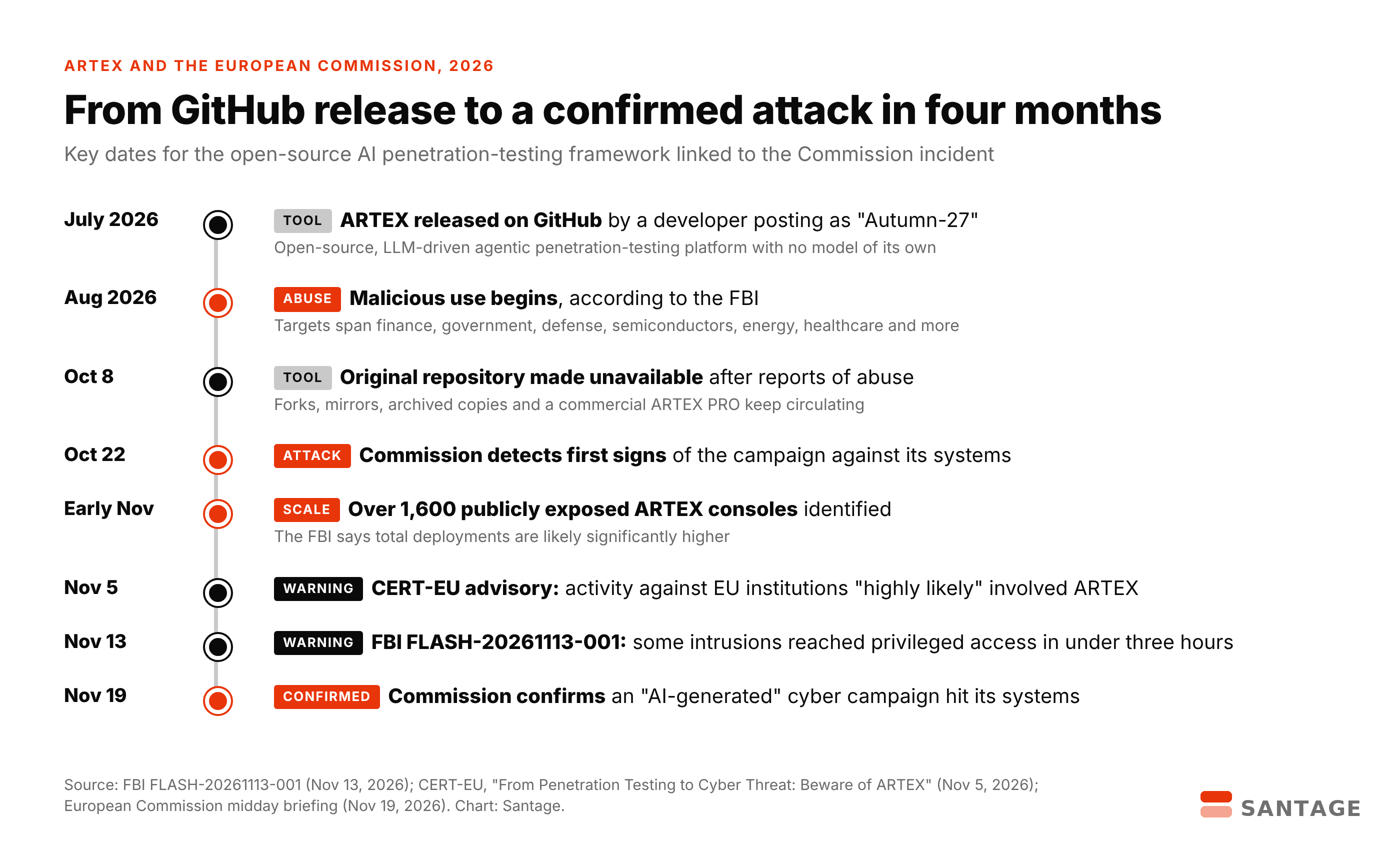
- The Commission says it detected the campaign on October 22. Staff systems for payroll, leave requests, medical reimbursements and translation were reportedly disrupted for more than 10 days, and the investigation remains open.
- CERT-EU warned on November 5 that AI-driven activity against EU institutions "highly likely" involved ARTEX, and an FBI alert on November 13 counted more than 1,600 publicly exposed ARTEX consoles, with some intrusions reaching privileged access in under three hours.
- ARTEX ships with no model of its own. The FBI says DeepSeek Flash models dominate attacker usage, while the tool also connects to Claude, GPT, GLM, Grok and Kimi, so safeguards inside any single model cannot switch it off.
The European Commission confirmed on November 19 that an AI-generated cyber campaign hit its internal systems in October, making the EU's executive the most prominent known victim of intrusions that European and American cyber agencies have tied to ARTEX, a free, open-source framework that lets an attacker connect a commercial AI model to a network and let it hunt for weaknesses with little human effort.
The European Commission confirmed an AI-generated campaign against its staff systems
Commission spokesperson Thomas Regnier told the November 19 midday briefing that the first signs of the campaign appeared on October 22, and described it as an AI-generated cyber campaign without naming the tool or the attackers. The Commission took several applications offline as a precaution and said it was checking other systems preventively. The affected services, as reported, include Sysper, the human resources platform, and MyPMO, the application staff use to claim medical reimbursements, along with payroll, leave requests and translation tools. Both were restored earlier this week. The Commission says it has found no evidence of a breach affecting staff data broadly, knows of no ransom demand, has notified affected individuals and is working with CERT-EU and the European Data Protection Supervisor. It is the institution's third disclosed cyber incident of 2026.
The tool attribution comes from the EU's own cyber agency. In an advisory published on November 5, CERT-EU said it had seen several threat actors worldwide use ARTEX to automate campaigns and had observed similar AI-driven activity against its constituency, the EU institutions, which "highly likely" involved the framework.
ARTEX turns any commercial AI model into an intrusion operator
ARTEX takes a security objective written in plain language, breaks it into goals and hands them to one or more AI agents that run real reconnaissance and exploitation tools, while a human operator watches a dashboard with an approval queue. A developer posting as "Autumn-27" released it on GitHub in July as a penetration-testing aid. The original repository went offline on October 8 after reports of abuse, but forks, mirrors, archived copies and a commercial edition called ARTEX PRO keep it in circulation.
The FBI's FLASH alert puts numbers on the spread. Malicious actors have used ARTEX since at least August against targets in banking, government, defense, semiconductors, energy, healthcare, manufacturing, telecommunications and legal services. Researchers had found more than 1,600 publicly exposed ARTEX consoles by early November, and the bureau says real deployments are likely far higher once systems behind firewalls are counted. Documented victims include South Korean financial institutions, where personal data on about 67,000 people was taken, and a supply-chain compromise of ConnectWise Cloud Backup that produced attempted sign-ins to more than 2,250 downstream customer tenants.
| Oct 22 | Commission detects the campaign |
| 1,600+ | Exposed ARTEX consoles, early November |
| <3 hrs | Fastest intrusions to privileged access |
| 67,000 | People whose data was taken from Korean banks |
Low-severity misconfigurations became the main attack surface
The most consequential line in CERT-EU's advisory concerns what ARTEX is good at. It works through large numbers of low-complexity misconfigurations that a human tester might skip for lack of time, and it runs long attack chains without the fatigue that limits manual work. That changes the economics of every security team that triages by severity. A scan finding rated "low" used to sit in the backlog because exploiting it alone gained little and chaining it with five others took a skilled person days. An agent that never tires can attempt those chains across hundreds of targets at once.
The tool "relies on configurable rules and the model itself to respect scope and avoid destructive actions;" and "there is no hard technical enforcement."
CERT-EU, advisory on ARTEX, November 5, 2026
CERT-EU's guidance reflects that shift directly. Alongside familiar advice on patching and multi-factor authentication, it tells defenders to fix every finding, including minor ones, so that AI tooling cannot chain them into higher-impact attacks.
| Horizon | What CERT-EU tells defenders to do |
|---|---|
| Immediate | Cut internet exposure to what must be online, isolate management panels, patch internet-facing assets first, watch admin accounts |
| Short term | Enforce multi-factor authentication on critical systems, hunt for ARTEX-style automated scanning in logs, use EDR to block privilege escalation |
| Ongoing | Remediate all findings including minor ones, extend monitoring to AI tools, test internet-facing systems with trusted AI-assisted tools |
Source: CERT-EU advisory on ARTEX, Nov 5, 2026. Table: Santage.
When an AI agent can chain a dozen low-severity findings in an afternoon, the backlog a security team parked last quarter becomes this quarter's attack path.
Model safeguards cannot block a framework that brings its own model
Because ARTEX connects to whichever model its operator supplies, the refusals that AI labs build into their systems protect only the users who choose a guarded model. The FBI says Chinese-origin models are the most common in attacker-controlled instances, with DeepSeek Flash models dominating because of their capability, low cost and lack of observable guardrails when a request is framed as penetration testing. That places the burden on network defenders and on the providers whose APIs ARTEX calls, which the FBI suggests watching through outbound connections to model endpoints. Santage's report on federal testers bypassing four chatbots' safeguards within 12 hours showed how thin model-level protection can be even when attackers use the guarded models, and our explainer on AI safety covers why those controls remain one layer among several.
Europe's cyber and AI plan now faces a test inside the Commission
In July the Commission presented an Action Plan on Cybersecurity and Artificial Intelligence that asked public bodies to start using AI to prevent and respond to attacks, with ENISA defining structured access to advanced models for defenders. The October incident turns that plan into an operational question for the Commission's own IT estate. The commercial side of the market is moving in the same direction: a day before the confirmation, Palo Alto Networks agreed to buy model-training startup Applied Compute to bring frontier AI into its security products.
The lasting significance of the Commission incident lies in the attacker's tooling, since investigators say the data taken so far appears limited. A free tool released in July, driven by whichever commercial model an attacker prefers, kept the EU executive's HR and medical systems disrupted for more than ten days, and the agencies tracking it say the number of running copies is still growing. Security teams that rank vulnerabilities by individual severity are now defending against software that judges them by how well they combine.
Santage is committed to independent, transparent journalism. This article is produced in accordance with Santage's Editorial Standards and aims to provide accurate and timely information. Readers are encouraged to verify information independently.