
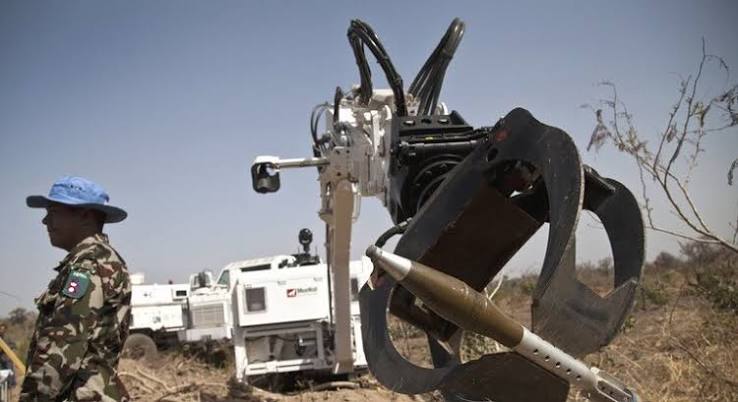
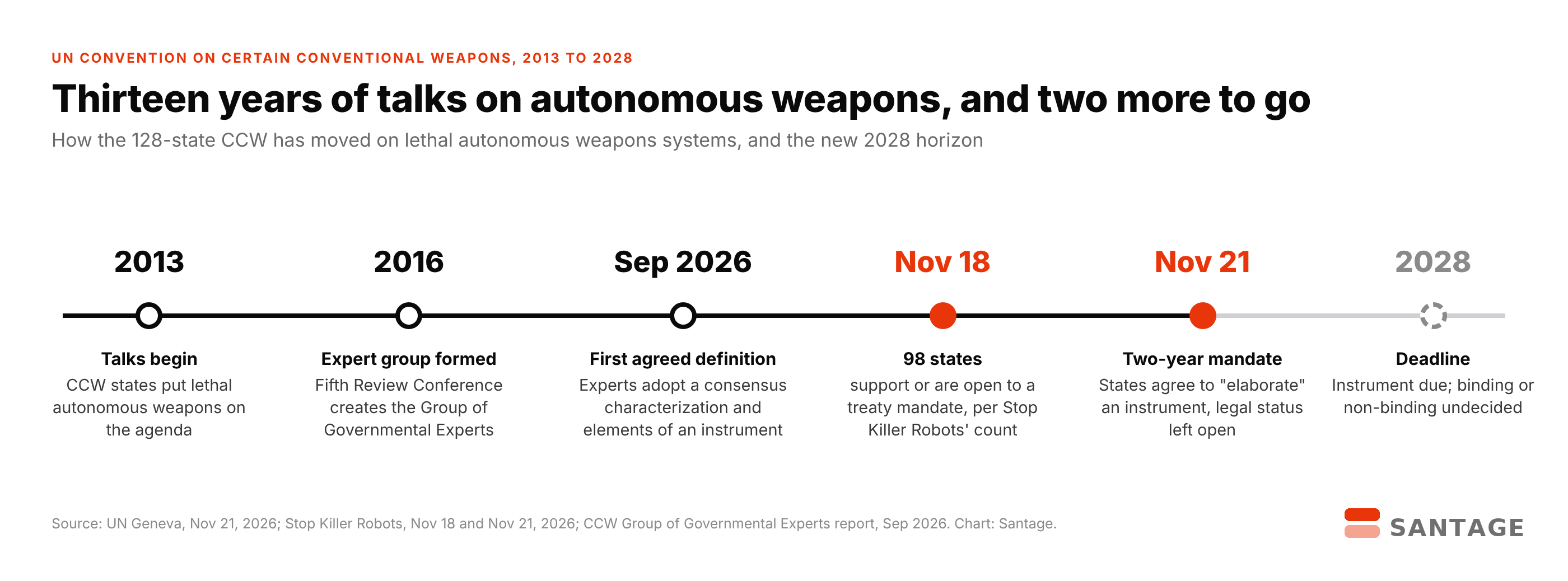
- The Seventh Review Conference of the Convention on Certain Conventional Weapons closed on November 21 with a mandate to "elaborate" an international instrument on lethal autonomous weapons systems over two years, ending in 2028.
- Stop Killer Robots counted 98 states that supported or were open to negotiating a protocol at mid-week, yet the final text leaves the legal status of the 2028 instrument undecided.
- The convention works by consensus, so a handful of states could narrow the outcome after 13 years of discussion, while AI targeting tools are already in use on battlefields.
The 128 countries that belong to the UN's main conventional weapons treaty agreed in Geneva early on Saturday to spend the next two years drafting rules for weapons that use AI to pick and strike targets without a human decision, after a week of talks that ended without the binding treaty mandate most participating states had asked for.
The CCW mandate sets a two-year drafting process ending in 2028
The conference ran from November 16 and finished after all-night negotiations in the early hours of November 21. United Nations Geneva announced the result on its official account.
The word "elaborate" is the compromise. A negotiating mandate would have committed states to produce a legally binding protocol, the outcome sought by UN Secretary-General António Guterres and the International Committee of the Red Cross. The adopted wording lets the process end in either a treaty or non-binding guidance. Because the convention decides by consensus, a small group of military powers was able to hold the text there, with the United States, Russia and Israel named in reporting as the main opponents of a binding track.
| 128 | States party to the CCW that adopted the mandate |
| 98 | States backing or open to a treaty mandate at mid-week |
| 2 years | To draft an instrument, ending in 2028 |
| 13 years | Of CCW discussion before this mandate |
Treaty supporters say AI targeting is moving faster than the rules
The campaign coalition that tracked statements all week called the result a setback. Its Geneva statement says a small number of states weakened the mandate in the final hours and asks for a binding protocol that bans systems which target people or escape meaningful human control. The coalition also wants positive obligations on every other system, such as limits on the area and duration of its use. Human Rights Watch, quoted in the same statement, noted that 163 countries had voted for a UN General Assembly resolution backing binding rules before the conference began.
"Autonomous weapons technology, including AI in the targeting cycle, is being deployed on the battlefield."
Nicole van Rooijen, Executive Director, Stop Killer Robots, statement, November 21, 2026
The UN's human rights office had made the same case before the talks opened.
The AI industry now has a two-year window on military autonomy
For companies building autonomous agents and targeting software, the outcome extends a period with no specific international rule on how much human judgment a weapon must keep. September's expert report gave states their first agreed characterization of these systems, and that definition will anchor the drafting. National policy will fill the gap until 2028, as it already has in the US, where the Pentagon's dispute with Anthropic over model guardrails reached the courts, and in Ukraine, where drone warfare has hit AI compute sites directly. Today's analysis of AI agents finding a zero-day in 11 minutes shows how quickly autonomous systems now act in the cyber domain, which the CCW does not cover.
Geneva produced a deadline and left the content open. Whether the 2028 text binds anyone will depend on the same consensus rule that softened this week's mandate, which gives the most capable military AI developers the strongest hand in writing the rules that would govern them.
Santage is committed to independent, transparent journalism. This article is produced in accordance with Santage's Editorial Standards and aims to provide accurate and timely information. Readers are encouraged to verify information independently.