

- Between July and November 2026, Dragos sent roughly 2 million prompts carrying unique fake AWS keys, SSH passwords and private links to widely used AI services, then logged every attempt to use them.
- Seeded secrets from at least 3 AI providers were used against Dragos test systems, some within hours, and none of the providers knew of the breach until Dragos told them. The providers are not named.
- Separately, sellers on an inference marketplace kept customer prompts through ordinary logging, and one Chinese AI lab fetched secret links from more than half the prompts sent to its models, including about two-thirds of requests flagged for no data retention.
Data sent to at least three AI model providers was stolen and used by attackers this year, according to a five-month study in which the industrial security firm Dragos seeded about two million AI prompts with fake credentials and watched where each one resurfaced.
Dragos seeded 2 million AI prompts with traceable fake secrets
The study, written by Dragos chief research officer HD Moore and published on November 19, works like a dye test for the AI supply chain. Each prompt carried a secret that existed nowhere else, so when an attacker tried a key or opened a link, Dragos could trace it back to the exact request, the date and the route it took to a model.
The most serious finding involves providers that were breached without knowing it. In the largest case, a couple of hundred AWS keys sent to one provider in a few late-October windows were all stolen, including requests the provider rejected before any model ran, which points to copying at the provider's front door. Some stolen requests had been marked Zero Data Retention. Attackers made tens of thousands of AWS API calls with the stolen keys, and one key seeded on October 21 was first used the next day and was still in use three weeks later. On November 1 the attacker added ARTEX, the open-source AI intrusion tool behind the European Commission incident Santage reported yesterday.
| ~2M | Seeded prompts, July to November 2026 |
| 3+ | AI providers whose data was stolen |
| Hours | Fastest time from prompt to key being tested |
| ~2/3 | "No retention" requests one Chinese lab still scraped |
Resellers and scrapers leaked prompts without any hack
Two other leak paths required no break-in at all. On one inference marketplace, sellers listed models at low prices, switched on logging and collected what customers sent; Dragos found the leak followed the individual seller, since prompts routed through other sellers were never touched. In one case a person in France used passwords from two prompts to try root SSH logins by hand. The study also found an unnamed Chinese lab fetching secret URLs from more than half of the prompts sent to its models between July and October, and several US hosting providers that resell that lab's models triggered the same scraper.
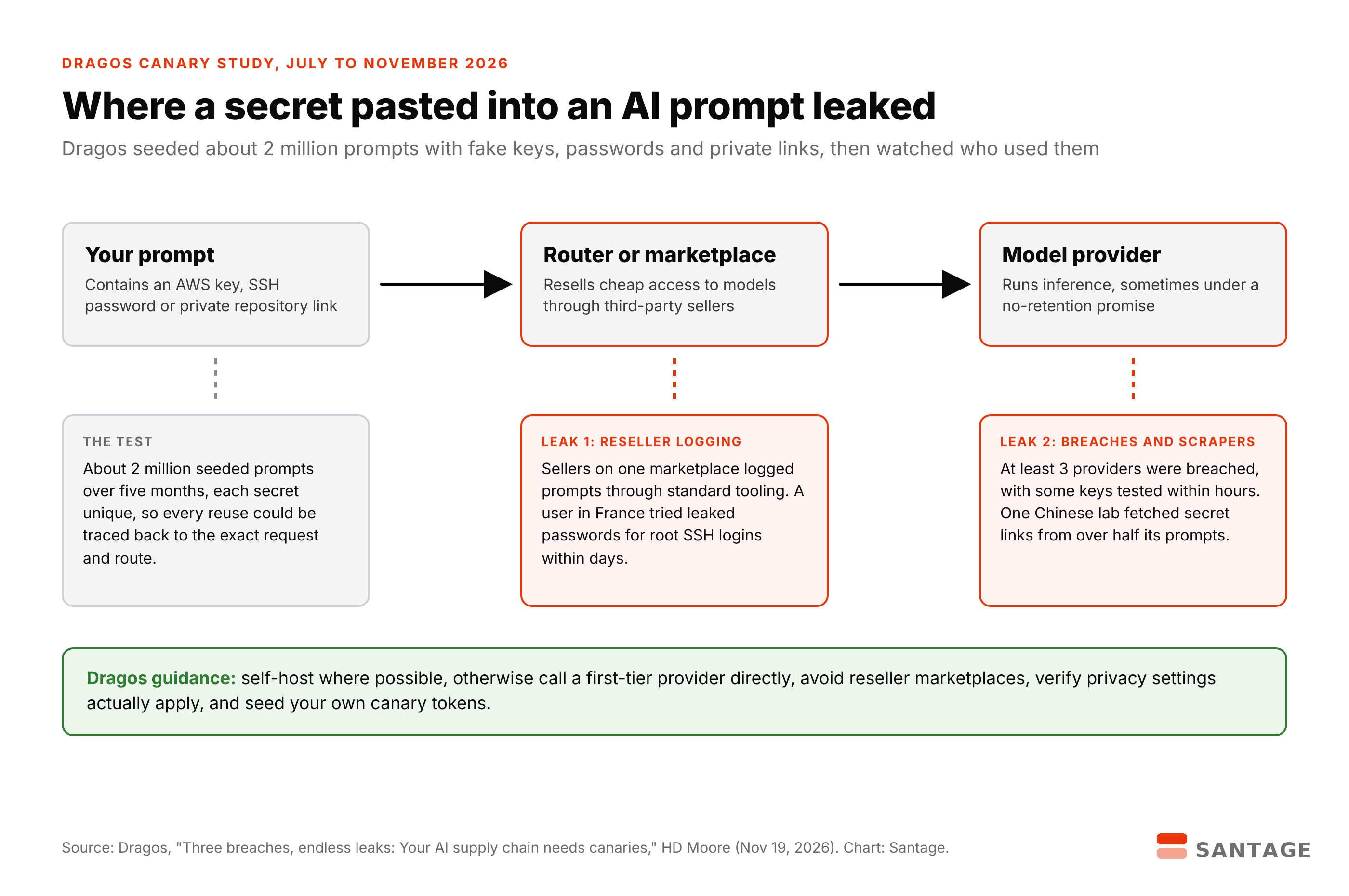
| Dragos recommendation | What it means in practice |
|---|---|
| Self-host where affordable | The only setup where no third party reads prompts |
| Use a first-tier provider directly | One contract and one privacy policy to enforce |
| Choose router upstreams yourself | Avoid reseller marketplaces and confirm privacy flags apply |
| Seed your own canaries | Treat any use of a planted token as an incident |
| Turn on secret filtering | Helpful, though it misses some sensitive data |
Source: Dragos, Nov 19, 2026. Table: Santage, condensed.
The study turns a compliance checkbox into a measurable risk. Privacy flags, zero-retention promises and provider policies are only as strong as every company on the route to the model, and Dragos traced about 2,000 such routes, several hundred of which passed through a system nobody had advertised. For companies building on AI inference through routers and resellers, the practical conclusion is that any credential placed in a prompt should be treated as already shared, and the cheapest token price on a marketplace can carry the highest cost.
Santage is committed to independent, transparent journalism. This article is produced in accordance with Santage's Editorial Standards and aims to provide accurate and timely information. Readers are encouraged to verify information independently.