
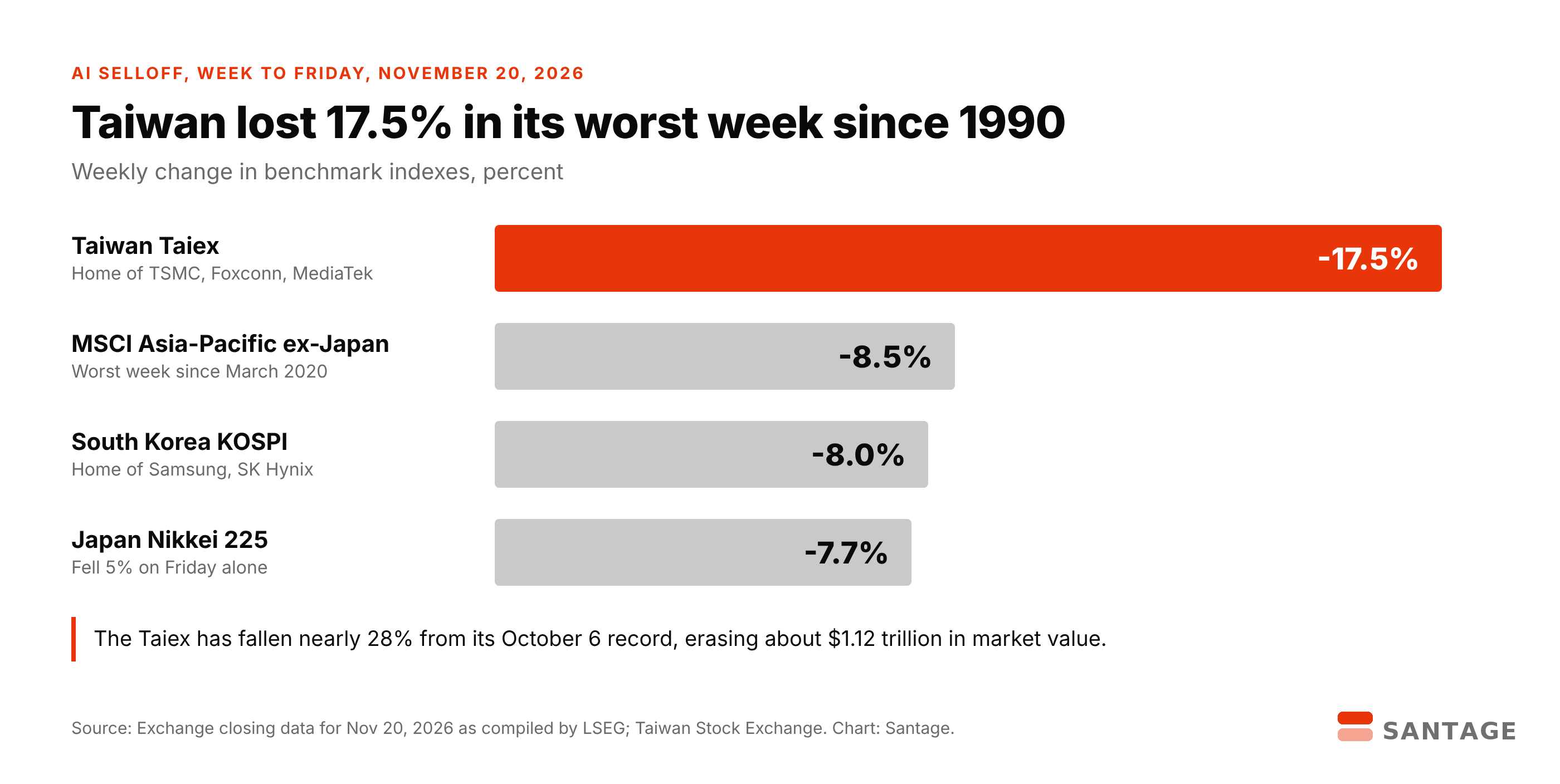
- The Taiex has fallen nearly 28% from its October 6 record, erasing about $1.12 trillion in value, and South Korea's KOSPI and Japan's Nikkei lost 8.0% and 7.7% this week.
- On Thursday the S&P 500 fell 2.02% for a sixth straight loss, Nvidia dropped 3.3% and AMD 7.7%, while Anthropic opened at $111.50 and closed at $97.17, 17% above its $83 IPO price.
- The split points to a rotation inside AI: investors paid up for direct ownership of a frontier lab while selling the hardware suppliers whose revenue depends on that lab's spending continuing.
Taiwan's benchmark Taiex fell 6.2% on Friday to close out a 17.5% weekly drop, its steepest five-day decline since 1990, as investors around the world sold the chipmakers and server builders behind the AI boom in the same week they bid up Anthropic's record stock market debut.
Taiwan led a week of AI losses across Asia
The heaviest selling landed where AI hardware is made. Taiwan is home to TSMC, which manufactures most advanced AI chips, and to Foxconn and the other contract manufacturers that assemble AI servers. Friday's 6.2% fall took the Taiwan Stock Exchange benchmark to its lowest close since mid-April, with TSMC down about 6% on the day and MediaTek down nearly 10%. In Seoul, memory makers SK Hynix and Samsung Electronics each lost about 7% on Friday, dragging the KOSPI down 5.2%. MSCI's broadest index of Asia-Pacific shares outside Japan lost 8.5% over the week, its worst run since March 2020.
Taiwanese regulators had already tried to slow the slide. On November 6 the Financial Supervisory Commission cut the daily limit on intraday short sales of borrowed shares to 3% of a stock's 30-day average volume, down from 30%, and raised the minimum short-sale margin to 130%, effective November 9. Officials also said a NT$500 billion stock stabilization fund stood ready to buy shares if needed. Those steps did little to slow this week's losses, which hit foreign-held technology names hardest and weakened regional currencies as overseas funds withdrew money.
| -17.5% | Taiex this week, worst since 1990 |
| $1.12T | Taiex value lost since October 6 |
| -8.5% | MSCI Asia-Pacific ex-Japan, worst week since 2020 |
| +17% | Anthropic's first-day gain on Nasdaq |
Anthropic's debut lifted Anthropic and nothing else
Anthropic began trading on Thursday under the ticker ANT, as Nasdaq had scheduled, a day after pricing its IPO at $83 and raising a record $81.3 billion. The first trade came at $111.50, briefly valuing the company near $2 trillion on a fully diluted basis, before the stock settled at $97.17 at the close, about $1.76 trillion. Many investors had expected the listing to restart momentum across AI stocks. US indexes rose early and then reversed hard.
| US market, Thursday Nov 19 | Move |
|---|---|
| Anthropic (ANT), first day | Closed at $97.17, up 17.1% from its $83 IPO price |
| S&P 500 | Down 2.02% to 7,175.83, a sixth straight loss |
| Nasdaq Composite | Down 2.25% to 23,879.20 |
| Philadelphia Semiconductor Index | Down 2.4% |
| Nvidia | Down 3.3% to $145.98, a sixth straight loss |
| AMD | Down 7.7% |
Source: Nasdaq and exchange closing data, Nov 19, 2026. Table: Santage.
Retail brokers reported clients selling individual AI stocks to fund Anthropic purchases, with AMD and Nvidia among the names sold. AMD also fell after a short seller published a report about its China business, which AMD disputes. Nvidia closed lower for a sixth day even after beating revenue forecasts on Tuesday, the first results since Jensen Huang's resignation, and it told analysts its guidance now assumes no licensed data center chip sales to China.
Anthropic's chip suppliers gained on its stock while losing on their own
The sharpest illustration of the split sits in Anthropic's final prospectus. Alongside the IPO, seven suppliers agreed to buy $26 billion of non-voting Class N stock at the $83 offer price, and several of them are the companies investors sold this week. At Thursday's $97.17 close, the stakes they committed to are worth about 17% more on paper.
| Supplier | Commitment at $83 | Value at $97.17 close |
|---|---|---|
| Nvidia | $10.0 billion | $11.71 billion |
| AMD | $2.5 billion | $2.93 billion |
| Broadcom | $1.0 billion | $1.17 billion |
| Micron | $1.0 billion | $1.17 billion |
| TSMC | $0.5 billion | $0.59 billion |
Source: Anthropic, PBC Form 424B4, Nov 18, 2026, for share counts; values are Santage arithmetic at the Nov 19 close. Table: Santage.
Nvidia's roughly $1.7 billion paper gain on its Anthropic position arrived on a day its own shares lost 3.3%, and AMD's gain of about $430 million came as its stock fell 7.7%. The suppliers are partly hedged against the rotation they are suffering from, because the cash they put into Anthropic flows back to them as orders for chips, memory and manufacturing capacity, and the equity they received in return is the asset the market currently prefers.
Investors spent the week buying the AI lab and selling its suppliers, which is a bet that model makers capture the returns while the hardware chain carries the spending risk.
Markets now want proof that AI spending pays
Several pressures converged on the hardware trade at once. Fed funds futures now price a quarter-point rate increase next month, the Federal Reserve's own risk survey flagged AI as the top concern among market contacts, and Nvidia faces a leadership transition. Behind all of them sits one question about AI infrastructure: whether the hundreds of billions committed to data centers will earn a return quickly enough to service the debt that funds them. Asia's exchanges answer that question first, because Taiwan and South Korea earn their AI money from capital spending itself.
Nvidia's quarter shows why strong results are failing to steady the trade. The company reported $115.8 billion in revenue for the period ended October 25, ahead of forecasts, and still lost ground every day this week. Interim chief executive Colette Kress told analysts that Nvidia sold $2.4 billion of licensed Hopper data center chips to China in the quarter and that its outlook now assumes none, removing a revenue line that Huang had lobbied Washington to keep open. For TSMC, SK Hynix and Samsung, which supply the wafers and high-bandwidth memory inside those chips, every downgrade in Nvidia's addressable market reaches their order books within a quarter or two, and their share prices moved first.
The week drew a clear line through the AI industry's balance sheet. Public investors gave Anthropic a valuation near $1.76 trillion on its first day while taking roughly $1.12 trillion off Taiwan's market since early October, a sign that money is moving toward the companies that own models and customers and away from the suppliers whose order books depend on those companies spending more each year. The next test for the hardware chain is whether frontier labs flush with IPO cash keep their purchase commitments on schedule.
Santage is committed to independent, transparent journalism. This article is produced in accordance with Santage's Editorial Standards and aims to provide accurate and timely information. Readers are encouraged to verify information independently.