

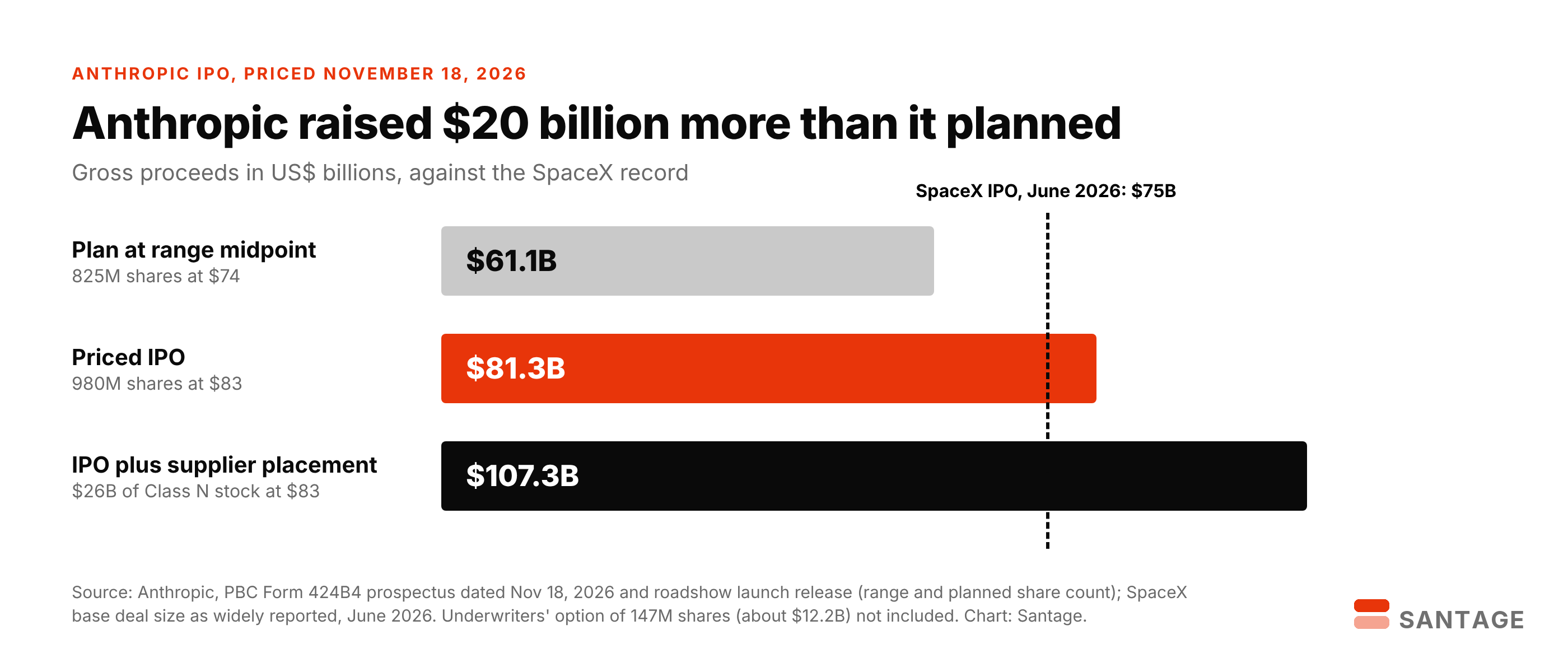
- Anthropic priced at $83, $5 above the top of its $70 to $78 range, and upsized the deal from 825 million to 980 million shares, for gross proceeds of $81.3 billion against SpaceX's $75 billion base deal in June.
- With the $26 billion supplier placement at the same price, Anthropic expects about $104.8 billion in net proceeds, roughly 1.5 times the $70.7 billion of compute commitments due in its next 12 months.
- At $83, Amazon's 14.6% stake is worth about $160.7 billion and Google's 13.4% about $147.3 billion, before Google adds another $10 billion through the placement.
Anthropic sold 980 million shares at $83 on Wednesday evening, above the top of its marketed range and 155 million shares more than it set out to sell, raising $81.3 billion in the largest initial public offering on record during a week when doubts about AI spending were running high on Wall Street.
Anthropic sold 19% more stock than planned, at a higher price
When Anthropic launched its roadshow on November 10, it offered 825 million Class A shares at $70 to $78, a deal worth about $61.1 billion at the midpoint. The final prospectus dated November 18 shows how far demand moved that plan. Anthropic sold 956,351,354 new shares and existing holders sold 23,648,646, a total of 980 million at $83, for $81.34 billion. After a $550 million underwriting discount, Anthropic keeps $78.84 billion and the selling stockholders $1.95 billion. Goldman Sachs and Morgan Stanley led the deal, and the underwriters hold a 30-day option on 147 million more shares, worth about $12.2 billion at the offer price.
| $83 | IPO price, above the $70 to $78 range |
| 980M | Shares sold, up from 825 million |
| $81.3B | Gross proceeds, a record for an IPO |
| $1.10T | Value of all 13.2 billion shares at $83 |
The record came in a hostile week. Nvidia reported its first quarter without founder Jensen Huang on Tuesday, beating forecasts with $115.8 billion in revenue after Huang's resignation had shaken chip stocks, and on Wednesday the Federal Reserve's October minutes opened with a warning about AI-related debt, an echo of the Fed survey Santage covered on Sunday. Pricing above the range against that backdrop is the clearest market verdict yet that investors want direct exposure to a frontier lab, and it lands a week after the company narrowed its price talk to $70 to $78.
Anthropic's suppliers paid the higher price too
The $26 billion concurrent placement of non-voting Class N stock is priced at the IPO price, so the jump to $83 cut the number of shares each of the seven buyers receives. Google and Nvidia, which would have received 135.1 million shares each at the $74 midpoint, now get 120.5 million each for the same $10 billion.
| Placement buyer | Commitment | Class N shares at $83 |
|---|---|---|
| $10.0 billion | 120,481,927 | |
| Nvidia | $10.0 billion | 120,481,927 |
| AMD | $2.5 billion | 30,120,481 |
| Broadcom | $1.0 billion | 12,048,192 |
| Micron | $1.0 billion | 12,048,192 |
| Microsoft | $1.0 billion | 12,048,192 |
| TSMC | $0.5 billion | 6,024,096 |
Source: Anthropic, PBC Form 424B4, Nov 18, 2026. Table: Santage.
Every name on that list sells Anthropic chips, memory, networking or cloud capacity, which means a share of the money flows back to them as revenue. The higher price works in Anthropic's favor on this leg: the same supplier checks now buy a smaller slice of the company.
Anthropic's suppliers bought its stock at the top of the market's appetite, which tells public investors the companies closest to its compute bill see more upside at $83.
Amazon and Google stakes are worth $308 billion at the offer price
The prospectus lists Amazon with 1,936,452,353 Class N shares, 14.6% of total capital stock, and Google with 1,774,959,745, or 13.4%. At $83 those holdings are worth about $160.7 billion and $147.3 billion, before Google's new $10 billion. Both cloud providers report Anthropic gains through their own earnings, so the offer price now sets a public mark for one of the largest paper assets in big tech. The Class N shares and the Long-Term Benefit Trust's Class T share stay off the exchange, and the Founder LLC's Class F stock carries 50.1% of general voting power, so Wednesday's buyers own economics with limited say over the board.
The cash covers 18 months of compute bills
Anthropic estimates net proceeds of about $104.8 billion from the offering and placement combined, or $117.0 billion if the underwriters take their full option, earmarked for compute and infrastructure, staff and possible acquisitions. It already held $95.6 billion in cash and $36.3 billion in short-term investments at September 30, and booked $17.0 billion of revenue in the quarter to that date. The pressure point is the commitment schedule: about $70.7 billion in compute and infrastructure obligations comes due within 12 months, part of roughly $900.9 billion in total. The IPO money covers the next year of those bills about one and a half times over, which buys Anthropic time to grow revenue into a commitment book that remains several times larger than everything it has raised. Readers who want the background on what that spending pays for can start with our explainer on AI infrastructure.
Anthropic's pricing turns the AI boom's biggest private bet into a public number that every supplier, cloud partner and rival will now be measured against. Investors paid $83 a share during a week of chip-sector turmoil and central bank warnings, and the company used that demand to raise roughly 1.5 years of near-term compute commitments in one night, which moves the next test to revenue growth and the commitment schedule now that access to capital is settled for the coming year.
Santage is committed to independent, transparent journalism. This article is produced in accordance with Santage's Editorial Standards and aims to provide accurate and timely information. Readers are encouraged to verify information independently.