

- Chief financial officer Colette Kress becomes interim CEO while keeping the CFO job, and the board named Harvey C. Jones, a former Synopsys CEO, as Nvidia's first-ever board chair.
- Nvidia shares closed at $166.19 on November 12, down 4.34% after falling about 14% intraday, and now sit 31% below their October 6 record of $239.24.
- Kress will present fiscal third-quarter results on November 17 against guidance of $108 billion, which assumes no data center compute revenue from China.
Jensen Huang resigned as president, chief executive and director of Nvidia on November 12, effective immediately, ending 33 years at the head of the company he co-founded and leaving the most important supplier in the AI industry to report a quarter guided at $108 billion with a finance chief as its interim leader.
Nvidia hands a founder-run company to its CFO and its first chair
The board announced the change before the market opened on Thursday in a short release that also went to the SEC. Kress, who joined Nvidia in September 2013 after nearly 25 years in finance roles at Cisco and Microsoft, will run the company and its finance organization at the same time until a permanent successor is found. The board says it will consider internal and external candidates and has given no timetable.
The second appointment says as much about how Nvidia was governed as the first. Nvidia had never had a chair of the board; Huang ran the company and sat on its board for three decades without one. Jones, who has spent more than 30 years as an entrepreneur, executive and venture investor, including as chief executive and executive chairman of the chip-design software maker Synopsys, now holds a role that did not exist on Wednesday.
"The Board has full confidence in Colette and the leadership team, and we expect the company's operations, customer commitments and product roadmap to continue without interruption."
Harvey Jones, Chair of the NVIDIA Board, NVIDIA Announces CEO Transition, November 12, 2026
The resignation closed a five-day sequence. On November 8 the board opened an independent inquiry into reports that Huang had been the target of a foreign intelligence effort, and Huang acknowledged a personal relationship in a message to staff, as Santage reported on November 9. On November 10 the independent directors said they had retained Joon H. Kim, a former acting US Attorney for the Southern District of New York, and his firm Wachtell, Lipton, Rosen & Katz to run that review. Further reports of personal relationships followed before the board's Thursday announcement. The release thanks Huang for "immeasurable contributions" and gives no reason for his departure.
Investors had marked down Nvidia before the resignation landed
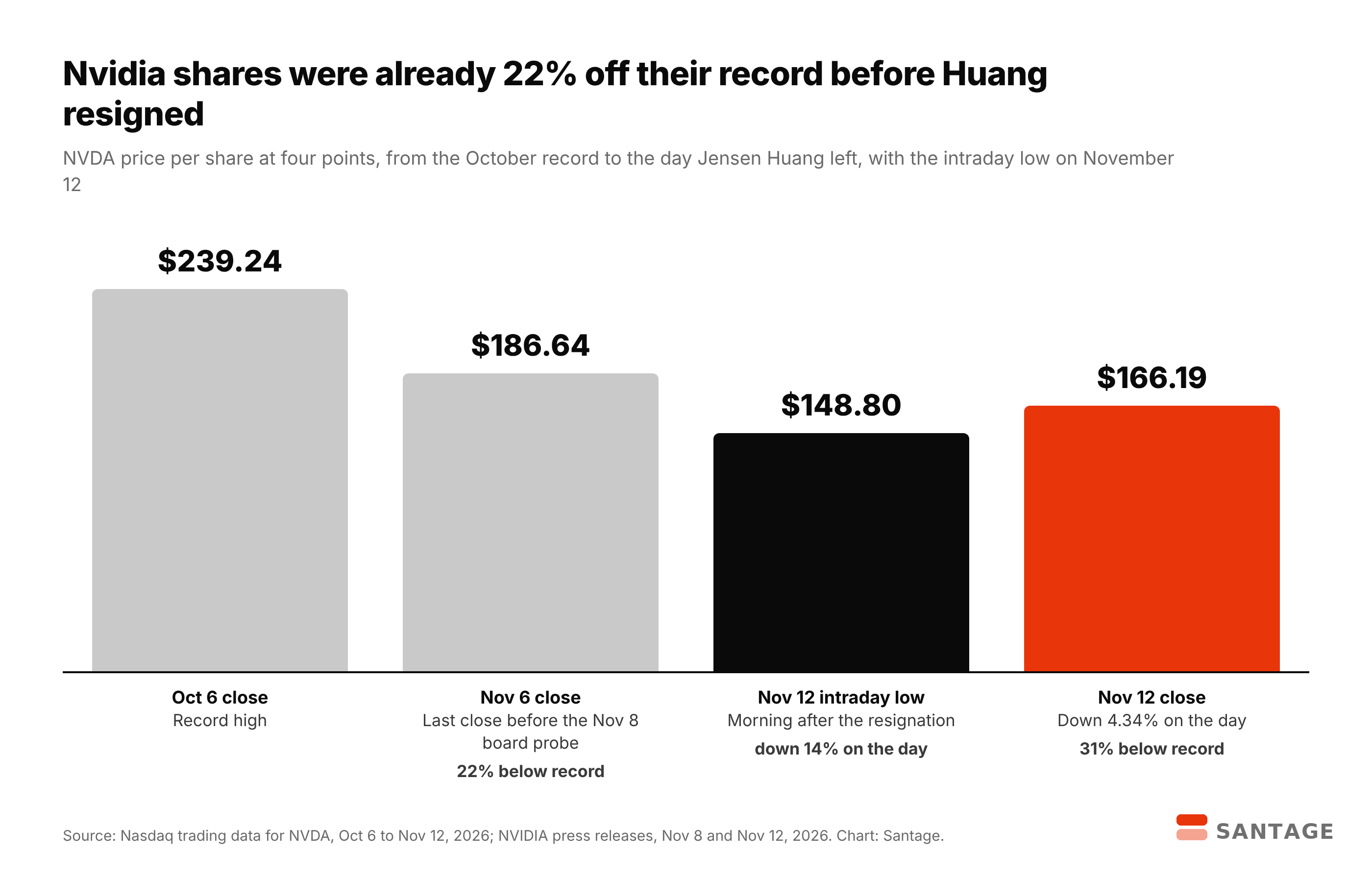
The shares opened sharply lower on Thursday, touching $148.80, then recovered to close at $166.19 as buyers stepped in. Trading volume of about 748 million shares was more than five times the three-month average. The close left Nvidia's market value near $4 trillion, and the stock 22% lower than its October record even before the November 8 board statement.
| 33 years | Huang's tenure as CEO, since co-founding Nvidia in 1993 |
| -4.34% | NVDA move on Nov 12, after an intraday drop of about 14% |
| 5.7x | Nov 12 trading volume versus the three-month average |
Kress owns the November 17 call, and the numbers are hers already
The sharpest test of the transition comes on Tuesday, when Nvidia reports fiscal third-quarter results at 1:20 p.m. Pacific and holds its call at 2 p.m. The guidance investors will measure the quarter against was set by Kress. In August she guided to revenue of $108 billion, plus or minus 2%, after a second quarter of $96.2 billion in which the data center business supplied $89 billion, about 92% of sales. That outlook assumed no data center compute revenue from China, so the quarter's math does not depend on the export licenses that sat at the center of Huang's relationship with Washington.
That shapes what the market loses. The people who build Nvidia's forecasts, run its supply chain and price its systems are still in their seats, and the interim CEO is the executive most familiar to institutional investors after Huang himself. The departure removes the company's product strategist and its most persuasive salesman, the founder who stood on keynote stages and sold AI infrastructure to heads of state as national capacity. Combining the CEO and CFO roles in one person also removes a check that most boards keep in place, which makes the permanent search more pressing than the "interim" label suggests.
Nvidia's next quarter was forecast by the executive now running the company, so Tuesday tests Nvidia's demand more than its leadership.
| Role | Before Nov 12 | After Nov 12 |
|---|---|---|
| Chief executive | Jensen Huang, co-founder | Colette Kress, interim |
| Chief financial officer | Colette Kress | Colette Kress, held jointly |
| Board chair | None; Nvidia had no chair | Harvey C. Jones, first-ever chair |
| Huang's board seat | Director | Resigned |
| Permanent CEO | Not applicable | Search open to internal and external candidates |
Source: NVIDIA, NVIDIA Announces CEO Transition, Nov 12, 2026.
Customers buy roadmaps, and the China file now needs a new face
For the labs and cloud providers that buy Nvidia systems, the operating question is continuity. Vera Rubin racks are already running at partners including Microsoft Azure, Google Cloud and Oracle, orders are booked quarters ahead, and the board has promised the roadmap continues unchanged. Hyperscaler purchasing decisions rest on delivery schedules and software support, which sit with engineering and operations teams below the chief executive.
The harder gap is political. Huang was Nvidia's chief negotiator on chip exports, on licenses for Chinese buyers that left some H200 licensees with empty offices, and on the sovereign compute deals that turned Nvidia into an instrument of industrial policy. House committee chairs had asked him for a closed-door briefing on November 18 about foreign contacts. An interim CEO who is also the CFO inherits those relationships at the moment Washington and Beijing are both watching who speaks for the company, and rivals selling inference chips, including AMD, whose shares rose about 6% on Thursday, now have an opening to court customers who want to diversify supply.
Nvidia's board has separated the company from its founder in four days and installed the two people investors trust most to keep the machine running: the CFO who wrote the forecast and an experienced chip-industry chair. That buys stability through Tuesday's results. It does nothing to answer the question that will set Nvidia's value for the next decade, which is who can do what Huang did for 33 years, deciding years in advance where AI computing goes and persuading customers and governments to follow.
Santage is committed to independent, transparent journalism. This article is produced in accordance with Santage's Editorial Standards and aims to provide accurate and timely information. Readers are encouraged to verify information independently.