

- The PHLX Semiconductor Index fell 12.3% on November 5, its steepest one-day drop since March 2020, while the Nasdaq Composite lost 5.5% and closed in correction.
- Investors sold AI hardware on the risk of slower data center permitting and tighter AI rules after the November 3 US elections, in which Ohio towns also passed local limits on new data centers.
- Potential Anthropic IPO investors told Reuters the $1.5 trillion valuation under discussion sits at the high end, and some doubt the roadshow can start the week of November 9.
Investors pulled roughly $2.5 trillion out of US stocks on Thursday, November 5, and the companies that sell the hardware for AI data centers lost the most. The PHLX Semiconductor Index closed 12.3% lower in its worst session since March 2020, Nvidia fell 9.3% to $181.60, and AMD dropped 17.3%. The rout landed days before Anthropic's planned IPO roadshow, and prospective buyers are now pressing the Claude developer for a lower price.
Chipmakers and data center suppliers led a second day of selling
The selling began beneath the surface on Wednesday, when the broad indexes rose after Tuesday's US midterm results while chip and data center shares slipped. On Thursday it spread across the market. The Dow gave back its entire 1,569-point Wednesday gain and more, closing 1,833 points lower, and the S&P 500 fell 4.4%. Nvidia's drop was its largest in more than a year and erased its gain for 2026, with no company announcement behind it. Qualcomm added its own pressure, falling 9.5% after a light quarterly outlook.
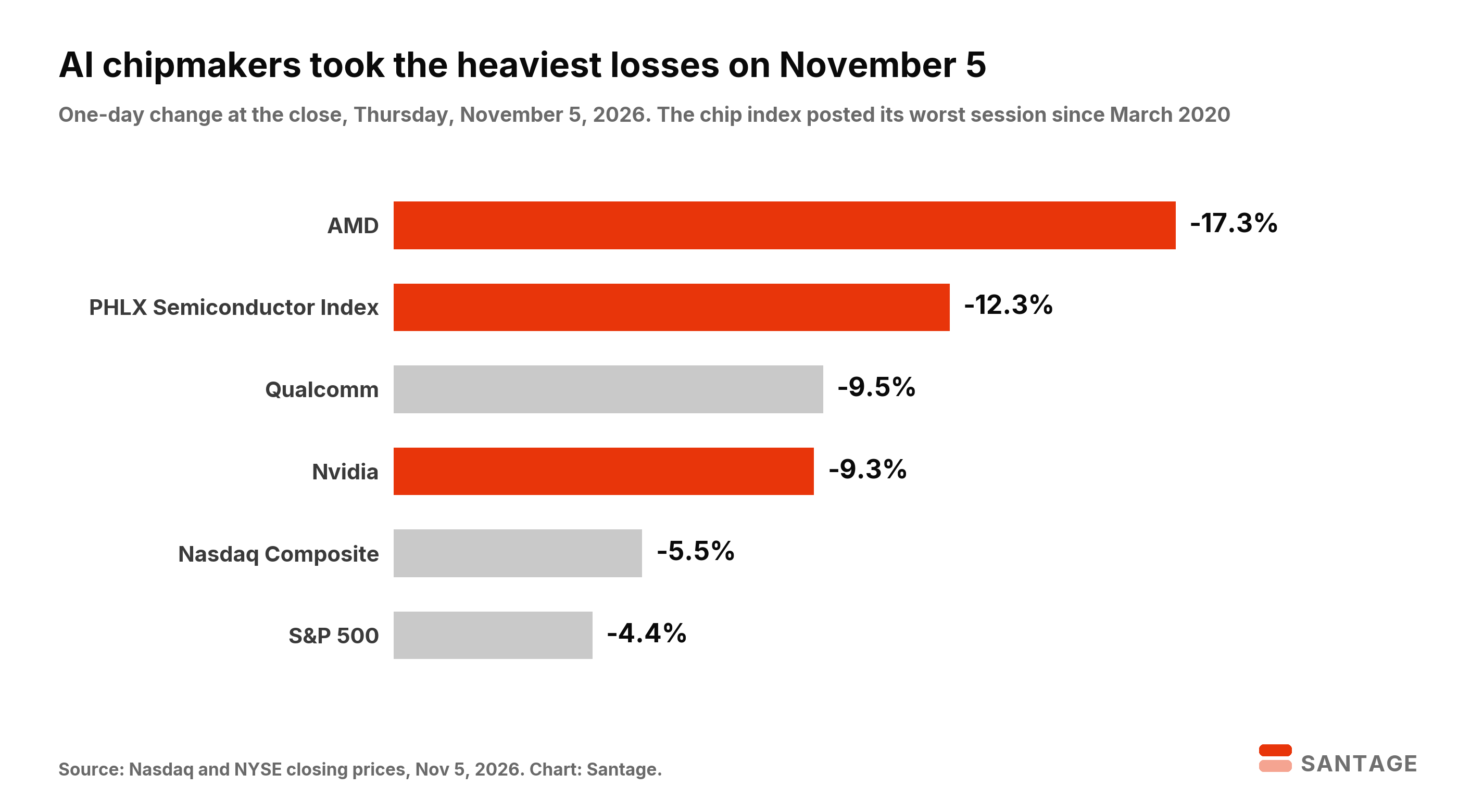
The concern traders priced is about where and how fast AI infrastructure gets built. Investors read the election results as raising the odds of slower data center approvals in key hosting states and stricter federal AI rules. The same ballots carried a local version of that pressure: Ohio alone had 21 data center measures before voters, and unofficial results show at least 14 of its 18 participating municipalities approving bans or restrictions, including Wilmington, where about 80% of voters rejected rezoning near a planned Amazon Web Services campus.
Anthropic's listing now depends on how buyers price compute risk
Anthropic is the first company to test that sentiment with a price. Its S-1 registration for a Nasdaq listing under the ticker ANT shows a business that grew third-quarter revenue to about $17 billion while committing roughly $895 billion to compute and infrastructure, the same buildout Thursday's sellers marked down. Four people familiar with investor discussions told Reuters that buyers want a more attractive valuation than the $1.5 trillion recently discussed, and that they are waiting for an October revenue figure the company left blank in its amended filing. Anthropic declined to comment.
| US market value lost on November 5 | About $2.5 trillion |
| PHLX Semiconductor Index, worst day since March 2020 | -12.3% |
| Nvidia close | $181.60, down 9.3% |
| Anthropic valuation investors call the high end | $1.5 trillion |
| Nvidia third-quarter results | November 17, 2026 |
The next hard data point arrives on November 17, when Nvidia reports results for the quarter that ended October 25. That report and Anthropic's roadshow will show whether Thursday's move reflected a real slowdown in AI spending or a repricing of permitting risk on top of demand that still exceeds supply. Hyperscalers had committed some $557 billion to AI capex for the year before this week, and none had announced a cut as of Thursday's close.
Thursday's selloff marked the first time public markets attached a price to the politics of building AI data centers. For Anthropic, whose IPO case rests on access to roughly $895 billion of contracted compute, that price now sits inside its valuation, and the question its bankers face next week is how large a discount buyers will demand to carry it.
Santage is committed to independent, transparent journalism. This article is produced in accordance with Santage's Editorial Standards and aims to provide accurate and timely information. Readers are encouraged to verify information independently.