

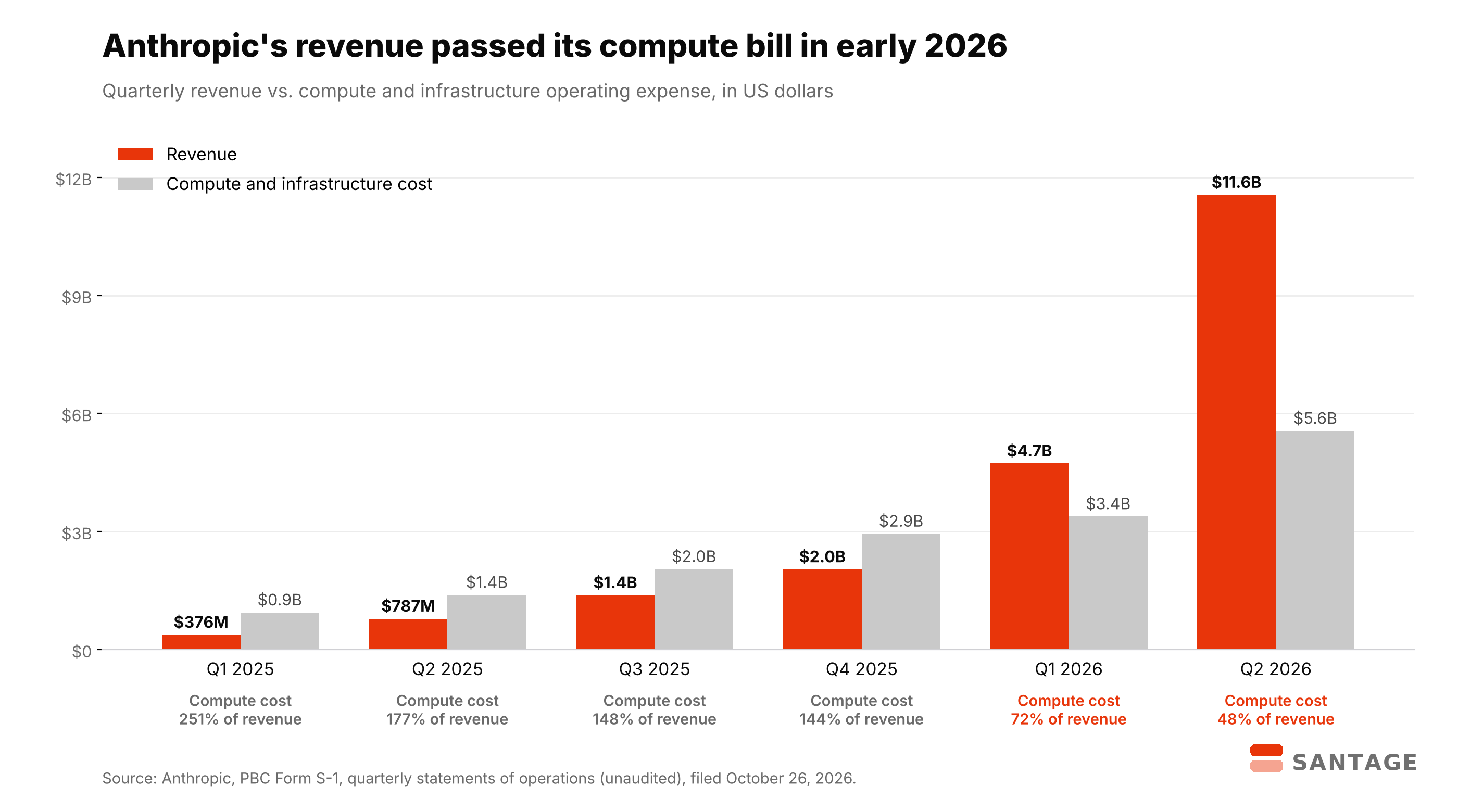
- Quarterly revenue rose from $376 million in Q1 2025 to $11.6 billion in Q2 2026, while compute and infrastructure expense rose from $944 million to $5.6 billion, so compute fell from 251% to 48% of revenue.
- Anthropic posted its first operating profit, $974 million, in Q2 2026; $72.4 billion of its $80.7 billion first-half net loss is a non-cash revaluation of convertible notes.
- Cloud marketplaces carried 48% of first-half 2026 revenue, up from 11% in 2023, and the top five customers supplied about 25% of nine-month revenue.
Anthropic’s public IPO filing shows a company whose cost of running AI has fallen below half of what it earns: compute and infrastructure expense equaled 48% of revenue in the second quarter of 2026, down from 251% eighteen months earlier. The Form S-1 filed on October 26 seeks a listing on the Nasdaq Global Select Market under the ticker ANT, with Goldman Sachs and Morgan Stanley leading and the share count and price range still blank.
Revenue overtook the compute bill in the first quarter of 2026
The quarterly statements in the filing tell the operating story more clearly than the annual totals. Through all of 2025, every dollar of revenue cost Anthropic more than a dollar of compute and infrastructure: $944 million of compute against $376 million of revenue in the first quarter, and $2.9 billion against $2.0 billion in the fourth. The lines crossed in early 2026, when revenue reached $4.7 billion against $3.4 billion of compute, and by the second quarter revenue of $11.6 billion was more than double the $5.6 billion compute line.
That shift carried the whole income statement. Operating losses of $935 million, $1.2 billion, $3.1 billion and $2.8 billion through 2025 narrowed to $1.7 billion in the first quarter of 2026 and turned into $974 million of operating income in the second, even as personnel costs reached $1.9 billion and sales, marketing and partnerships spending hit $2.1 billion that quarter. Annual revenue went from $41 million in 2023 to $386 million in 2024 and $4.6 billion in 2025, and first-half 2026 revenue of $16.3 billion was up 1,300% year on year. The filing also credits cheaper models for some of the demand, stating that Claude Opus 5.5 cut customers’ cost per task by about 40% against Claude Opus 5.
| Net revenue retention, September 30, 2026 | About 900% |
| Customers paying $100,000 or more a year (TTM) | More than 11,900 |
| Customers paying $1 million or more a year (TTM) | More than 1,900 |
| Customers paying $10 million or more a year (TTM) | About 250 |
Most of the $80.7 billion loss comes from Anthropic’s rising valuation
The headline net loss is large, and almost all of it is an accounting effect of Anthropic becoming more valuable. The company reports a net loss of $80.7 billion for the six months to June 30, 2026, of which $72.4 billion is the change in fair value of convertible notes, derivative liabilities and SAFEs. As the enterprise valuation climbs, the notes held by early investors are marked up and the increase runs through the income statement as a loss. The same mechanism explains $34.3 billion of the $42.0 billion loss for 2025 that Santage reported from the draft prospectus in September. For investors comparing ANT with listed software companies, the operating line and the compute ratio are the more useful measures. The revaluation charge should shrink once most of the notes convert at the IPO, although the filing says Amazon’s notes can stay outstanding under an ownership cap and convert into Class N shares quarter by quarter afterwards.
“We do not expect our revenue will continue to grow at comparable rates, and we cannot assure you that it will continue to grow at all.”
Anthropic, PBC, Form S-1, Risk Factors, October 26, 2026
Amazon, Google and Microsoft now sell almost half of Claude
The less discussed number in the filing is the channel mix. Revenue from customers buying Claude through cloud provider marketplaces on AWS, Google Cloud and Microsoft Azure was about 11% of the total in 2023, 32% in 2024, 47% in 2025 and 48% in the first half of 2026. Receivables from those marketplaces made up 58% of Anthropic’s net accounts receivable at June 30. The same three companies supply much of Anthropic’s compute, and Amazon also holds notes under an April 2026 purchase agreement disclosed in the filing.
That arrangement explains how a five-year-old company reached 1,900 customers paying more than $1 million a year, since enterprise buyers can spend existing cloud commitments on Claude. It also gives three hyperscalers, each of which builds or resells competing models, a hand in both Anthropic’s costs and nearly half its distribution. Concentration sits on the customer side too: the filing says no single customer exceeded 10% of revenue for the nine months to September 30, but the top five together reached about 25%, and many top customers are on short or expiring contracts.
Governance and lock-ups set the terms for public buyers
Public shareholders will buy into a public benefit corporation whose Long-Term Benefit Trust holds a special Class T common stock with the power to elect and remove the Class T directors. The underwriters’ lock-up runs to the 180th day after the prospectus, with specified early-release provisions, and the filing says additional shares become saleable at various times starting on the first trading day. Each co-founder has also pledged 80% of his or her personal equity to philanthropy. Anthropic reported $16.8 billion of third-quarter revenue to prospective investors earlier this month, a figure the public filing does not yet include in its full statements.
The S-1 shows that Anthropic’s economics turned in a single quarter, when compute dropped below half of revenue and the business started making an operating profit, and the open question for ANT buyers is how much of that margin survives as the hyperscalers that sell and power Claude renegotiate their share.
Santage is committed to independent, transparent journalism. This article is produced in accordance with Santage's Editorial Standards and aims to provide accurate and timely information. Readers are encouraged to verify information independently.