

- Thrive Capital, Lightspeed, Redpoint and Founders Fund led Fractile's $720 million Series C, with the UK's Sovereign AI fund, the British Business Bank and CapitalG also investing.
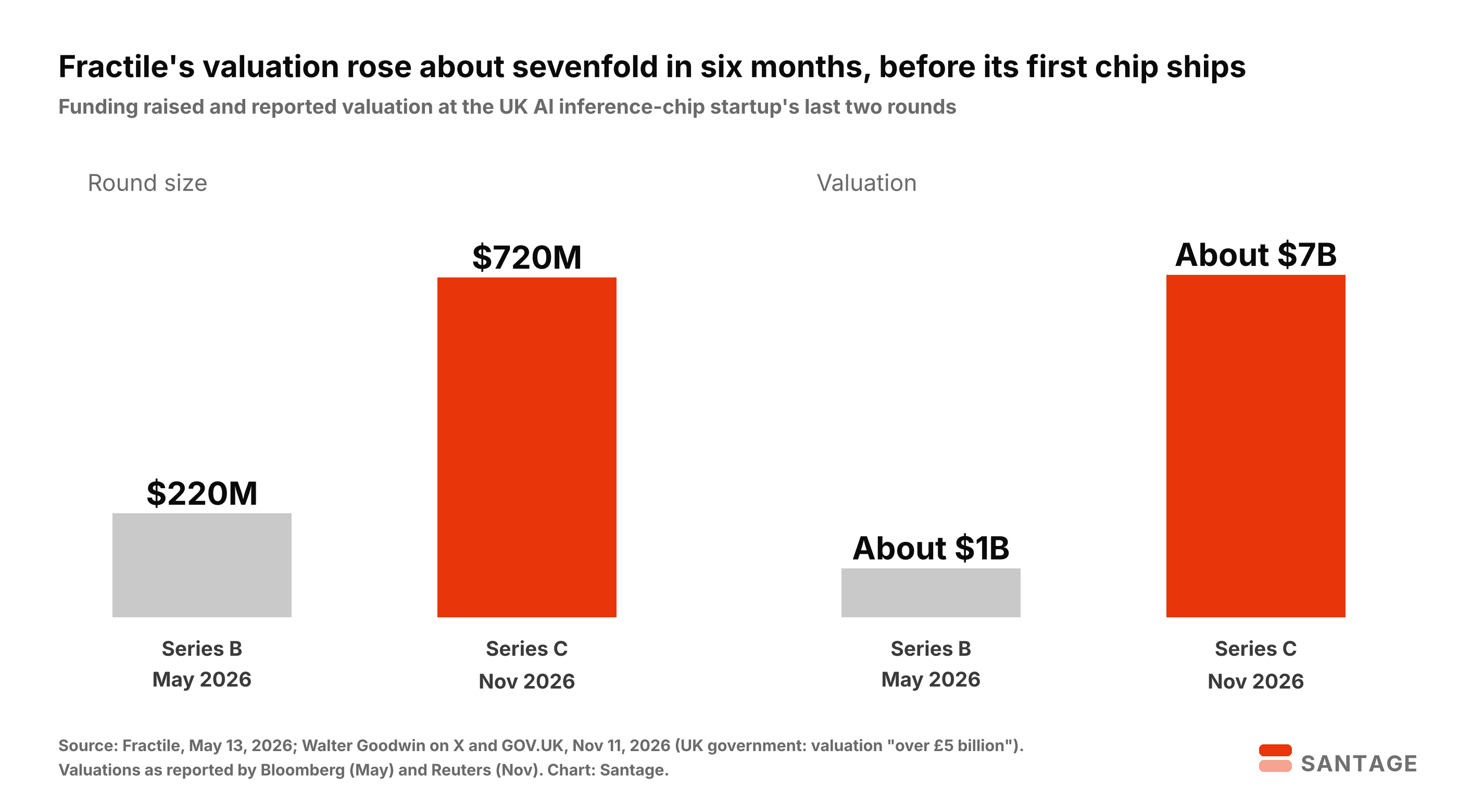
- The UK government values the company at over £5 billion; a person involved in the deal told Reuters the figure is about $7 billion, against roughly $1 billion at its $220 million round in May.
- Fractile builds chips for fast inference on long agent workloads and plans to ship its first chips and systems in 2027.
Fractile, a London and Bristol startup designing chips to run AI models faster, closed a $720 million Series C on November 11 at a valuation the UK government puts at over £5 billion, and the British state took a direct stake through its Sovereign AI Venture Fund and the British Business Bank, a bet on homegrown inference hardware made before Fractile has shipped a single production chip.
Fractile's $720 million Series C values the chipmaker at over £5 billion
Chief executive Walter Goodwin announced the round on X, naming Thrive Capital, Lightspeed, Redpoint and Founders Fund as leads. The UK government's release adds Google's growth fund CapitalG to the investor list and describes the round as worth more than £500 million.
The raise lands six months after a $220 million round in May led by Accel, Factorial Funds and Founders Fund, which Bloomberg reported valued the company at about $1 billion. Founded by Goodwin in the summer of 2022, Fractile says the new money lets it ship its first chips and systems in 2027.
| Series C closed Nov 11, 2026 | $720M |
| Valuation stated by the UK government | £5B+ |
| Reported valuation at May 2026 round | ~$1B |
| Target for first chips and systems | 2027 |
Fractile designs inference chips for long, sequential agent work
Fractile's pitch rests on speed per answer. Its site says it is building chips and systems to generate output at thousands of tokens per second while handling large models at very long contexts, and it has described a design that stacks memory directly on its chips to ease the bandwidth limit that slows today's GPUs at serving time.
Goodwin's announcement ties that to how frontier labs now spend compute. He wrote that OpenAI ran 10,000 parallel agents for 80 hours on a Millennium Prize problem at a cost of over $10 million, and argued that fewer agents thinking for longer scale better in every respect except the wait for a response. Hardware that shortens that wait, without cutting throughput, model size or context length, is the gap Fractile is targeting. Santage's model hardware standard explainer covers why memory bandwidth, more than raw compute, caps inference speed.
Britain's Sovereign AI fund buys into the inference-chip race
London framed the deal as industrial policy. AI Minister Kanishka Narayan tied it directly to domestic manufacturing.
"Britain needs to build more of the technology that powers it."
Kanishka Narayan, UK AI Minister, GOV.UK, November 11, 2026
The state's cheque is likely small. The government's notes say Sovereign AI fund equity investments typically run £1 million to £10 million, and it does not disclose individual amounts, so private investors carry almost all of the $720 million. The backing works as a public commitment to keep Fractile's chip work in Britain, and Business Secretary Jonathan Reynolds pointed to the company's plans to expand in Bristol at a time when the country is leaning on AI for growth: the Bank of England said this month that AI activity made up just under a fifth of UK growth in 2026.
The price also stands out among chip challengers. Tenstorrent, which already sells silicon, raised $1.5 billion at $6.2 billion in October, and Fractile's reported $7 billion now sits above it on a product due next year. Bloomberg reported in August that Fractile had agreed a roughly $250 million supply deal with Anthropic; neither company has confirmed it.
Fractile has raised close to $1 billion in six months on a thesis about latency, and its investors are pricing the chip as if agent workloads will reward the fastest single answer over the cheapest bulk throughput. The company now has until 2027 to show that silicon delivers on the promise that its valuation already assumes.
Santage is committed to independent, transparent journalism. This article is produced in accordance with Santage's Editorial Standards and aims to provide accurate and timely information. Readers are encouraged to verify information independently.