
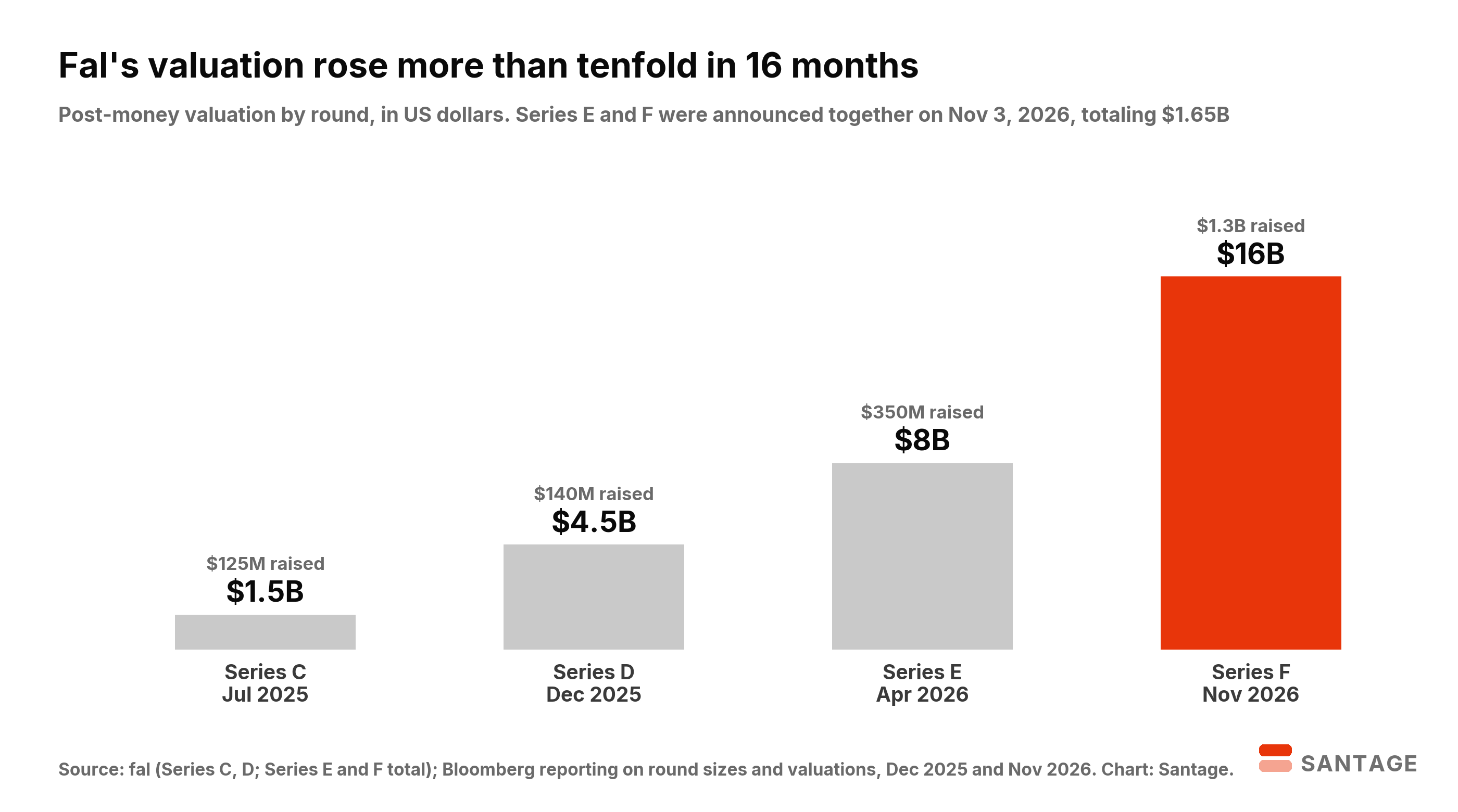
- Fal raised $1.65 billion across its Series E and F, and the Series F values it at $16 billion, up from $1.5 billion in July 2025 and $8 billion in April 2026.
- At a reported $800 million in annualized revenue, investors are paying about 20 times sales, close to the 17.5 times Fireworks AI drew at $17.5 billion in July.
- Nvidia has invested in fal, Fireworks and Together AI, the three most valuable independent inference platforms, which together carry about $42 billion in valuations.
Fal, a San Francisco company that runs image, video and audio AI models for other businesses, is now valued at $16 billion, ten times what investors paid for it 16 months ago. On November 3 the company announced two funding rounds totaling $1.65 billion: a Series E led by Sequoia Capital that closed earlier in the year and a Series F led by Bessemer Venture Partners, with Nvidia investing again. Bloomberg reported that the Series F raised $1.3 billion at the $16 billion valuation, double the $8 billion set in April, and that the company reached $800 million in annualized revenue this year.
Fal raised $1.65 billion in two rounds and doubled its price in seven months
The company confirmed the rounds and their leads in a blog post, saying the money will fund inference capacity and the team through 2027. It did not publish the round sizes or valuation, which come from Bloomberg's reporting: $350 million at $8 billion for the Series E in April and $1.3 billion at $16 billion for the Series F, with Sound Ventures, HOF Capital and T. Rowe Price also taking part.
The climb has been steep and steady. Fal raised a $125 million Series C at $1.5 billion in July 2025, then a $140 million Series D led by Sequoia at $4.5 billion that December, when its revenue had passed $200 million. Annualized revenue of $800 million would mean the business roughly quadrupled in about a year.
Generative media is a separate and faster-growing inference market
Most attention in AI inference goes to text models, where the hyperscalers and model labs sell tokens directly. Fal built its business on a different workload. It hosts hundreds of image, video and audio models behind simple APIs, including its own, and optimizes them to run quickly, so a developer can generate a product photo, a short clip or a voice track without managing GPUs. In its announcement the company says entertainment studios, advertising agencies, e-commerce brands, game developers and marketing teams now run these models inside the pipelines that deliver their final work.
That customer list explains the growth. A video model consumes far more compute per request than a chatbot reply, and once a studio or a retailer builds generation into its daily production, usage grows with the volume of work it produces. Bloomberg reported that demand outran fal's capacity over the summer and forced it to impose rate limits, which is why the company is putting much of the new money into compute.
| Series F valuation, November 2026 | $16 billion |
| Raised across Series E and F | $1.65 billion |
| Reported annualized revenue, 2026 | About $800 million |
| Valuation to reported revenue | About 20 times |
| Valuation in July 2025 | $1.5 billion |
Investors now price independent inference platforms at roughly 20 times revenue
Fal's round completes a set of large 2026 deals for inference specialists. Fireworks AI, which serves custom versions of open models for enterprises, raised $1.505 billion at $17.5 billion in July after passing $1 billion in annualized revenue, and Together AI raised $800 million at $8.3 billion on July 1.
| Company | Latest round | Valuation | Disclosed revenue | Focus |
|---|---|---|---|---|
| fal | Series F, Nov 2026 | $16B | About $800M annualized (reported) | Image, video and audio models |
| Fireworks AI | Series D, Jul 2026 | $17.5B | Over $1B annualized | Custom open models for enterprises |
| Together AI | Series C, Jul 2026 | $8.3B | Over $1B in annual bookings | Open-model cloud and GPU clusters |
The pricing gap between them tracks what each sells. Fal and Fireworks earn most of their revenue from software-heavy inference with high utilization, and both trade near 20 times sales. Together, which also rents GPU clusters, sits closer to 8 times bookings, a multiple nearer to cloud infrastructure. T. Rowe Price's presence in fal's round adds a public-markets investor to the cap table, a pattern that often appears in the last private rounds before a listing.
Nvidia's stake in all three inference leaders is the number most coverage missed
Nvidia invested in fal's Series D and Series F, in Fireworks' Series D and in Together AI's Series C. Across those three companies, which together carry about $42 billion in valuations, Nvidia holds equity in the platforms that buy or rent large volumes of its GPUs to serve customers. Each round therefore funds demand for the investor's own chips, the same circular pattern in AI funding that central bankers at the BIS have started to measure.
For fal, the risk sits in the same place as the opportunity. Open image and video models keep improving, which feeds its catalog, while model labs and cloud providers increasingly host those models themselves. Fal's defense is speed, breadth and integration into production pipelines, and its valuation now assumes that customers will keep paying a specialist for those advantages.
Fal's jump to $16 billion shows that investors now treat generative media as its own compute market, separate from chatbots and coding agents, and are willing to pay software multiples for the companies that run it. The next test is whether $800 million in revenue can keep growing faster than the GPU bill that comes with it, a question that also sits behind OpenAI's push to put its models to work on physical engineering.
Santage is committed to independent, transparent journalism. This article is produced in accordance with Santage's Editorial Standards and aims to provide accurate and timely information. Readers are encouraged to verify information independently.