
- United's revised contract defines an AI agent broadly, covering assistants in search and messaging apps, AI browsers and tools offered through travel agencies, whether or not a person approves each action.
- The ban sits in Rule 6.J with hidden-city, throwaway and back-to-back ticketing, where listed remedies include invalidating tickets and refusing to board passengers.
- Delta and American still allow some AI bookings, so travel is splitting between airlines that license agent access and airlines that refuse it.
United Airlines on November 11 rewrote its Contract of Carriage so that using an AI agent to make, modify or service a ticket, or to buy anything from the airline, is now a prohibited practice listed beside hidden-city ticketing, which makes United the first major US carrier to bar personal AI assistants and gives it contractual grounds to cancel tickets those assistants book.
United's contract now treats AI-agent bookings like hidden-city ticketing
United announced the change in a short newsroom statement that cites three risks: credentials shared with third-party assistants exposing sensitive data, agents triggering unintended purchases, account changes or use of MileagePlus miles, and automated actions that could breach federal aviation rules. Its example is check-in, where a passenger must personally confirm their bags carry no banned items.
"Flight check-in requires human acknowledgment that bags do not contain banned substances like explosives."
United Airlines, United Restricts Access for Third-Party AI Agents, November 11, 2026
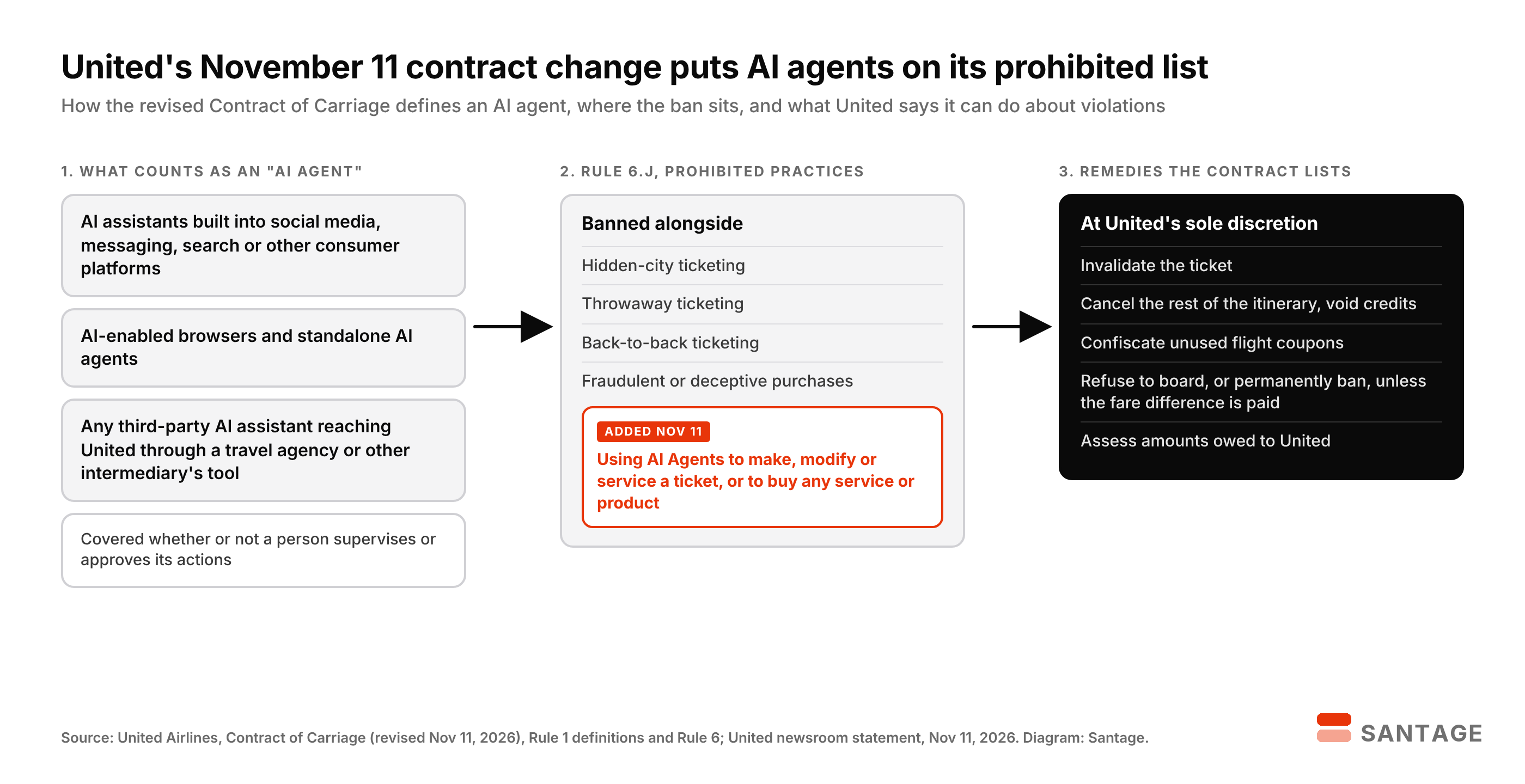
The statement describes "updates to our booking, ticketing and distribution policies." The Contract of Carriage, dated November 11, shows what that means in practice. Rule 1 adds a definition of "AI Agent," and Rule 6, which governs tickets, adds a sixth item to its list of prohibited practices. Every other entry on that list is a fare-rule evasion, and the remedies that follow let United, at its sole discretion, invalidate a ticket, cancel the rest of an itinerary, confiscate unused coupons, refuse to board a passenger or ban them until a fare difference is paid.
The definition reaches supervised assistants and agents inside travel agencies
The wording matters more than the press release. United defines an AI agent as any software that takes autonomous or semi-autonomous action to search, book, buy or manage its products "whether or not Passenger or another individual supervises or approves its actions." A human tapping "confirm" at the end of an agentic checkout, the safeguard most consumer agents rely on, does not take the booking outside the rule.
The definition also names assistants built into social media, messaging and search platforms, AI-enabled browsers, and any third-party assistant that reaches United through a tool supplied by a travel agency or other intermediary. That last clause carries the ban into distribution, where airlines have the most leverage, because agencies selling United tickets are bound by the airline's ticketing rules.
The obligations land on the traveler. The contract binds the ticketed passenger, and the agent developer is a stranger to it, so a family whose holiday flights were booked by an assistant is the party whose ticket can be voided. United says it will update its Digital Trust Center to explain the change and where to get help if an agent takes an unintended action.
United wrote the AI-agent ban as a rule for passengers, so the people who carry the risk of an agent's booking are the travelers who trusted it.
US airlines are splitting over who controls the booking
United's rivals have chosen differently, at least for now.
| Airline | Stance on personal AI agents | What it said or did |
|---|---|---|
| United | Prohibited | Contract of Carriage Rule 6.J, revised Nov 11, 2026 |
| Delta | Allowed when authenticated | Says it supports "certain interactions with AI assistants when they can be appropriately authenticated" |
| American | Allowed for some tools | Says some AI tools can facilitate ticket purchases, and it can block automated traffic when needed |
| Southwest | Sanctioned channel | Launched an official flight-search plugin in ChatGPT |
Source: United Contract of Carriage and newsroom, Nov 11, 2026; Delta and American spokesperson statements, Nov 11, 2026; Southwest Airlines news release.
The commercial logic sits behind the security case. Airlines earn heavily from seat fees, upgrades and loyalty programs, and an assistant that shops purely on price and books across carriers weakens all three. United chief executive Scott Kirby has said he does not want "another middleman," according to The Wall Street Journal. Southwest's plugin shows the alternative: the airline builds the channel, sets the terms and keeps the customer record.
Banking moved before airlines did. In October JPMorgan said outside AI agents could not log into Chase accounts or move money, and United's statement pointed to banking and retail leaders that "have taken similar actions," urging other companies to follow.
Agent builders need airline permission, and travelers need to check how they booked
For companies building consumer AI agents, the always-on assistants such as OpenAI's dots, the practical result is that booking a United flight now requires a sanctioned route the airline has yet to offer. Logging in with a user's MileagePlus password, the approach that also exposes accounts to prompt injection from hostile web pages, is the method United's statement singles out as a security risk.
Delta's wording points to the likely settlement. An agent that authenticates through the airline's own login, instead of a copied password, gives the carrier a record of who acted and a switch to cut off a tool that misbehaves. That moves the burden onto agent makers to win permission airline by airline, which favours the largest assistants with the scale to negotiate and leaves smaller travel startups relying on the agencies that United has now told to keep agents out.
Enforcement will be partly technical and partly contractual. United says it will restrict access directly on its platforms and indirectly through agencies and aggregators, and the contract gives it a basis to act after the fact. United has not said how it will detect an agent-made booking or whether it will cancel tickets bought that way during the holiday season. Passengers who used an assistant for upcoming trips should confirm the booking directly with United.
United has turned the question of AI shopping agents from a website-blocking problem into a matter of contract law, and that choice will shape the market for travel agents more than any model release. If rivals follow, consumer assistants will book airlines only through channels the airlines sanction and price; if Delta and American hold their ground, United will be testing whether travelers value its app enough to abandon the agents they were promised.
Santage is committed to independent, transparent journalism. This article is produced in accordance with Santage's Editorial Standards and aims to provide accurate and timely information. Readers are encouraged to verify information independently.