
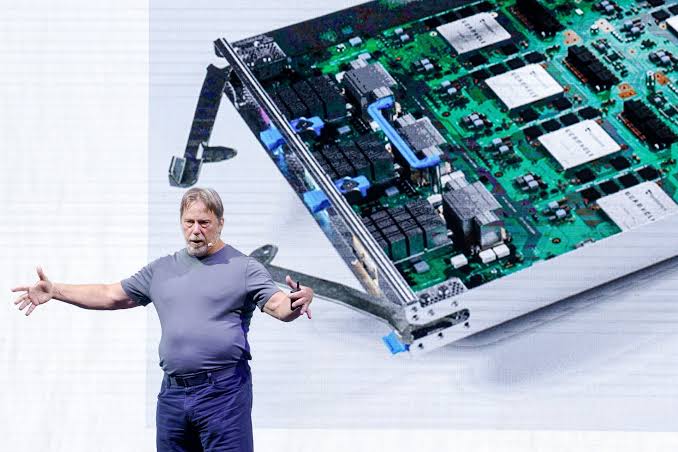
- Tenstorrent's valuation rose from $2.6 billion in December 2024 to $6.2 billion, a 2.4x step in 22 months, on a $1.5 billion raise.
- Santage-tracked peers Etched ($21 billion in August) and Cerebras ($48.8 billion at its May IPO) are priced 3x to 8x higher.
- Two electronic trading firms, Virtu and XTX Markets, joined the cap table, two months after Jane Street led Etched's $700 million round.
Tenstorrent, the RISC-V AI chip company run by Jim Keller, has closed a $1.5 billion Series E at a $6.2 billion post-money valuation, more than double the $2.6 billion it carried after its December 2024 round. Trace Capital and Innovation X led the round, according to Tenstorrent's funding announcement, with ARK Invest, Fidelity, Morgan Stanley, Sandisk, T. Rowe Price-advised accounts, Tether Investments, Virtu Financial and XTX Markets among the participants.
Tenstorrent's $6.2 billion valuation caps a sixfold climb since 2021
Tenstorrent was valued at $1 billion when it raised more than $200 million in its 2021 Series C. The December 2024 Series D of $693 million lifted it to $2.6 billion, and the new round more than doubles that. The company says the money will go to deploying its Galaxy servers at scale, serving open-weight large language and video generation models, and developing the CPU and AI core designs it licenses to other chipmakers.
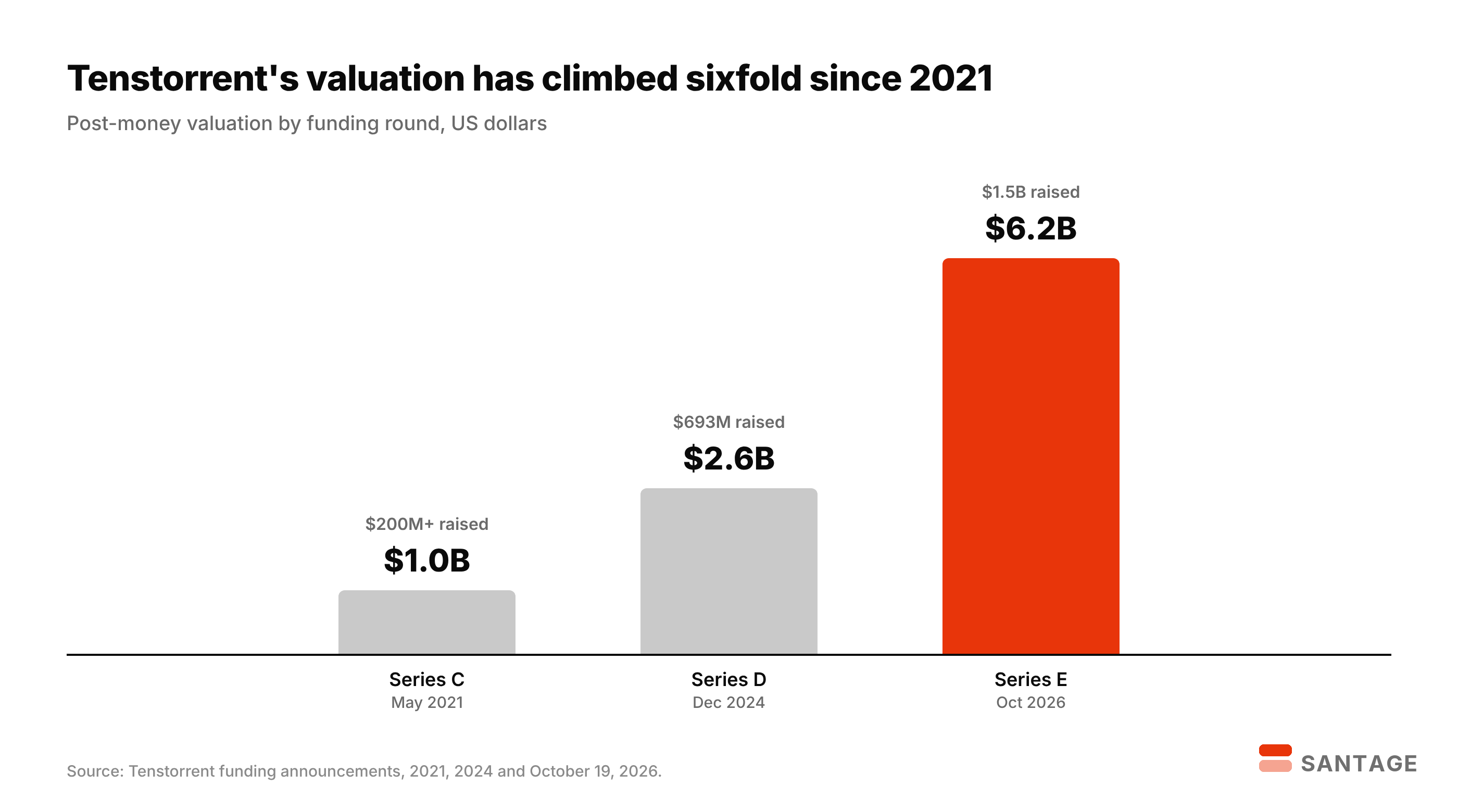
“We built one architecture and sell it at every size. The future of compute is open, scalable, and owned by the people building on it.”
Jim Keller, CEO of Tenstorrent, Series E announcement, October 19, 2026
That line describes a business model unusual among AI chip challengers. Tenstorrent sells a single card or workstation, full racks and superclusters, and it also licenses its TT-Ascalon RISC-V CPU and Tensix AI cores to companies designing their own silicon, naming Samsung and LG as licensees. Its software stack is open source, which lets developers run open-weight frontier models on its hardware locally and lets enterprises deploy them on premises.
A licensing business gives Tenstorrent a different risk profile from inference-chip peers
The valuation gap with Tenstorrent's closest peers is the number that frames this round. Santage has tracked two other independent challengers to Nvidia this year, and both command far higher prices.
| Company | Latest valuation | Event | Main business |
|---|---|---|---|
| Tenstorrent | $6.2 billion | $1.5B Series E, Oct 2026 | Servers, workstations, CPU and AI core IP licensing |
| Etched | $21 billion | $700M round, Aug 2026 | Inference chips and racks |
| Cerebras | $48.8 billion | Nasdaq IPO, May 2026 | Wafer-scale training and inference systems |
Source: Tenstorrent, October 19, 2026; Santage reporting on Etched (August 19, 2026) and Cerebras (May 13, 2026).
Etched and Cerebras sell systems built around a single class of chip, and their valuations rise and fall with the inference contracts they win. Tenstorrent spreads its revenue across hardware sales and intellectual property licensing, which ties part of its income to the growing number of companies, carmakers and electronics groups among them, that want custom silicon without designing every block themselves. Its earlier backers include Samsung, LG Electronics and Hyundai Motor Group, all potential licensees.
The lower price also reflects what Tenstorrent has yet to show. It has disclosed no revenue figure or customer contract value in this round, while Etched pointed to more than $1 billion in signed contracts when it raised in August. Investors at $6.2 billion are paying for an architecture and a licensing base with less proof of volume than the higher-priced peers can offer.
At $6.2 billion, Tenstorrent is valued at less than a third of Etched despite selling both chips and the designs behind them, a discount that will narrow quickly if Galaxy servers start landing the kind of production contracts Etched used to justify its price.
Trading firms are becoming a recurring source of AI chip capital
The investor list carries its own signal. Virtu Financial and XTX Markets are electronic trading firms, and their participation follows Jane Street's lead role in Etched's August round, which came alongside Jane Street becoming Etched's first production customer. Trading firms run some of the most latency-sensitive compute anywhere and have balance sheets large enough to write growth checks, so they bring both demand and capital to the chip startups they back. Sandisk, a memory and storage maker, adds a strategic supplier to the table at a time when memory supply shapes what AI systems can be built.
Tenstorrent arrived at this round by declining a sale. Earlier this year it held talks with companies including Intel and Qualcomm about a possible takeover, and Keller told Bloomberg the company chose to raise money instead. He pointed to a May demonstration of Galaxy servers running DeepSeek models as a turning point. The company now has about 1,150 employees across Santa Clara, Austin, Toronto, Belgrade, Tokyo and Bangalore.
Open hardware is now a funded strategy
The round gives an open, RISC-V based alternative to Nvidia enough capital to scale manufacturing as an independent company, and it arrives as the largest buyers of compute build their own chips, from Microsoft's Maia 300 to Meta's Iris. Each of those buyers needs CPU and AI core designs from somewhere, and Tenstorrent is positioned to license them. The $1.5 billion buys Tenstorrent time to prove that open designs can win volume, and the next valuation step will depend on whether it can publish the customer numbers its pricier rivals already have.
Santage is committed to independent, transparent journalism. This article is produced in accordance with Santage's Editorial Standards and aims to provide accurate and timely information. Readers are encouraged to verify information independently.