
- After stripping out a long-run technology trend, the Bank finds novel AI-related activity produced just under a fifth of UK GDP growth in 2026, driven by firms that develop and implement AI.
- Companies in the Bank's Decision Maker Panel estimate AI has raised their productivity by about 0.5% over three years, or 0.1 to 0.2 percentage points a year since early 2024, with close to zero effect on total employment.
- The same firms expect AI to add about 0.9 percentage points a year to productivity growth over the next three years, with roughly half of that coming through slower employment growth.
The Bank of England estimates that AI-related activity accounted for just under a fifth of UK economic growth since the start of 2026, while the firms putting the technology to work report productivity gains of only about 0.5% over three years. The finding, in the November 5 Monetary Policy Report that accompanied a quarter-point rise in Bank Rate to 4%, is one of the clearest attempts by a major central bank to separate the economics of building AI from the economics of using it.
AI suppliers, not AI users, produced the UK's AI-driven growth
The Bank built an AI activity proxy from three industry codes: publishing, which includes AI agent and application software; computer programming and consultancy, which includes advice on model selection; and information services, which covers AI data processing and data centres. After adjusting for the trend these sectors already followed, the Bank concludes in the November Monetary Policy Report that novel AI-related activity accounts for just under a fifth of GDP growth since January, with the gains concentrated in upstream development and implementation rather than in adoption across the rest of the economy.
That activity helped the UK outrun the Bank's own forecasts. GDP grew 0.5% in the second quarter and is expected to have grown 0.7% in the third, against July projections of 0.3% and 0.1%, despite an energy shock from the Middle East conflict that has pushed CPI inflation to 3.5%. Business investment rose 3% in the first quarter and 1.8% in the second, its fastest two-quarter run since 2022, and the Bank's regional Agents name AI-related spending as one driver.
| Share of UK GDP growth in 2026 from novel AI activity | Just under a fifth |
| Productivity gain firms attribute to AI over three years | About 0.5% |
| Annual productivity boost firms expect from AI over the next three years | About 0.9 percentage points |
| Bank Rate after the November 4 decision | 4% |
UK firms put AI's productivity gain at 0.5% over three years
The Bank's survey of finance chiefs gives a modest verdict on adoption so far. Firms in the Decision Maker Panel estimate that AI has raised their productivity by about 0.5% over the past three years, which the Bank says is in line with impacts reported in other countries and implies AI added 0.1 to 0.2 percentage points a year to UK productivity growth from early 2024. The Bank treats AI as only one of several explanations for the recent productivity pickup, and it notes that productivity has also improved in low-paid sectors with less AI exposure, such as wholesale, retail and accommodation, where employment has fallen.
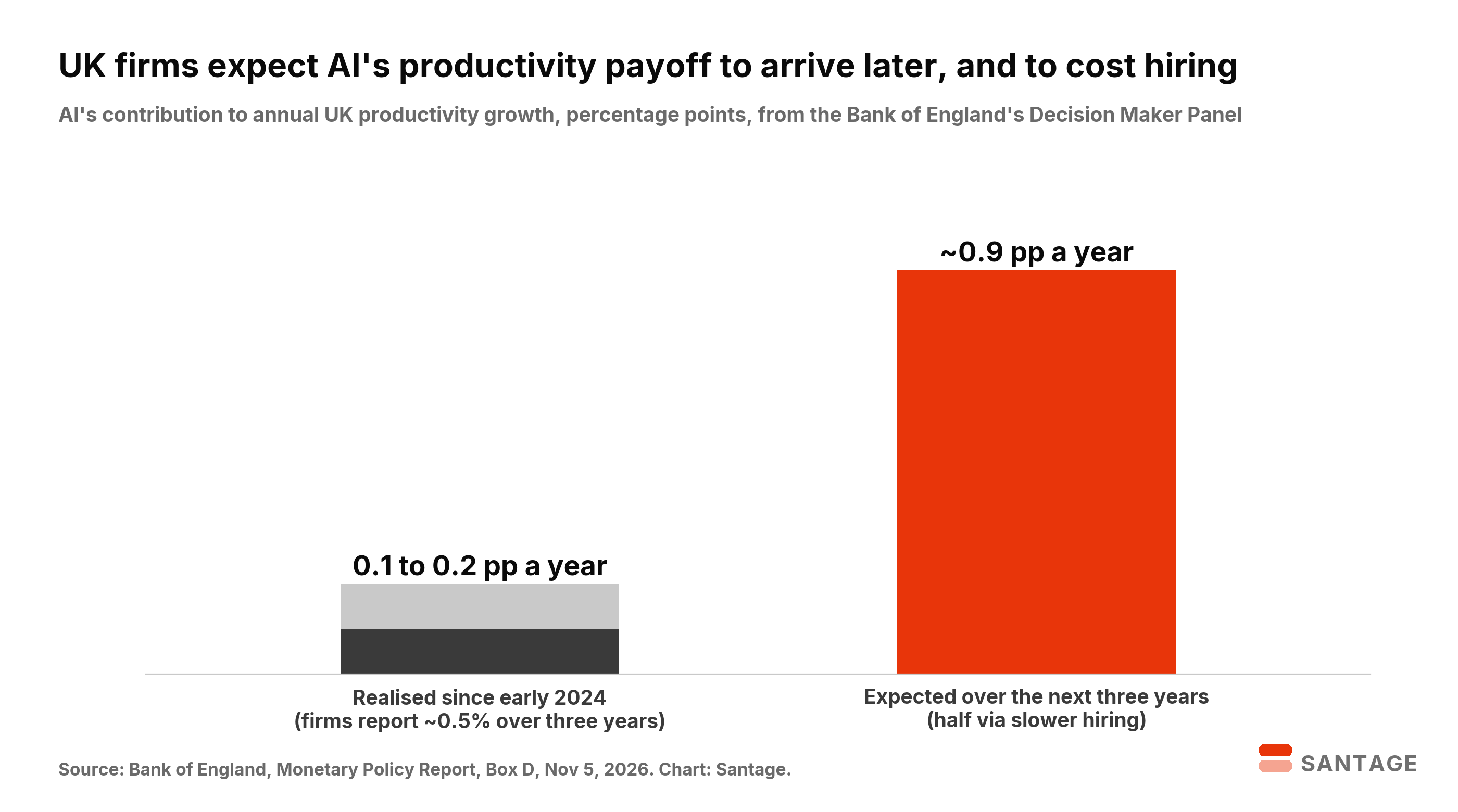
Expectations run far ahead of results. Panel firms expect AI to lift productivity growth by about 0.9 percentage points a year over the next three years, split roughly equally between faster output and slower employment growth. If that holds, AI's measured contribution would rise several times over from today's 0.1 to 0.2 points, and about half of the gain would show up as jobs that were never created.
AI is slowing UK hiring before it changes total employment
The labour market data show the mechanism already at work. Firms in the panel report close to zero aggregate effect of AI on employment, and unemployment fell to 4.7% in the three months to August. The Bank's Agents, who interview companies across the country, describe a quieter change:
"AI adoption is reducing the likelihood of firms hiring or replacing workers."
Bank of England, in Monetary Policy Report, November 2026, November 5, 2026
The Agents add that adoption has not materially raised the likelihood of firing workers so far. Fewer replacements for leavers and fewer new roles weigh most on people trying to enter the workforce, which is consistent with the pressure on early-career technical paths that showed up in the 12% drop in US computer science enrollment last month.
| Channel | What the Bank found | Report section |
|---|---|---|
| Growth | Novel AI activity made just under a fifth of 2026 GDP growth, mostly upstream | Box C |
| Investment | Business investment up 3% in Q1 and 1.8% in Q2, partly AI-related | Section 1.2 |
| Productivity | Firms report about 0.5% over three years, 0.1 to 0.2 pp a year | Box D |
| Expectations | About 0.9 pp a year over three years, half via slower hiring | Box D |
| Jobs | Close to zero net effect so far; fewer hires and replacements | Box D |
| Prices | AI chip demand lifting Asian export prices and UK import costs | Section 1.1 |
The global AI buildout reaches the UK as import costs
The report also traces how other countries' AI spending lands on British prices. Demand for AI-related products such as memory chips has pushed up export prices in China and advanced Asian economies, which the Bank links to a pickup in UK core goods inflation, and it expects strong AI demand to keep UK import price inflation elevated over the coming quarters. Core goods inflation could rise above 2.5% by the second quarter of 2027. The US hyperscalers behind much of that demand had committed some $557 billion to AI capital spending this year, and the UK is paying part of the bill through the price of imported hardware.
For investors and policymakers, the Bank's numbers split the UK's AI story into two economies. The one building and installing AI infrastructure is already large enough to shift national growth, and the one using AI has so far banked about half a percent of productivity while quietly hiring less. The UK's growth case for AI now rests on whether the 0.9-point gain firms expect arrives before the investment wave behind this year's growth fades.
Santage is committed to independent, transparent journalism. This article is produced in accordance with Santage's Editorial Standards and aims to provide accurate and timely information. Readers are encouraged to verify information independently.