
- Capital spending at Microsoft, Alphabet, Amazon, Meta and Oracle doubled to $556.9 billion while operating cash flow rose 29% to $542.9 billion, leaving combined free cash flow at negative $14.0 billion against a $143.5 billion surplus a year earlier.
- Share buybacks fell 83% to $13.6 billion, and the share of operating cash returned to investors dropped to 9.3% from 27.4%, the lowest in at least 15 years.
- On the same day OpenAI reportedly cut its funding round to about $20 billion from $30 billion, a sign that the outside capital now carrying the buildout is pricing AI risk more tightly.
The five largest US cloud and platform companies now spend more on building AI capacity than their businesses bring in, which turns the AI buildout from a self-funded project into one that depends on lenders, share buyers and private investors. Microsoft, Alphabet, Amazon, Meta and Oracle spent $556.9 billion on capital projects in the first nine months of 2026 against $542.9 billion of operating cash flow, the first time spending has exceeded that cash in data going back to 2011, according to a Reuters analysis of LSEG data and company filings published on October 30.
Five companies spent $557 billion and generated $543 billion in nine months
Operating cash flow at the group reached a record, so the crossover reflects spending racing ahead of strong businesses. Capital expenditure roughly doubled from about $277 billion in the same period of 2025, while cash from operations grew by about $122 billion, which means every extra dollar the five businesses generated was matched by more than two extra dollars of construction, chips and data center leases.
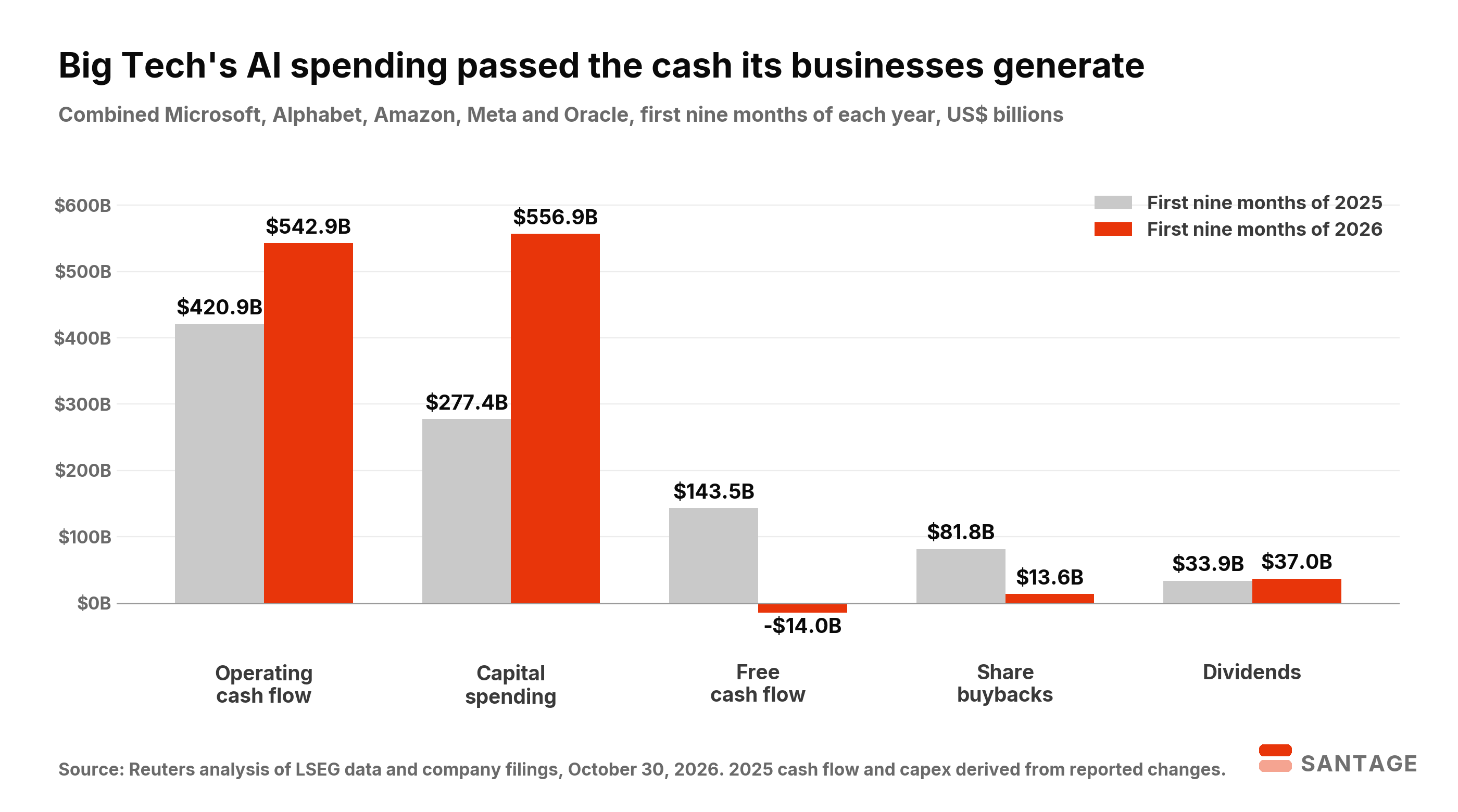
Shareholder payouts absorbed the difference. Dividends, which companies treat as a commitment, rose to $37.0 billion from $33.9 billion, while buybacks, the flexible lever, nearly vanished. Alphabet and Meta have repurchased no shares in 2026, and Microsoft’s $4.4 billion in the September quarter accounts for almost all of what remains. With combined free cash flow below zero, the $50.6 billion paid out this year came from cash reserves, borrowing or new share sales. Alphabet alone raised about $29 billion of debt and $12.4 billion from selling stock, and Meta launched a $35 billion stock sale on October 26.
| Capital spending | $556.9 billion, roughly double a year earlier |
| Operating cash flow | $542.9 billion, up 29% |
| Share buybacks | $13.6 billion, down 83% |
| Share of operating cash returned to investors | 9.3%, down from 27.4% |
The AI buildout now runs on borrowed and raised money
For most of the last decade these companies funded their AI infrastructure from the cash machine of search, advertising, software and retail, with enough left over to retire shares every quarter. That arrangement ended in the third quarter of 2026. Amazon, whose purchases of property and equipment reached $77.3 billion in the quarter, carries trailing free cash flow of negative $42.4 billion, as Santage reported from its third-quarter filing, and it still guides to about $220 billion of capital spending for the full year. The other four have signalled further increases.
The five largest AI spenders now need investors to fund the buildout at the same moment investors are marking AI assets down.
The shift changes who carries the risk. When capital spending came out of surplus cash, a misjudged data center hurt margins. When it is financed with bonds and new shares, the bet is spread to creditors and diluted shareholders, and the cost of that money rises whenever AI stocks fall, as they have through most of October.
OpenAI’s smaller round shows the same squeeze one level down
The capacity Big Tech is building only pays off if its largest customers can afford to rent it, and those customers fund their compute contracts from private capital. OpenAI cut the target of its latest round to about $20 billion from $30 billion and is now raising at a $1.25 trillion valuation, down from the $1.4 trillion it first pitched, the Financial Times reported on October 30, adding that the first close may come in below $20 billion.
That trim matters to the hyperscalers’ own math. A growing share of their backlog consists of multi-year commitments from model developers, such as the compute obligations Anthropic disclosed in its IPO filing, and the Bank for International Settlements has already found that more than half of AI funding comes from AI companies themselves. When private rounds shrink, the demand that justifies the next year of construction becomes less certain, even as the construction itself is increasingly paid for with debt.
Operating cash no longer covers capital spending, so the gap is filled by bonds, share sales and leasing. The capacity is rented to AI labs, which pay with money raised in private rounds. A tighter private market at the bottom of the chain therefore feeds straight back into the borrowing costs and demand outlook at the top.
Per-share earnings now have to come from AI profits
Buybacks had been doing quiet work for these stocks. Alphabet cut its share count by 9.5% between the end of 2020 and the end of 2025, a lift of roughly 2% a year to earnings per share that has now stopped. Without that support, per-share growth depends entirely on whether AI revenue rises fast enough to outrun depreciation on the equipment being bought today. The third-quarter cloud numbers give the bullish case real evidence, with AWS up 39%, Azure up 48% and Google Cloud up 103%, yet those gains are still smaller than the spending that produced them.
For companies building on these platforms, a capital-constrained hyperscaler is likely to favor long contracts, prepayments and vendor-financed leases over open-ended capacity, and to protect margins on inference pricing. For investors, the 2027 test is simple to state: free cash flow has to turn positive again before the debt raised in 2026 starts to reprice.
Big Tech has spent a decade proving that its businesses could fund almost anything, and the AI buildout is the first project large enough to break that rule. The $14 billion gap between spending and cash this year is small next to the sums involved, but it marks the point where the industry’s most expensive bet stopped being paid for by its own profits and started being paid for by everyone else’s capital.
Santage is committed to independent, transparent journalism. This article is produced in accordance with Santage's Editorial Standards and aims to provide accurate and timely information. Readers are encouraged to verify information independently.