
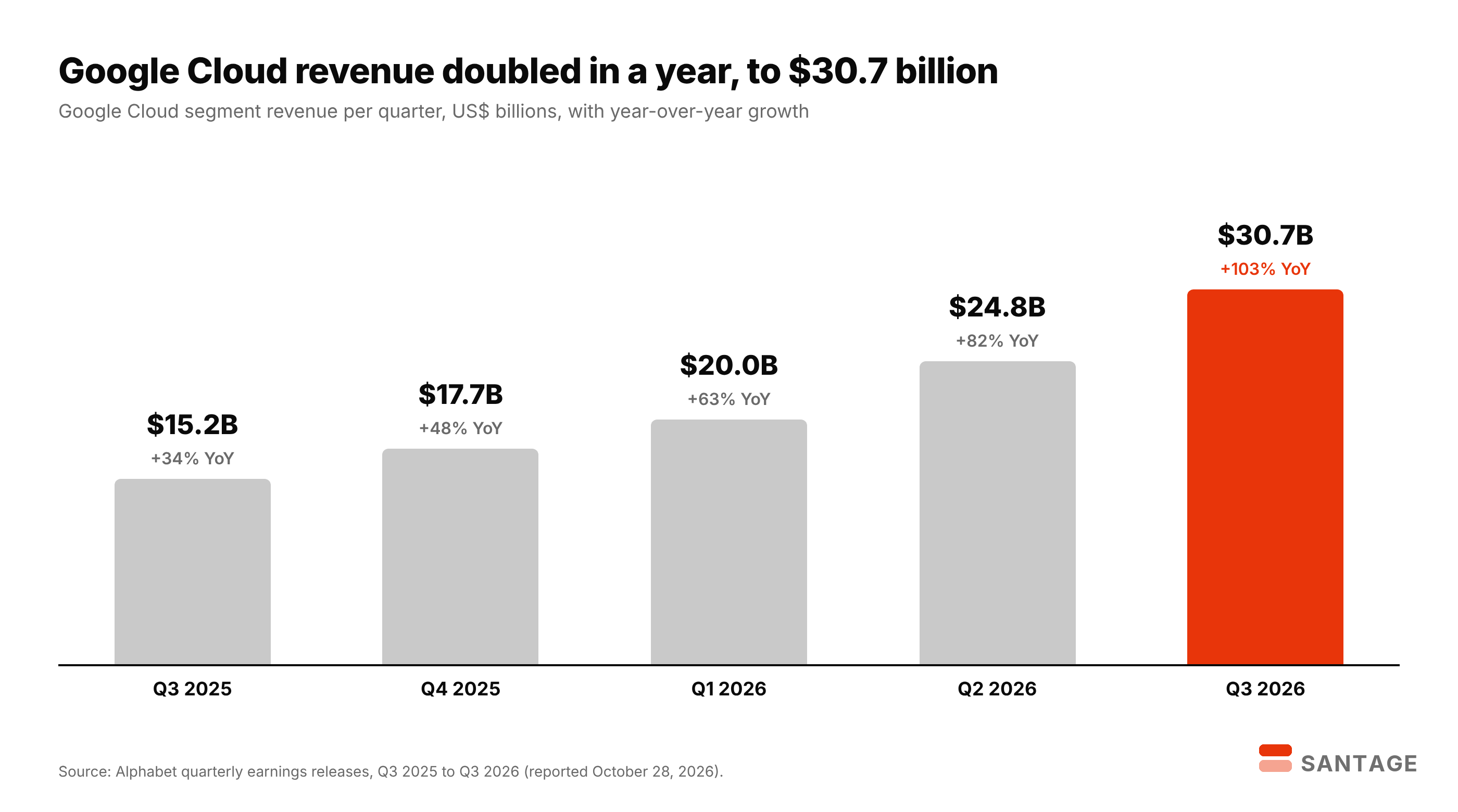
- Google Cloud revenue rose 103% to $30.7 billion and its operating income more than tripled to $11.1 billion, a 36.2% margin, with a $561 billion backlog.
- Alphabet named Anthropic, Apple, Meta, Oracle and trading firms among TPU customers and partners, a day after Oracle agreed to offer TPUs in its own cloud from 2027.
- Capex of $51.4 billion drove free cash flow to minus $9.1 billion, and Alphabet shares fell more than 11% after hours despite the cloud result.
Google has become an AI chip supplier at hyperscale, and its cloud unit’s results now show it. Alphabet reported on October 28 that Google Cloud revenue more than doubled to $30.7 billion in the third quarter, up from $15.2 billion a year earlier, with sales of its Tensor Processing Unit (TPU) systems to outside data centers named as a meaningful driver, according to Alphabet’s earnings release. The same quarter cost Alphabet $51.4 billion in capital spending and pushed free cash flow to negative $9.1 billion.
Google Cloud grew faster than any hyperscaler at this scale
The acceleration has been steady for a full year. Growth rose from 34% in the third quarter of 2025 to 48%, 63%, 82% and now 103%, and the segment’s quarterly revenue is approaching that of Microsoft Azure, which grew 48% to $33.2 billion in the quarter Microsoft reported the same evening, according to Microsoft’s results.
Profitability rose faster than sales. Cloud operating income reached $11.1 billion, against $3.6 billion a year earlier, lifting the margin from 23.7% to 36.2%. Alphabet said just over 55% of the $561 billion backlog should turn into revenue within 24 months, which implies roughly $300 billion of contracted cloud sales over the next two years.
| Q3 2026 | Google Cloud | Microsoft Azure |
|---|---|---|
| Quarterly revenue | $30.7 billion | $33.2 billion |
| Year-over-year growth | 103% | 48% |
| Parent company capex in the quarter | $51.4 billion | $45.2 billion |
| Forward signal | $561 billion cloud backlog | Azure guided to 49% to 50% growth next quarter |
TPU systems turned Alphabet’s chips into a product line
Alphabet began delivering TPU systems into customers’ own data centers in the second quarter, and on the third-quarter call management called those sales a meaningful contributor that should keep scaling in the fourth quarter and ramp significantly in 2027. It named Anthropic, which buys directly and through Broadcom, along with Apple, Meta, Citadel Securities, Jump Trading and Caltech, and listed Oracle and the Crux AI venture as partners delivering TPU systems.
“We see strong demand for our TPU systems across a wide range of customers, and we expect that to continue as we scale.”
Sundar Pichai, CEO, Alphabet, Q3 2026 earnings call, October 28, 2026
The customer list widened in the 48 hours before the results. Oracle said on October 27 that Google’s chips will be available in Oracle Cloud Infrastructure from 2027, the first hyperscale cloud outside Google to offer them, and The Information reported the same day that OpenAI plans to buy TPUs outright after renting them since 2025, which neither company has confirmed. A week earlier OpenAI had put its models on Google Cloud. Google’s three largest AI rivals are now, or are reportedly about to become, buyers of its AI infrastructure.
Google now earns from the AI race whichever model wins it. Anthropic, Meta and Apple already run on its chips, and OpenAI is reportedly next, which turns Gemini’s competitors into Google Cloud’s growth.
Spending outran cash generation for a second straight quarter
The bill is the reason shares fell. Capex of $51.4 billion was more than double the $24 billion of a year earlier, bringing spending for the first nine months to $132 billion against an unchanged 2026 guide of $195 billion to $205 billion, and Alphabet said 2027 spending will rise significantly from there. Free cash flow was negative for the second quarter running, after Alphabet raised $84.75 billion in equity in June to fund the buildout.
| Google Cloud revenue | $30.7 billion, up 103% |
| Cloud operating margin | 36.2%, up from 23.7% |
| Capital expenditure in the quarter | $51.4 billion, up from about $24 billion |
| Free cash flow | Negative $9.1 billion |
Selling TPU systems also changes how Google Cloud books revenue. A chip sale is recognized when hardware is delivered, while cloud rentals are earned over years, so part of the 103% reflects one-time system deliveries that need replacing each quarter to sustain the rate. Alphabet said cloud growth was strong excluding TPU systems, without giving the split, and warned that third-party capacity coming online in the fourth quarter will pressure cloud margins.
Investors are now pricing the cash, and the revenue counts for less
Alphabet’s revenue rose 25% to $127.6 billion, a half-trillion-dollar annual run rate, and Gemini passed one billion app users, yet the stock fell more than 11% in after-hours trading. Microsoft’s shares rose about 4% the same evening after it reported Azure growth above its own forecast on capex below its guidance. For Meta, which launched a stock sale this week to fund its AI spending, and every other hyperscaler, the market has moved from rewarding AI revenue to asking how much cash each dollar of it consumes.
Google Cloud’s quarter answers the demand question for AI compute in full, with rivals lining up to buy Google’s own silicon. The open question for 2027 is whether TPU system sales can keep cloud growth near 100% while Alphabet spends more than it earns from operations, because that gap is what investors marked down on October 28.
Santage is committed to independent, transparent journalism. This article is produced in accordance with Santage's Editorial Standards and aims to provide accurate and timely information. Readers are encouraged to verify information independently.