
- AWS revenue rose 39% to $46.0 billion and its operating income climbed to $17.8 billion from $11.4 billion, a 38.7% margin.
- Amazon’s total operating margin reached 13.9%, its highest ever, on operating income of $28.1 billion.
- Property and equipment purchases hit $77.3 billion in the quarter, and trailing free cash flow swung to an outflow of $42.4 billion.
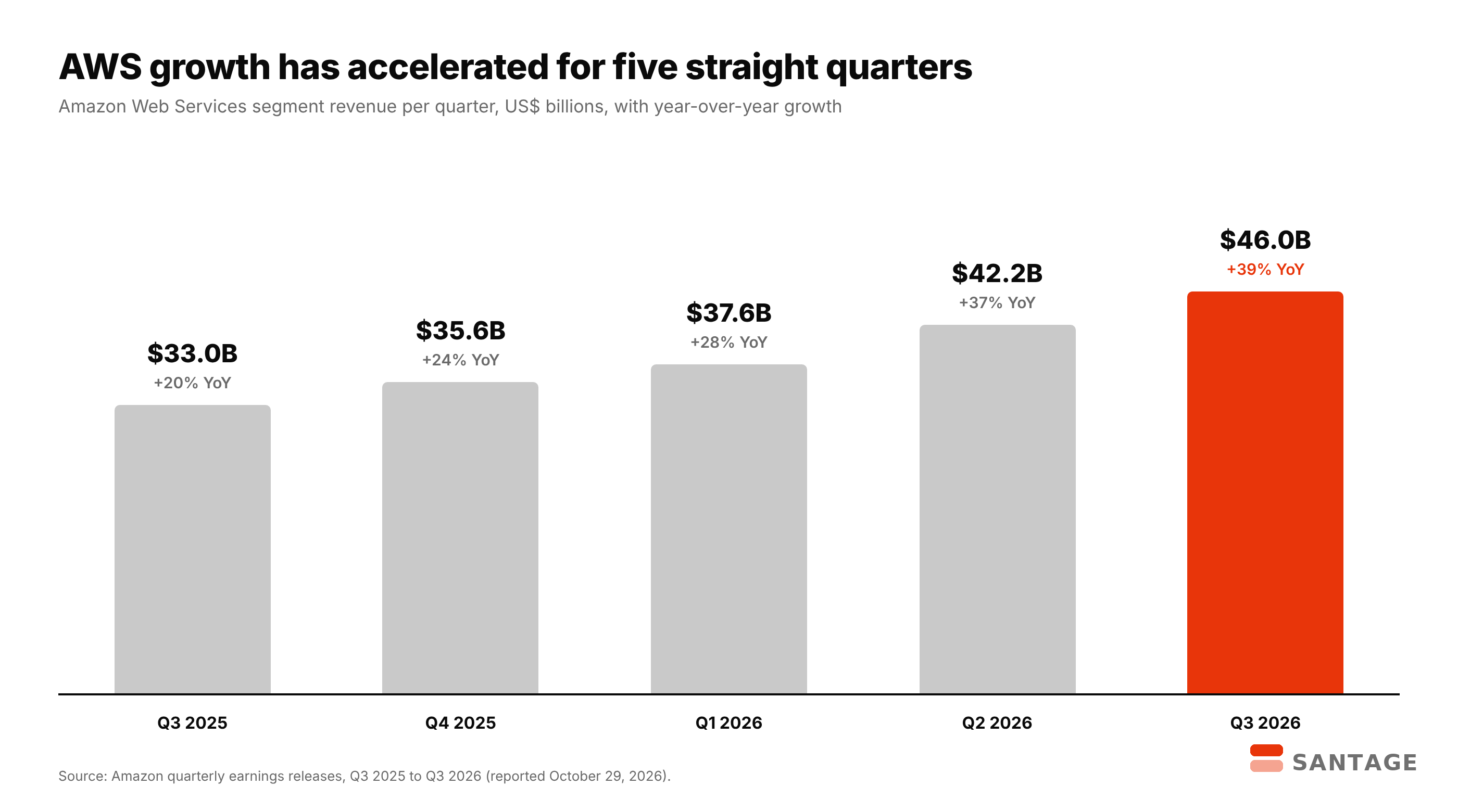
Amazon Web Services grew faster in the third quarter than at any point in recent years, and the bill for that growth is now the largest in Amazon’s history. AWS revenue rose 39% to $46.0 billion in the three months to September 30, putting the cloud unit on a $184 billion annual run rate, while Amazon spent $77.3 billion on property and equipment in the same quarter, according to Amazon’s earnings release filed on October 29.
AWS has accelerated for five consecutive quarters
The growth rate has climbed every quarter since the third quarter of 2025, when AWS grew 20%. It reached 24% at the end of 2025, 28% in the first quarter of 2026, 37% in the second and 39% now, which adds roughly $13 billion of quarterly revenue in a single year.
AI demand shows up most clearly in Amazon Bedrock, the service that sells access to outside and in-house models. Amazon said Bedrock token volume grew nearly 17 times year over year and that Fortune 500 spending on the service rose nearly sevenfold, while customers of its AgentCore agent platform deployed twice as many AI agents in the quarter as in the previous three combined. Amazon also disclosed a new AWS agreement with OpenAI, alongside GPT-6 variants and Claude 5 models added to Bedrock.
“There has never been a trillion dollar revenue business, and we may have two of them in the next 5-10 years.”
Andy Jassy, CEO, Amazon, Q3 2026 earnings release, October 29, 2026
AWS is now the slowest-growing hyperscaler at the largest scale
Amazon’s 39% sits below the rates its rivals posted a day earlier, yet AWS still adds more dollars per quarter than either of them. The comparison with Alphabet’s and Microsoft’s results shows how the race has split between base and speed.
| Q3 2026 | AWS | Microsoft Azure | Google Cloud |
|---|---|---|---|
| Quarterly revenue | $46.0 billion | $33.2 billion | $30.7 billion |
| Year-over-year growth | 39% | 48% | 103% |
| Parent company capex in the quarter | $77.3 billion | $45.2 billion | $51.4 billion |
The spending explains why Amazon reports a record margin and a cash outflow in the same quarter. Trailing twelve-month purchases of property and equipment reached $215.2 billion, against operating cash flow of $168.3 billion, leaving free cash flow at negative $42.4 billion compared with a positive $14.8 billion a year earlier. Amazon has guided to roughly $220 billion of capital spending for 2026, the bulk of it tied to AI infrastructure.
| AWS revenue | $46.0 billion, up 39% |
| AWS operating margin | 38.7%, on operating income of $17.8 billion |
| Property and equipment purchases in Q3 | $77.3 billion |
| Trailing twelve-month free cash flow | Negative $42.4 billion |
For the fourth quarter Amazon guided to net sales of $240 billion to $247 billion and operating income of $28.5 billion to $33.5 billion. Group net income slipped to $20.7 billion from $21.2 billion only because last year’s quarter included $9.5 billion of gains on Amazon’s Anthropic stake.
AWS has answered the question of whether Amazon could keep pace in AI demand, with growth now near 40% on a business larger than Azure and Google Cloud. The question for 2027 is how long Amazon can spend $77 billion a quarter while the cloud unit’s margin holds near 39%, because that margin is what pays for the buildout.
Santage is committed to independent, transparent journalism. This article is produced in accordance with Santage's Editorial Standards and aims to provide accurate and timely information. Readers are encouraged to verify information independently.