
- DeepSeek's own table puts V4.1-Flash-1017 at 77.0 on the DeepSWE v1.1 coding benchmark, above Claude Opus 5 at 74.0 and GPT-5.6 Sol at 73.0, while it still trails Opus 5 on reasoning and terminal tasks.
- DeepSeek compared itself with models a generation old, and against current flagships its DeepSWE score sits just behind Gemini 4 Argon's 77.9 while its Terminal-Bench score trails Claude Opus 5.5 by 24 points.
- The lab also opened Search and Fetch APIs at $0.75 per 1,000 calls each, free inside DeepSeek Harness, Claude Code and Codex until billing starts on October 31 at 16:00 UTC.
DeepSeek released DeepSeek-V4.1-Flash-1017 on October 17, an update to its fast open model that the Chinese lab says outscores OpenAI's GPT-5.6 Sol on 9 of the 11 benchmarks it published, with the full weights available under an MIT license. The release note calls the model “a Pareto improvement in performance and cost,” and it now answers every API call made to deepseek-flash, replacing the version DeepSeek shipped in September.
DeepSeek's update lifts agentic and coding scores over its September release
The model card describes 1017 as a minor update to V4.1-Flash, yet the gains over its predecessor are large on agent work. Terminal-Bench 4.0 rose from 31.2 to 42.3, ProgramBench from 20.3 to 29.1, and Humanity's Last Exam without tools from 36.8 to 42.6. DeepSeek says the model uses “reinforcement learning with self-feedback to improve end-to-end project development” and finishes tasks faster with shorter outputs, which cuts cost per task.
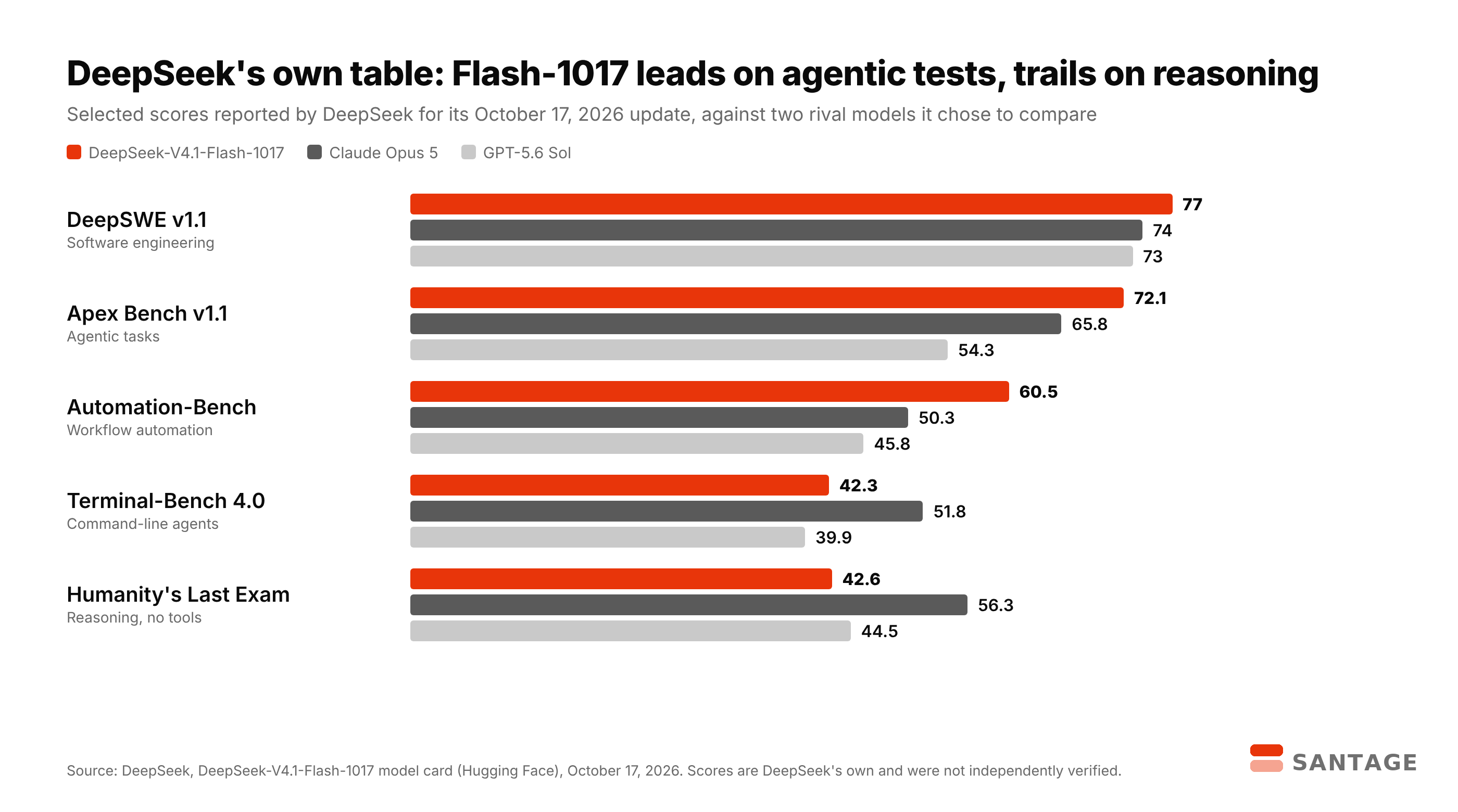
Against Opus 5 the picture is closer, with DeepSeek ahead on 4 of the 11 tests, including Apex Bench (72.1 against 65.8) and Automation-Bench (60.5 against 50.3). Both comparison models are a generation old. Vendor-published scores for today's flagships put Google's Gemini 4 Argon at 77.9 on DeepSWE and Claude Opus 5.5 at 74.2, while Opus 5.5 scores 66.4 on Terminal-Bench 4.0 against DeepSeek's 42.3. Labs run these tests with different harnesses, and none of DeepSeek's figures has been independently reproduced.
| Output, per million tokens | $0.60 off-peak, $1.20 peak |
| Input, per million tokens (cache miss) | $0.15 off-peak, $0.30 peak |
| Context window | 1 million tokens, up to 384K output |
| Search or Fetch API | $0.75 per 1,000 successful requests each |
| Peak hours | 01:00 to 04:00 and 06:00 to 10:00 UTC, weekdays |
DeepSeek is selling web search into rival coding agents
The more consequential launch sits beside the model. DeepSeek's new Search and Fetch endpoints run on what it calls its in-house search engine, “serving hundreds of millions of requests daily worldwide,” and the company has made those tools free when called from its own DeepSeek Harness and from Anthropic's Claude Code and OpenAI's Codex until per-request billing begins. A Chinese lab is pricing a piece of agent infrastructure for developers who build on its two largest American competitors' tools, a sign that competition among open-weight models now extends to whoever supplies an agent's view of the web.
On DeepSWE a free, MIT-licensed model now sits within a point of Google's best published score, while on Terminal-Bench it trails Claude Opus 5.5 by 24 points, which places the remaining open-model gap in long-running command-line agent work.
The timing also lands one day after Beijing published draft export controls covering 23 AI technologies, which would put the weights of the largest models under licensing. The rules are still a draft and exclude open-source releases already published, so 1017 shows Chinese labs still releasing weights freely while the controls remain unsettled.
For developers, the practical result is a model that comes within a point of the best American systems on software engineering tests at a fraction of their price, with a web search bill attached that starts at the end of the month.
Santage is committed to independent, transparent journalism. This article is produced in accordance with Santage's Editorial Standards and aims to provide accurate and timely information. Readers are encouraged to verify information independently.