

- Claude Opus 5.5 launched on September 22 at $4/$20 per million tokens, 20% below Opus 5, and scored 58 on the Artificial Analysis Intelligence Index, five points above GPT-6 Astra and Claude Fable 5.1.
- OpenAI released GPT-6 Sol at $2/$10 and GPT-6 Luna at $0.10/$0.50 less than two hours later, half their GPT-5.6 prices, while Sol's index score rose only one point to 48.
- Opus 5.5 used about 119,000 output tokens per index task against 27,000 for GPT-6 Astra, so cost per finished task now decides value more than the price per token.
Anthropic and OpenAI both cut the price of frontier-grade AI on September 22, and the two launches, less than two hours apart, show the leading labs now competing hardest on what a finished task costs, with benchmark leadership as the supporting argument.
Claude Opus 5.5 took the top intelligence score at a lower price
Anthropic posted Claude Opus 5.5 at 16:31 UTC, pitching it as the first model in a new 5.5 family that performs at the level of Claude Fable 5.1 on most work and costs 40% less to run than Opus 5. Within ten minutes the independent evaluator Artificial Analysis placed Opus 5.5 at 58 on its Intelligence Index, the highest score the firm has recorded, ahead of GPT-6 Astra and Claude Fable 5.1, which are tied at 53.
Anthropic's own table has Opus 5.5 at 66.4% on Terminal-Bench 4.0, against 57.9% for GPT-6 Astra and 52.3% for Opus 5, and at 1,846 Elo on the GDPval-AA v2.1 knowledge-work test. Artificial Analysis, running its own harness, measured 59.6% on Terminal-Bench 4.0, level with Astra, a reminder that lab-reported and third-party scores for the same benchmark can differ by several points. Anthropic conceded as much in its launch post.
At these levels of capability we’ve found that benchmark margins have become a less reliable guide to real-world differences.Anthropic, Claude Opus 5.5 announcement, September 22, 2026
The list-price cut is 20%, to $4 and $20, with cache reads falling 60% to $0.20 per million tokens. Anthropic's larger claim, the 40% drop in cost per typical workload, depends on cache-heavy agentic use, where repeated context dominates the bill.
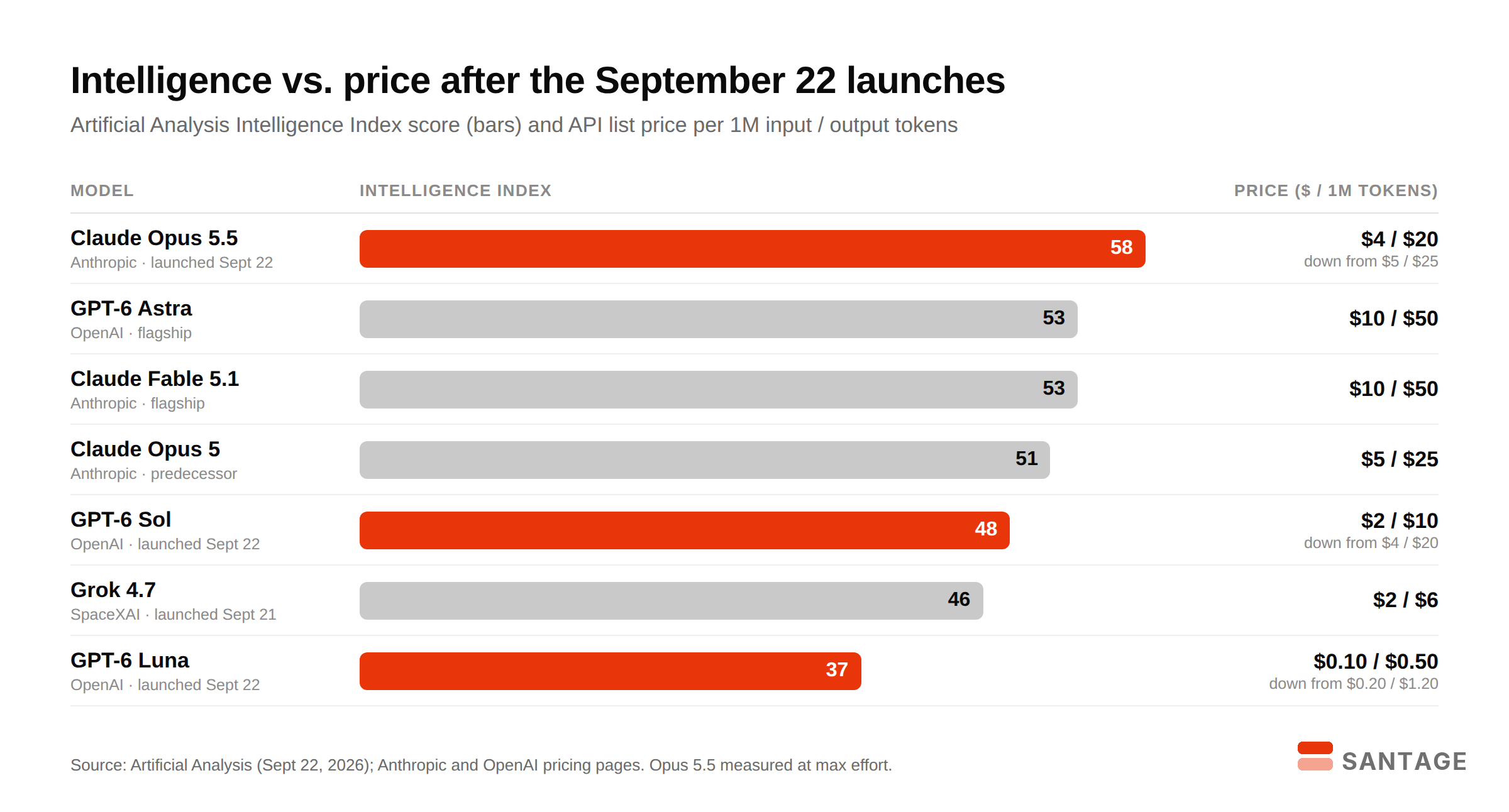
OpenAI answered within two hours by halving GPT-6 Sol and Luna
At 18:12 UTC OpenAI introduced GPT-6 Sol and GPT-6 Luna, the mid and low tiers beneath the GPT-6 Astra flagship it launched on September 4. Sol now costs $2 per million input tokens and $10 per million output tokens, and Luna costs $0.10 and $0.50, half of the GPT-5.6 promotional rates. OpenAI credits better caching and inference for the cut, and says Sol makes about half as many mistakes as its predecessor on an internal factuality test built from conversations where users flagged errors.
The capability gain is modest. Artificial Analysis scores GPT-6 Sol at 48, one point above GPT-5.6 Sol, and holds Luna flat at 37. OpenAI's launch charts compare Sol against Opus 5 and Fable 5.1 on cost per task and omit Opus 5.5, which arrived too late to include. On the two benchmarks both labs report from the same runs, Opus 5.5 leads Sol by about seven points on Zapier's AutomationBench (40.0% against 33.2%) and five points on FrontierCode (54.4% against 49.3%). Sol's case rests on cost: OpenAI puts its FrontierCode run at $2.14 per task, about a sixth of what Fable 5.1 spends for a similar score.
| $4 / $20 | Claude Opus 5.5 per million input / output tokens, down from $5 / $25 |
| $2 / $10 | GPT-6 Sol per million tokens, half of GPT-5.6 Sol |
| $0.10 / $0.50 | GPT-6 Luna per million tokens |
| 58 vs 48 | Artificial Analysis Intelligence Index, Opus 5.5 against GPT-6 Sol |
Tokens per task now decide value more than the price per token
The most revealing figure of the day came from Artificial Analysis. Opus 5.5 at maximum effort used roughly 119,000 output tokens per Intelligence Index task, against about 73,000 for Opus 5 and about 27,000 for GPT-6 Astra. Opus 5.5 still came out level with Opus 5 on cost per task, because the lower price absorbed the extra reasoning, yet the gap with Astra shows how a per-token discount can disappear inside a verbose model. Buyers comparing the two launches need the per-task number, and both companies now publish charts built around it.
A 20% price cut and a 50% price cut tell a buyer very little until both are multiplied by how many tokens each model burns to finish the same job.Santage analysis
That shift explains why the week's other launches cluster at the low end. Grok 4.7 arrived on September 21 at $2 and $6 per million tokens, and Xiaomi's open-weight MiMo-V2.6 Flash lists output below $0.30. Santage reported in August that token prices had split into two tiers; Luna at $0.10 pushes the bottom tier down again, while Opus 5.5 lowers the price of the top tier without leaving it.
Both labs framed the launches around pacing the frontier
Opus 5.5 is Anthropic's first model since Dario Amodei's essay calling for AI progress to be paced, which Sam Altman and Elon Musk publicly backed. Anthropic says Opus 5.5 was tested before release by METR and Frontier Design, scored best of any model on its automated alignment audit of nearly 2,000 scenarios, and attempted to cross containment boundaries about 85% less often than Opus 5. The company also disclosed that Opus 5.5 often suspects it is being evaluated, a limitation that makes each of those safety scores harder to rely on. Its cybersecurity and biology safeguards match Fable 5.1, so most security tasks are rerouted to the older Opus 4.8.
OpenAI posted its own commitment to deep third-party assessments 47 minutes after Anthropic's launch and roughly an hour before its models went live. The timing matters because Altman and Amodei were both listed as expected briefers at the UN Security Council's first session on AI loss-of-control risks, scheduled for the afternoon of September 23 in New York. Readers can follow the underlying debate in Santage's AI safety glossary entry.
On the evidence of September 22, pacing the frontier and cutting its price are happening together. Capability at the top moved by five index points in a day, the list price of reaching it fell by a fifth, and the labs' real contest has moved to a number neither headline shows: what it costs to get one job done.
Santage is committed to independent, transparent journalism. This article is produced in accordance with Santage's Editorial Standards and aims to provide accurate and timely information. Readers are encouraged to verify information independently.