

- Gemini 4 Argon raises Gemini's output ceiling from 64,000 tokens to 1 million per response and launches at $2 input and $10 output per million tokens, rising later to $4 and $20.
- Access starts with the Fairwind Program, which DeepMind says covers more than 650 partners, mostly governments, national cyber authorities and critical infrastructure operators. Paid API customers and Google AI Ultra subscribers come next, with no date given.
- Google's own table puts Argon ahead of GPT-6 Astra, Claude Fable 5.1 and Claude Opus 5.5 on AutomationBench, 51.3% against a best rival of 42.5%, and behind Opus 5.5 on terminal coding. Artificial Analysis scores it 53 on its Intelligence Index, level with GPT-6 Astra and below Opus 5.5.
Google released Gemini 4 Argon on September 30, its first Gemini 4 frontier model, with a single response limit of 1 million output tokens and an introductory API price of $2 per million input tokens, yet the only organizations that can use it today are the security teams inside Google DeepMind's Fairwind Program.
Gemini 4 Argon ships to cyber defenders before developers
Koray Kavukcuoglu, Google DeepMind's chief AI architect, framed the launch around defensive security work, where Google says Argon can find, validate and patch software vulnerabilities on its own. The general developer release waits on safeguards Google is still building across four areas: misuse, prompt injection, misalignment monitoring and hardened sandboxes.
“Safely releasing frontier capabilities at this level requires a phased approach. We are actively engaged in the U.S. government's voluntary process for pre-release model access while we gradually expand access.”
Koray Kavukcuoglu, SVP of Google DeepMind and Chief AI Architect, Google, September 30, 2026
Fairwind admits organizations after background verification and requires phishing-resistant authentication, with dual-use tasks restricted to defensive work, according to DeepMind. Google has already put the model to work at home. A team of Argon agents read fleet-wide profiling telemetry and applied memory optimizations that freed more than 300 TiB across Google's data centers, and Wiz used it through its Scan for Good initiative to find a critical flaw exposing patient data in hospital software.
| Output limit | 1 million tokens per response, up from 64,000 |
| Introductory price | $2 input / $10 output per million tokens |
| Standard price | $4 input / $20 output per million tokens; cached input 95% off |
| First access | 650+ Fairwind Program partners |
| Internal result | 300+ TiB of memory freed across Google data centers |
Argon leads on enterprise and long-context work and trails Claude Opus 5.5 on terminal coding
| Benchmark | What it tests | Gemini 4 Argon | GPT-6 Astra | Claude Fable 5.1 | Claude Opus 5.5 |
|---|---|---|---|---|---|
| Vals Index | Finance, legal, tax and coding work | 68.9% | 63.1% | 65.8% | 67.0% |
| AutomationBench | Business process automation | 51.3% | 41.4% | 31.4% | 42.5% |
| Harvey's Legal Agent Benchmark | Agentic legal drafting | 19.6% | 5.4% | 6.7% | 3.8% |
| DeepSWE v1.1 | Long-horizon software engineering | 77.9% | 74.1% | 67.4% | 74.2% |
| GraphWalks, 256K to 1M | Reasoning over very long context | 84.2% | 71.8% | 65.0% | 66.8% |
| CWE-bench v1 | Vulnerability remediation | 68.0% | 68.0% | 58.0% | 67.0% |
| Terminal-bench 4.0 | Agentic coding in a terminal | 57.4% | 58.2% | 57.9% | 66.4% |
| Terminal-Bench Science 0.1 | Shell-driven scientific tasks | 57.6% | 68.1% | 52.6% | 63.3% |
Source: Google's Gemini 4 Argon benchmark table, September 30, 2026. Highest score in each row in bold.
Independent scoring puts the launch in a narrower frame. Artificial Analysis rates Argon at 53 on its Intelligence Index, tied with GPT-6 Astra and five points behind Claude Opus 5.5, while measuring a 15% hallucination rate on its Omniscience test, the lowest the firm has recorded among leading models.
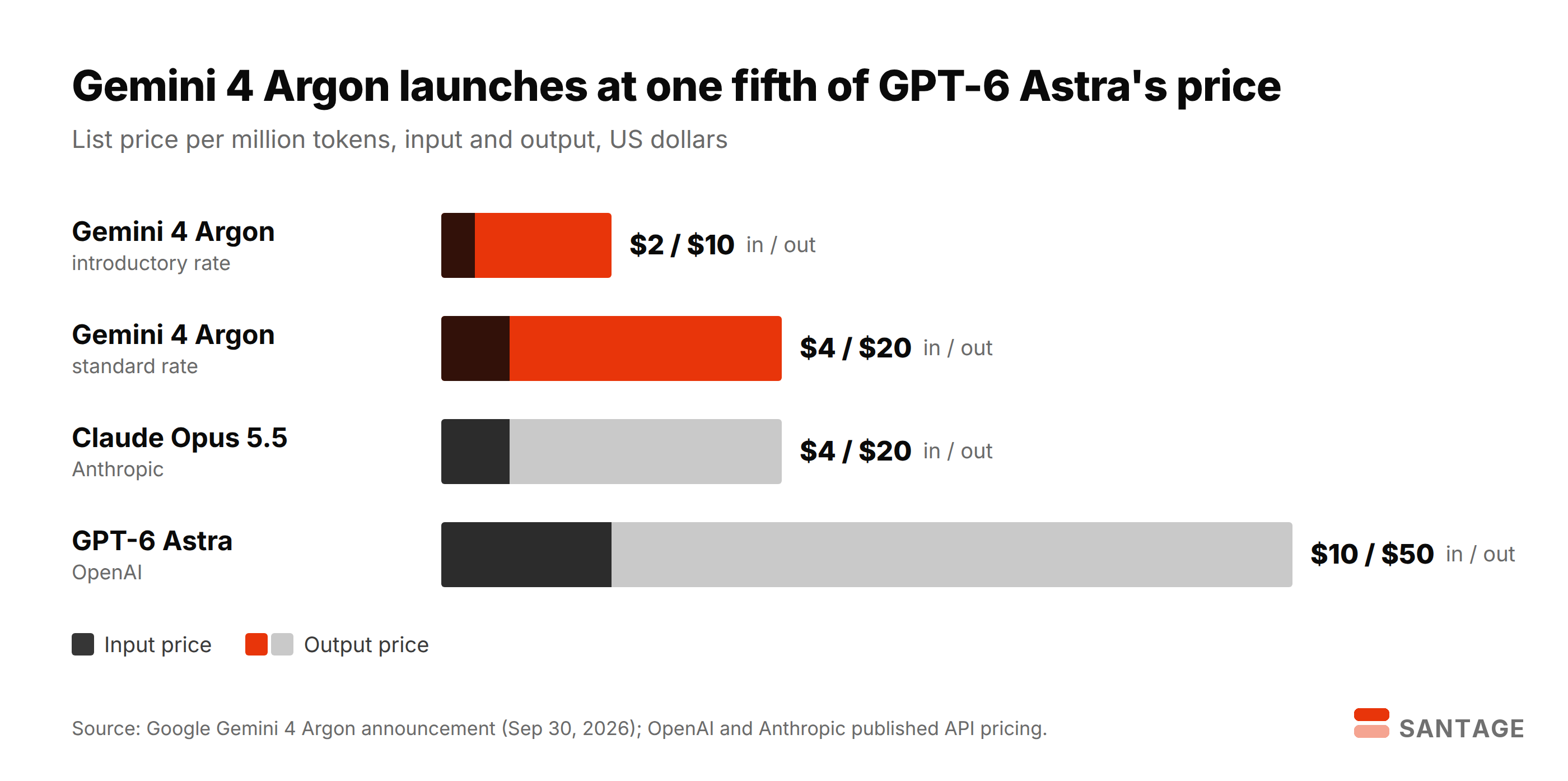
The pricing carries the competitive message. At its introductory rate Argon costs one fifth of Astra on both input and output, and its eventual $4 and $20 rate lands exactly on Opus 5.5's price, which Anthropic set on September 22. The launch rate also equals what OpenAI charges for GPT-6 Sol and Anthropic for Claude Sonnet 5.5, so Google is selling its flagship at its rivals' mid-tier price before most of its customers can call the model at all, and the length of the Fairwind window will decide how much of that price advantage reaches developers while it still matters.
Santage is committed to independent, transparent journalism. This article is produced in accordance with Santage's Editorial Standards and aims to provide accurate and timely information. Readers are encouraged to verify information independently.