
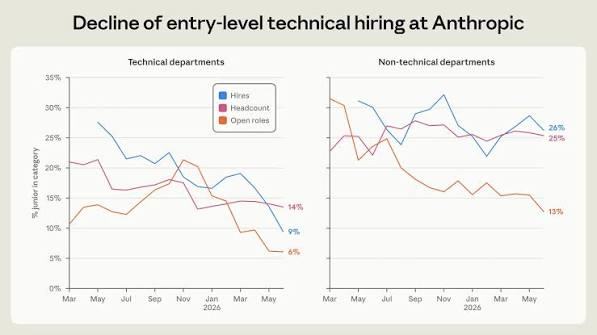
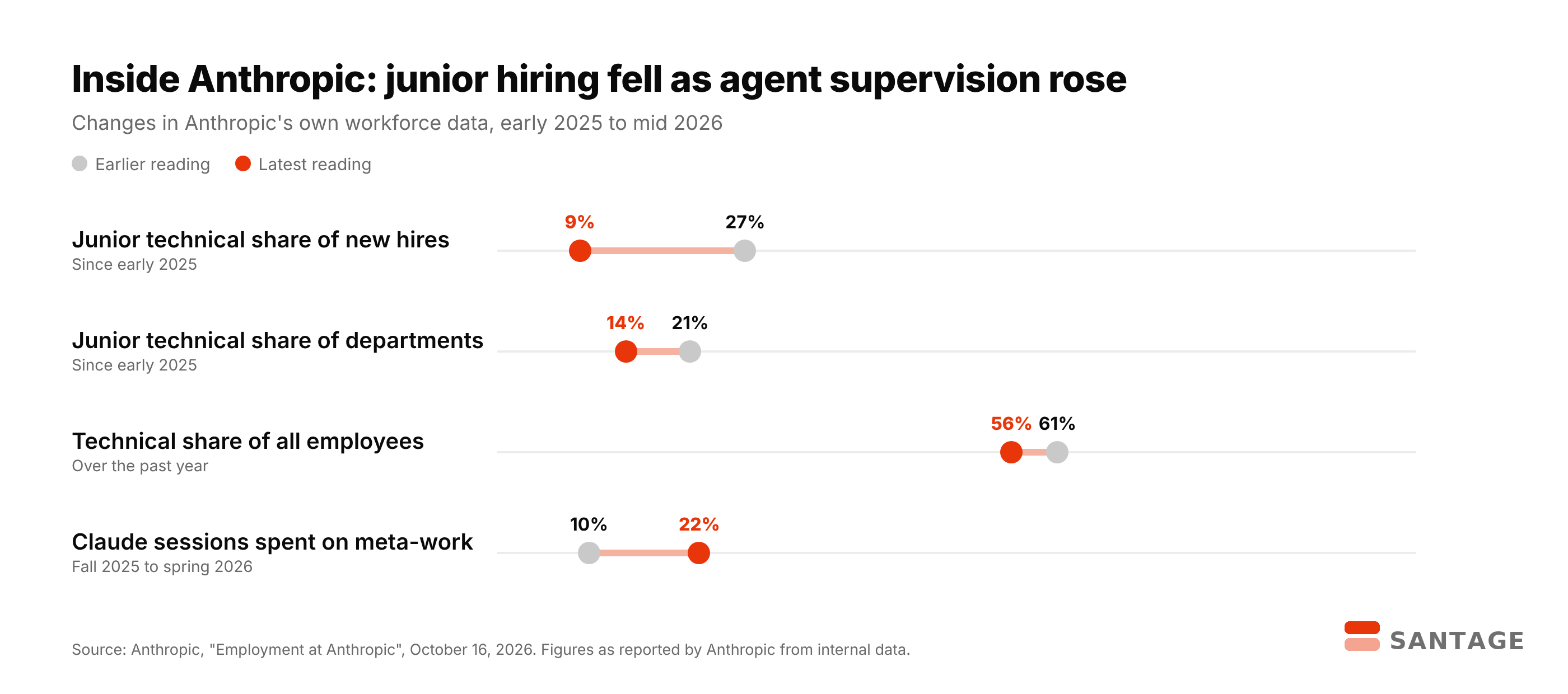
- Junior technical hires at Anthropic fell from 27% to 9% of all technical hires, junior postings dropped sharply after December 2025, and the technical share of the workforce slipped from 61% to 56%.
- Interactive agent hours reached six times employee hours by August, while about 80% of Claude session time is spent waiting for a human to respond.
- Anthropic staff expect AI to be able to do 75% of their work hours by 2030, against 28% for US workers, and the evidence for that view comes from one of the most AI-saturated companies in the world.
Anthropic has published the most detailed account yet of what happens inside a company that runs on its own AI agents, and the sharpest change it reports is at the entry level, where junior roles fell from 27% of technical hires to 9% since early 2025. The study, “How employment is changing at Anthropic”, written by four Anthropic economists and released on October 16 alongside a national survey comparing its staff with American workers, describes a workplace where agents now log six times the hours of the people supervising them and where human attention has become the scarce input.
Anthropic's own data shows entry-level technical hiring falling by two thirds
The study draws on headcount records, hiring scorecards, calendars, Slack activity, Claude usage logs and 17 employee interviews covering the twelve months to April 2026. Its clearest finding concerns who gets hired. Junior employees made up 21% of technical departments in early 2025 and 14% by mid 2026, and around a third of machine learning managers and a fifth of software engineering managers said in an April survey that they were hiring less because of AI.
Output moved the other way. Commits per engineer run at about five times the pace of six months earlier, the ratio of engineers to product managers has climbed to roughly 17 to 1, and coding agent sessions started by non-technical staff rose from 2 a month in August 2025 to 90 in May 2026. Anthropic estimates its revenue per employee at two to four times what Meta and Google earned at the same five-year mark, using their annual filings. The hiring numbers show who absorbed the cost of that shift: the people who would once have learned the job by doing its routine parts.
Agents now log six times the hours of Anthropic's employees
Combined autonomous and interactive agent hours first passed human work hours in March 2026, and by August the interactive AI agents run by individual employees logged six times the hours of the staff directing them. Standing instructions for agents grew from a few hundred in July 2025 to 8,500 a year later, and agents now appear in nearly half of Anthropic's active public Slack channels.
| Interactive agent hours vs employee hours | 6 to 1 by August 2026 |
| Claude session time spent waiting on a human | About 80% |
| Median employee meeting time | Up 20% year over year |
| Standing agent instructions | 8,500, up from a few hundred in July 2025 |
| Company headcount | Tripled over the past year |
The more revealing numbers describe the people on the other side of those agents. About 80% of interactive Claude session time is spent idle until a person replies, reading every word Claude produces for non-technical teams would take more than half a working week, and the share of sessions devoted to meta-work, meaning the coordination of other agent work, rose from 10% to 22% between fall 2025 and spring 2026. Median meeting time grew 20% over the year. One engineer quoted in the report describes facing “an army of Claudes, with every one asking for my attention.”
“Agents did not replace human interaction, but rather added to it.”
Anthropic, “How employment is changing at Anthropic”, October 16, 2026
The bottleneck in an agent-heavy company has moved from producing work to reviewing it, which explains why senior staff with judgment become more valuable at the same moment the training ground for that judgment shrinks. Hiring scorecards point the same way, with interviewers commenting more on candidates' autonomy and judgment and less on domain expertise.
Anthropic staff expect AI to do 75% of their work by 2030, US workers expect 28%
The companion survey, run with Morning Consult among 10,980 American adults in August and with 1,334 Anthropic employees in an internal poll the same month, measures how far that experience has shaped beliefs. Staff and the public mostly agree on what AI can do today and diverge sharply on the pace of change from here.
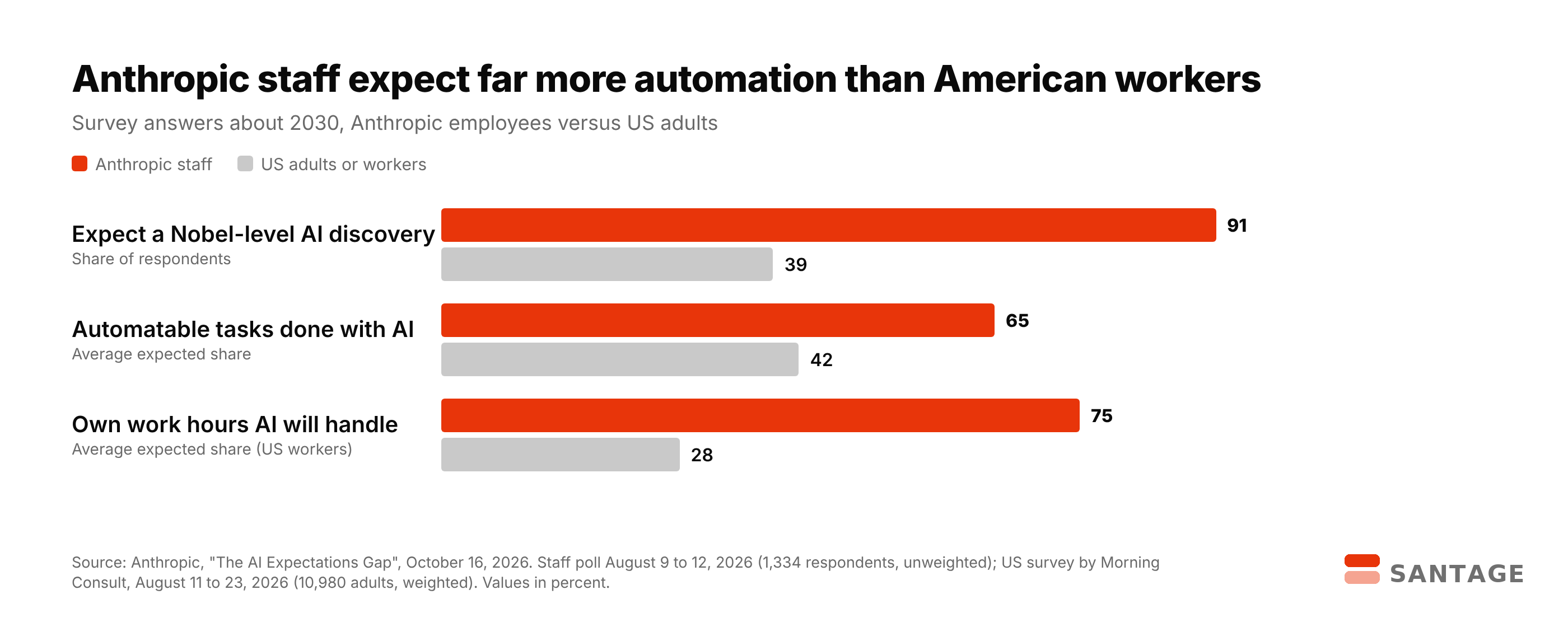
Only about 1 in 20 US workers expects AI to be able to do 80% or more of their hours by 2030, and that group forecasts 12.2% unemployment that year, against the 4.2% rate respondents were shown. Staff also estimate AI already does a median 51% of the work of building a frontier model and expect that to reach 95% by the end of 2030. Translated through the authors' economic model, the median staff member's answers imply 17.1% US GDP growth in 2030, compared with 5.4% for the median American.
Anthropic is a ceiling case for AI at work, and the authors work for it
Every figure in both reports comes from Anthropic, about Anthropic, and the authors flag the obvious limits themselves: the staff poll is unweighted, staff answers are personal views, and the US panel is opt-in online. The company sits at the extreme of AI adoption, it has tripled in size in the last year, and it is preparing for a public listing in which evidence that Claude multiplies output per employee is also a sales argument. An Anthropic executive quoted in the study offers the human counterweight: “a workforce that is anxiously worried is not a workforce doing its best work.”
The most important number in Anthropic's study is the 9%, because a company that tripled its headcount while cutting its junior technical intake to a third of its former share is showing employers elsewhere how AI changes hiring before it changes total employment.
The data shows a company built around agents that keeps hiring experienced people while narrowing the junior path into the profession, and the worry it describes is already global, with workers in 34 of 37 countries telling Pew they expect AI to cut jobs. If other employers follow Anthropic's pattern, the first measurable labor effect of agentic AI will be a missing cohort of junior engineers, and the companies that deploy agents fastest will be the ones that have to decide who trains their next generation of reviewers.
Santage is committed to independent, transparent journalism. This article is produced in accordance with Santage's Editorial Standards and aims to provide accurate and timely information. Readers are encouraged to verify information independently.