
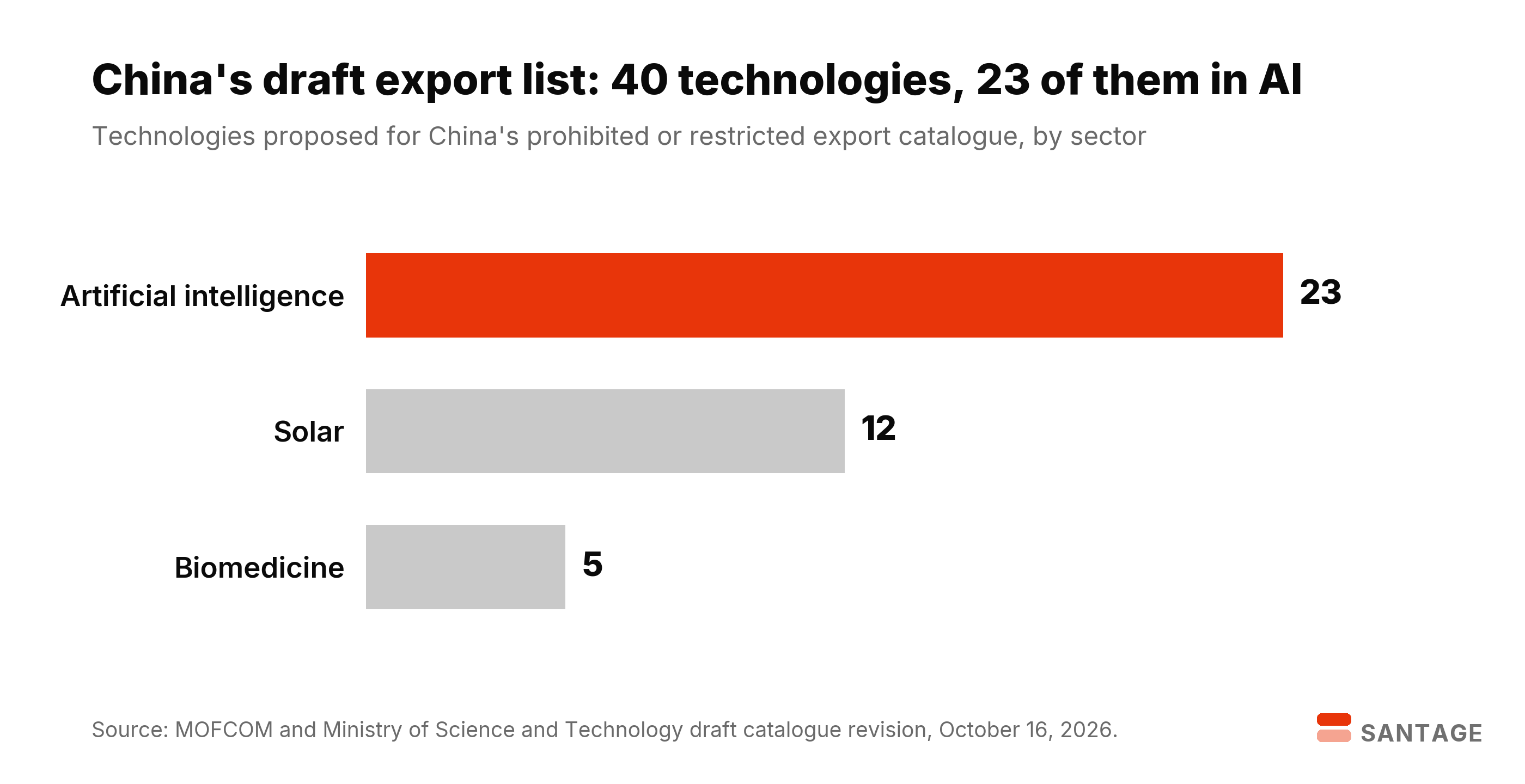
- China's draft adds 40 technologies to its export control catalogue, 23 in AI, 12 in solar and 5 in biomedicine, with comments due November 15 and registration required from October 16.
- Weights, checkpoints and source code of models trained with 10^26 or more operations, holding 2 trillion or more parameters, or ranking in the global top 10 on a covered metric would need an export licence.
- API, app and SaaS access to Chinese models stays outside the controls, and models already released as open source are excluded, while future open releases fall under automatic licensing.
China has drafted export rules that would put a licence requirement on the weights of its largest AI models while leaving the API channel that sells those models to the rest of the world untouched. On October 16, the Ministry of Commerce (MOFCOM) and the Ministry of Science and Technology published a proposed revision to China's catalogue of technologies prohibited or restricted from export, adding 40 technologies, 23 of them in artificial intelligence, with 14 proposed for outright prohibition and 26 for restriction. Public comments are open until November 15, and an interim rule that took effect the same day already requires companies to register exports of listed technologies, including deals that are under way but not yet complete.
The draft licenses model weights above 2 trillion parameters or 10^26 operations
The core AI item restricts the export of a large model's weights, key checkpoints, underlying source code and architecture design, along with its training-optimization and inference-acceleration techniques, once the model crosses any one of three lines: training compute of 10^26 floating-point operations or more, 2 trillion or more parameters, or a global top-10 ranking on a covered metric at the time of export. The ranking test reaches well beyond headline benchmarks, since the draft lists task-specific capability, global call volume, safety performance and training efficiency as metrics that can count, and points to rankings by “mainstream” evaluation bodies and large industry platforms in China and abroad without naming any.
The list goes further than models. AI agents qualify under any of four tests, including tool use across 200 or more third-party tools with selection accuracy and multi-tool task success rates of 90% or higher, multi-agent systems coordinating 60 or more agents, and planners that break one instruction into 20 or more subtasks. Compute is covered through the technology that runs clusters of more than 10,000 AI accelerator cards: interconnects of 800 GB/s or more, recovery of distributed training from failure, communication scheduling, and unified scheduling across AI chips from two or more vendors. Design know-how for AI processing chips and memory chips is also in scope. At the strictest tier, the draft proposes outright export bans on core technology for models trained on legally defined “core data”, on agents built for national defense and critical information infrastructure, and on AI systems that generate or mutate malicious code.
| Item | Threshold in the draft | Proposed treatment |
|---|---|---|
| Large model weights, checkpoints, source code | 10^26+ FLOPs, or 2 trillion+ parameters, or global top 10 on a covered metric | Restricted (licence) |
| Models trained on “core data” | Any size | Prohibited |
| Models trained on “important data” | Any size, unless such data is 0.1% or less of training and safeguarded | Restricted |
| AI agents | Any of four tests, e.g. 200+ third-party tools with 90%+ selection accuracy and 90%+ multi-tool success, or 60+ cooperating agents | Restricted |
| Agents for defense and critical infrastructure | Meets the restricted-agent thresholds | Prohibited |
| Cluster technology (interconnect, fault recovery, scheduling) | For clusters of more than 10,000 accelerator cards; interconnects of 800 GB/s+ | Restricted |
| AI malicious-code generation and mutation | E.g. 60%+ attack success against multi-engine malware detectors, aimed at sensitive systems | Prohibited |
Source: MOFCOM and Ministry of Science and Technology, Announcement No. 48, Annex 1 (draft), October 16, 2026. Table: Santage.
Beijing keeps the API channel open and puts the weights behind a licence
MOFCOM's explanatory Q&A draws the line at where the model runs. Selling access through APIs, apps, websites and SaaS sits outside the technology export controls, and so does lightweight on-device deployment. Running a covered model on servers abroad counts as an export, and a Chinese company deploying on its own overseas cloud stays in scope with access to automatic licensing. MOFCOM says the vast majority of AI technology will remain freely exportable once the rules take effect.
“Reinforcing the security bottom line, preventing misuse and abuse, and ensuring that AI remains under human control.”
Ministry of Commerce of the People's Republic of China, statement on the draft AI export controls, October 16, 2026
The commercial logic is clear from that split. Chinese labs can keep earning revenue from every foreign developer who calls their models, while a foreign company that wants to own and run a frontier Chinese model on its own hardware needs Beijing's permission first. The 10^26 compute figure is also familiar, because it is the same training threshold Washington used for reporting duties in its 2023 executive order on AI and for model-weight controls in its January 2025 AI diffusion rule, both since rescinded. China has now written the American line into its own rulebook and pointed it at the asset where Chinese labs have built their global reach, which is open-weight models.
The ranking clause matters more than the parameter count, because a model can trip the control by placing in the global top 10 on safety, call volume or training efficiency, and the draft names no specific body that decides those rankings.
The open-source exemption covers past releases and adds a gate for future ones
Technology already public through open-source code or published papers is excluded, so existing open releases from DeepSeek, Alibaba's Qwen team and Moonshot remain freely usable. Future open-source releases of covered models get “automatic licensing” and similar facilitation, which MOFCOM says should work on a near “report and export” basis, a lighter procedure that is still a procedure. The ministry also promises extra facilitation for technology exports among members of the World AI Cooperation Organization. At least two Chinese models, Moonshot's Kimi K3 and Alibaba's Qwen3.8-Max, are estimated to sit above the 2-trillion-parameter line, although the draft itself names no model.
That gate lands one month after Xi Jinping proposed an open-source AI community across BRICS nations, and it follows the US advisory naming six Chinese labs for distilling American frontier models. Both governments are now treating model weights as strategic property, with Washington guarding against extraction and Beijing guarding against export.
Companies building on Chinese models face a registration question now
The interim registration rule is the part with immediate effect. It covers transfers of IP ownership abroad, overseas licensing, and any change that puts a foreign entity in control of a China-based technology owner, which brings cross-border acquisitions and joint ventures inside the regime before the catalogue is final. Enterprises outside China that fine-tune existing Chinese open models are unaffected for now, while any plan to host a future frontier Chinese model in a third-country data center will run through a MOFCOM licence. The US and China agreed a bilateral AI incident channel only weeks ago, and this draft shows that cooperation on safety is moving in parallel with competition over control.
Beijing has spent years arguing against American export controls on chips, and its first comprehensive AI export draft adopts Washington's own compute threshold and applies it to model weights. China is betting its models can be everywhere as a service while the weights that produce them stay at home, and the November 15 comment deadline is the last window for foreign developers to influence where that line finally sits.
Santage is committed to independent, transparent journalism. This article is produced in accordance with Santage's Editorial Standards and aims to provide accurate and timely information. Readers are encouraged to verify information independently.