
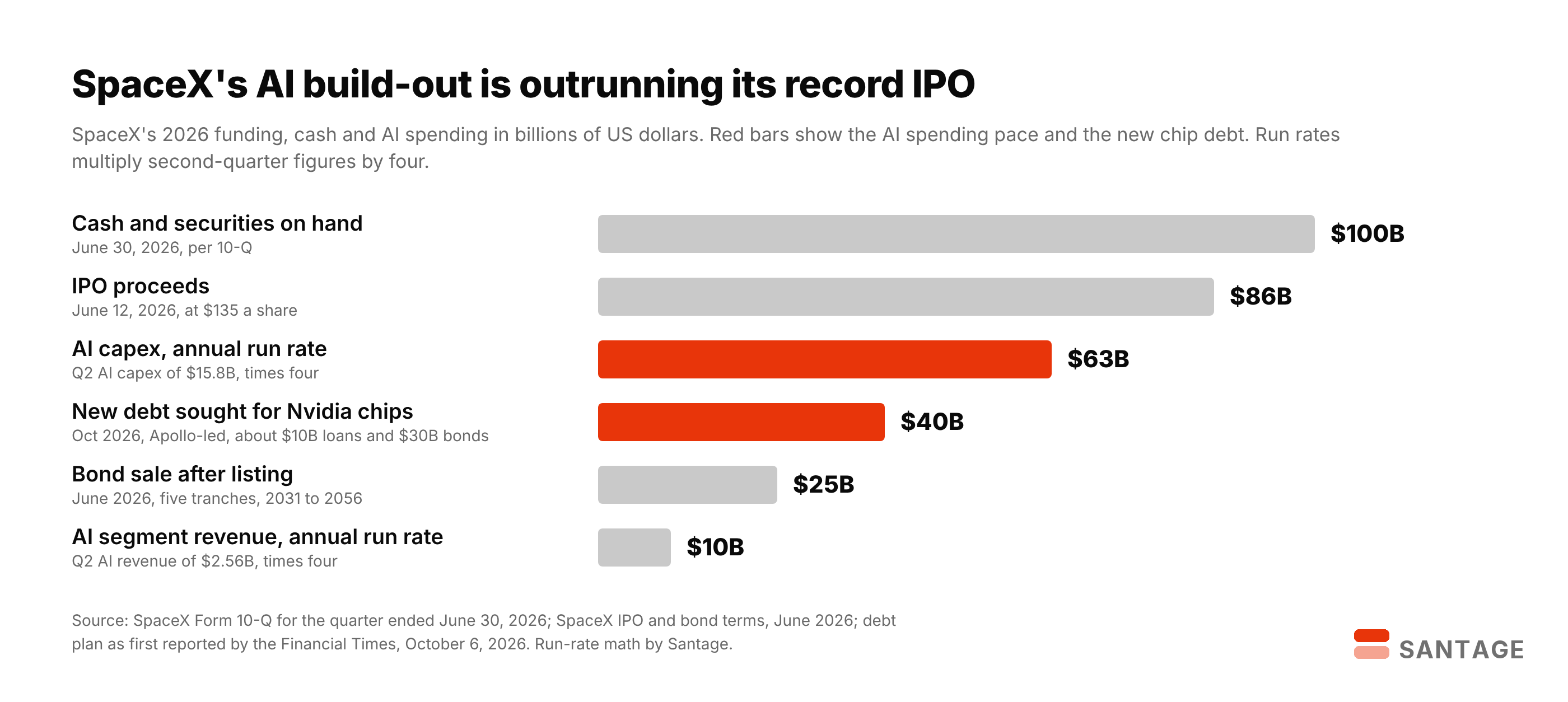
- SpaceX is seeking about $40 billion in Apollo-led debt for Nvidia GPUs, on top of an $86 billion IPO in June and a $25 billion bond sale ten days later.
- Its AI segment spent $15.8 billion on capital expenditure in the second quarter, 86% of the company's $18.4 billion total, against $2.56 billion of AI revenue.
- At the second-quarter pace, AI capex runs at about $63 billion a year, roughly six times the AI segment's annualized revenue of about $10 billion.
SpaceX is arranging about $40 billion of new borrowing to buy Nvidia chips for the Colossus data centers that train and serve Grok, a deal first reported by the Financial Times on October 6, even though the company ended June with roughly $100 billion of cash and marketable securities. The plan, led by Apollo Global Management with Pimco among the lenders in talks, would combine about $10 billion of bank loans with about $30 billion of investment-grade debt. Four months after the largest IPO in history, SpaceX is turning to the bond market to keep up with AI spending that its listing proceeds alone will not cover.
SpaceX's AI unit spent $15.8 billion in one quarter
The scale of the borrowing makes sense once the second-quarter numbers are laid side by side. SpaceX's quarterly filing for the period ending June 30 shows total revenue of $7.81 billion, up 92% from a year earlier, and capital expenditure of $18.37 billion, more than twice that revenue. The AI segment, built from the xAI merger in February, accounted for $15.83 billion of the capex. It booked $2.56 billion of revenue, up 247%, and an operating loss of $1.26 billion. SpaceX absorbed xAI at a $125 billion valuation for the AI business, which placed the entire Grok compute bill inside a company whose public investors largely bought into launch and satellite broadband.
| New debt sought for Nvidia chips | About $40 billion: $10 billion loans, $30 billion investment-grade debt |
| AI segment capex, Q2 2026 | $15.8 billion, 86% of SpaceX's $18.4 billion total |
| AI segment revenue, Q2 2026 | $2.56 billion, up 247% year on year |
| Cash, equivalents and marketable securities, June 30 | About $100 billion |
The chip order is tied to a specific build. Elon Musk has said SpaceX will use Nvidia hardware exclusively in its AI data centers and that the Colossus 2 site could more than double its Nvidia chip count by the end of the year. At the second-quarter rate, $40 billion buys roughly two and a half quarters of AI capex, which is why a company with $100 billion in the bank is still raising more.
Starlink's cash flow is what makes the chip debt investment grade
SpaceX can borrow $30 billion at investment-grade rates because of the business that has nothing to do with Grok. Starlink, reported as the connectivity segment, earned $1.66 billion of operating profit on $4.29 billion of revenue in the second quarter and doubled its subscriber base to about 12 million. Its recurring subscription cash flow is the kind of collateral bond buyers price easily, and it sits beside a $47.5 billion contracted backlog across launch, government and connectivity work.
| SpaceX segment, Q2 2026 | Revenue | Operating result |
|---|---|---|
| Connectivity (Starlink) | $4.29B | $1.66B profit |
| AI (xAI, Grok, Colossus) | $2.56B | $1.26B loss |
| Space (launch, Starship) | $0.96B | $0.54B loss |
Source: SpaceX Form 10-Q, quarter ended June 30, 2026. Compiled by Santage.
The structure moves the risk of the AI infrastructure build-out onto the balance sheet of the whole company. Equity investors in June bought a satellite internet business with a rocket company and an AI lab attached. Lenders in October are financing GPUs whose useful life is measured in a few years, backed in practice by a broadband franchise expected to keep generating cash for decades. If Grok's revenue grows into the hardware, the debt is cheap capital well spent. If it does not, Starlink subscribers end up servicing the interest on chips that have already depreciated.
Starlink's subscription revenue is now securing SpaceX's borrowing for Nvidia GPUs, a business whose economics look nothing like a satellite network's.
Private credit is becoming the default lender for AI compute
Apollo's role places SpaceX inside a financing pattern Santage has tracked all year. Private credit firms such as Apollo, Pimco and Blue Owl already stand behind roughly $300 billion of AI infrastructure debt kept off Big Tech balance sheets, and chip-linked borrowing has spread from Broadcom's $100 billion facility to model labs themselves. The difference here is transparency. SpaceX is a listed company raising on its own balance sheet, so the obligation will appear in its filings, and its shareholders will see the interest cost alongside the AI segment's results each quarter.
SpaceX shares slipped about 1% in after-hours trading on the report while Nvidia gained about 0.5%, and the deal is expected to close in 2027. For Nvidia, a single customer pre-financing a $40 billion order is the clearest demand signal of the quarter, and it arrives as other large buyers, including OpenAI, which is seeking $30 billion at a $1.4 trillion valuation, stretch to fund their own compute plans. For investors in the AI build-out, it shows that even the best-capitalized buyer in the market now funds compute partly with debt.
The record IPO was supposed to give SpaceX's AI ambitions years of runway, and by the second quarter it was covering about a year and a half of spending. Grok's revenue still has to grow into the hardware, and until it does, the company's broadband subscribers are effectively the guarantors of its GPU bill.
Santage is committed to independent, transparent journalism. This article is produced in accordance with Santage's Editorial Standards and aims to provide accurate and timely information. Readers are encouraged to verify information independently.