

- The reported target is at least $30 billion at roughly $1.4 trillion pre-money, against the $852 billion valuation and $122 billion of committed capital in OpenAI's March 2026 round.
- Annualized revenue run rate is approaching $70 billion, up more than 70% since the start of the third quarter, which puts the target at about twenty times current revenue.
- Talks are early and terms could change, the figures come from Bloomberg's reporting rather than OpenAI, and the company has not commented.
OpenAI is in early talks to raise at least $30 billion at a valuation of about $1.4 trillion, a 64% markup on the round it closed six months ago, and the structure being discussed is bridge financing meant to substitute for the public listing the company has ruled out for this year.
The round is priced at twenty times revenue and rising faster than revenue
Six months separate the two numbers. In March, OpenAI closed with $122 billion committed at an $852 billion valuation. The figure now under discussion is roughly $1.4 trillion before the new money counts, Bloomberg reported on September 29, citing people familiar with the talks.
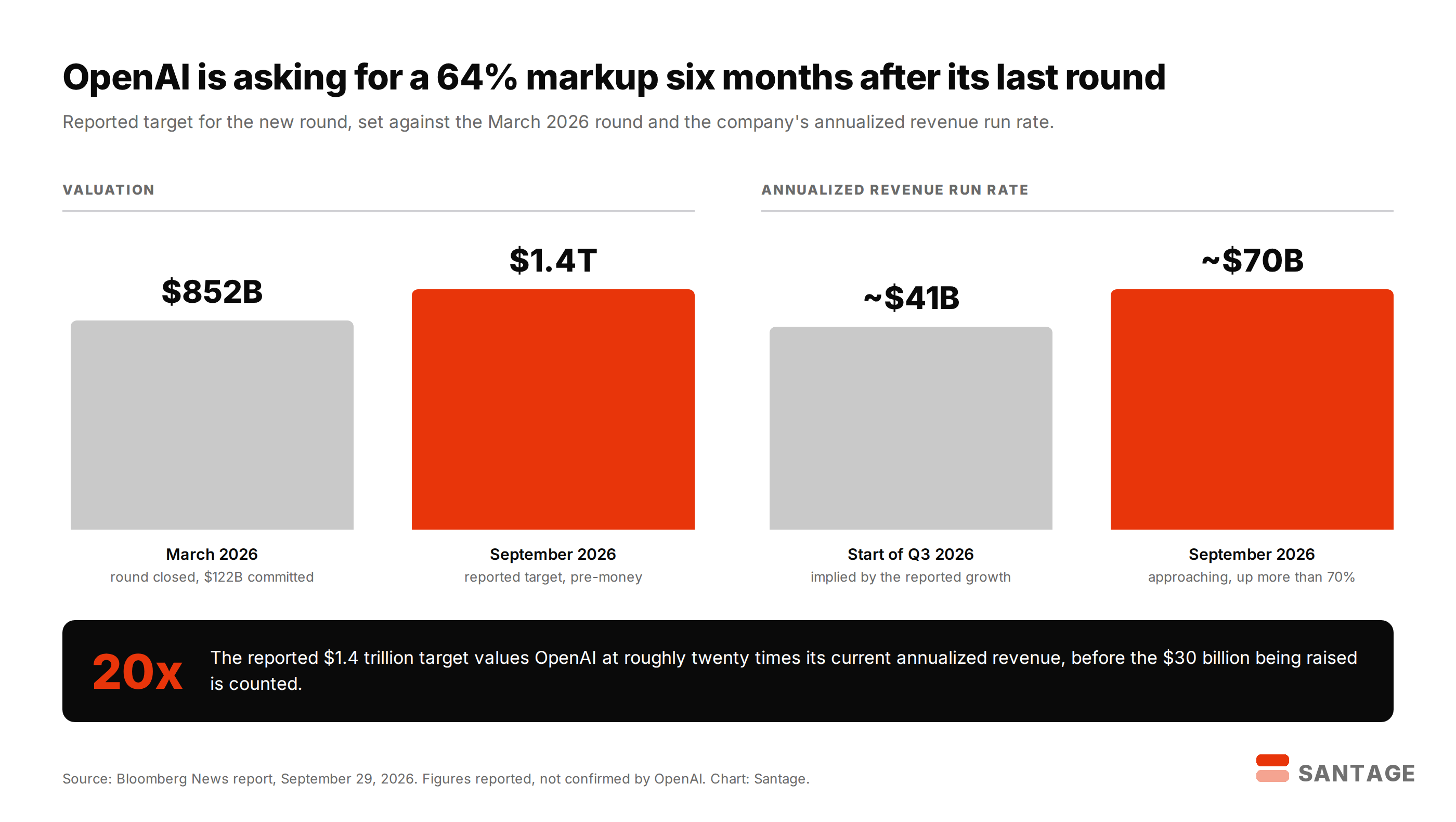
Revenue moved in the same window and moved hard. The annualized run rate is approaching $70 billion, having grown more than 70% since the beginning of the third quarter, which implies something near $41 billion in July. A business adding roughly $29 billion of annualized revenue in one quarter is compounding at a rate almost nothing in enterprise software history matches. Valuation still outran it, going from about fifteen times revenue in March to about twenty times now.
| Amount sought | At least $30 billion |
| Valuation | About $1.4 trillion, pre-money |
| Previous round | March 2026, $122 billion committed at $852 billion |
| Annualized revenue run rate | Approaching $70 billion, up more than 70% since the start of Q3 |
| Weekly ChatGPT users | 1.2 billion |
Bridge financing is a way of buying time on the listing question
The word doing the work in the reporting is “bridge.” Bridge financing spans the gap to a specific future event, and here the event is an IPO that Sam Altman said earlier this month would not happen in 2026, citing safety concerns about the technology. A company with OpenAI's capital requirements cannot simply wait. Private capital at this size and frequency is the alternative to the public markets, and each round of it raises the valuation the eventual listing has to clear.
DevDay gave the round its revenue story on the same day
The timing was not accidental. OpenAI held DevDay on September 29 and announced more than twenty products, and the ones that matter to an investor are the ones that widen the paths money can travel down. GPT-6.1 Sol arrived at $2 per million input tokens and $10 per million output tokens, roughly a fifth of what GPT-6 Astra costs, which drops the price floor for high-volume inference customers. A Pro 500 subscription at $500 a month opened a tier above everything the company had sold to individuals. An enterprise marketplace launched with more than thirty partners including Adobe, Figma, Salesforce and ServiceNow.
Dots, the always-on agent line the keynote led with, is the product that carries the most weight for the financing case, because agents running continuously in the cloud consume compute on a schedule rather than when a user types. That converts an episodic cost into a recurring one, and recurring costs are what a $30 billion raise is for.
The number most coverage is missing sits on the cost side
A twenty times multiple on $70 billion of revenue is a defensible price for a business growing this fast. The harder question is what the compute behind it costs, and OpenAI discloses nothing. The comparison available is Anthropic's, whose draft IPO prospectus showed $7.33 billion of compute spending against $4.6 billion of 2025 revenue and roughly $518 billion in long-term compute commitments. Frontier labs at this stage spend more on infrastructure than they collect from customers, and the gap is filled by exactly these rounds.
A raise structured as a bridge to an IPO that has been postponed is a bridge to a date nobody has set.
Investor demand is reported to be driving these talks rather than the company going out to solicit it, which is the strongest signal in the story and the one hardest to verify. If accurate, OpenAI is being offered capital at a price that assumes several more years of the growth it posted last quarter. The company has now raised at three valuations in eighteen months, each one setting a floor the next has to beat, and the mechanism that keeps clearing those floors is a private market with no requirement to explain how it arrived at the number.
Santage is committed to independent, transparent journalism. This article is produced in accordance with Santage's Editorial Standards and aims to provide accurate and timely information. Readers are encouraged to verify information independently.