
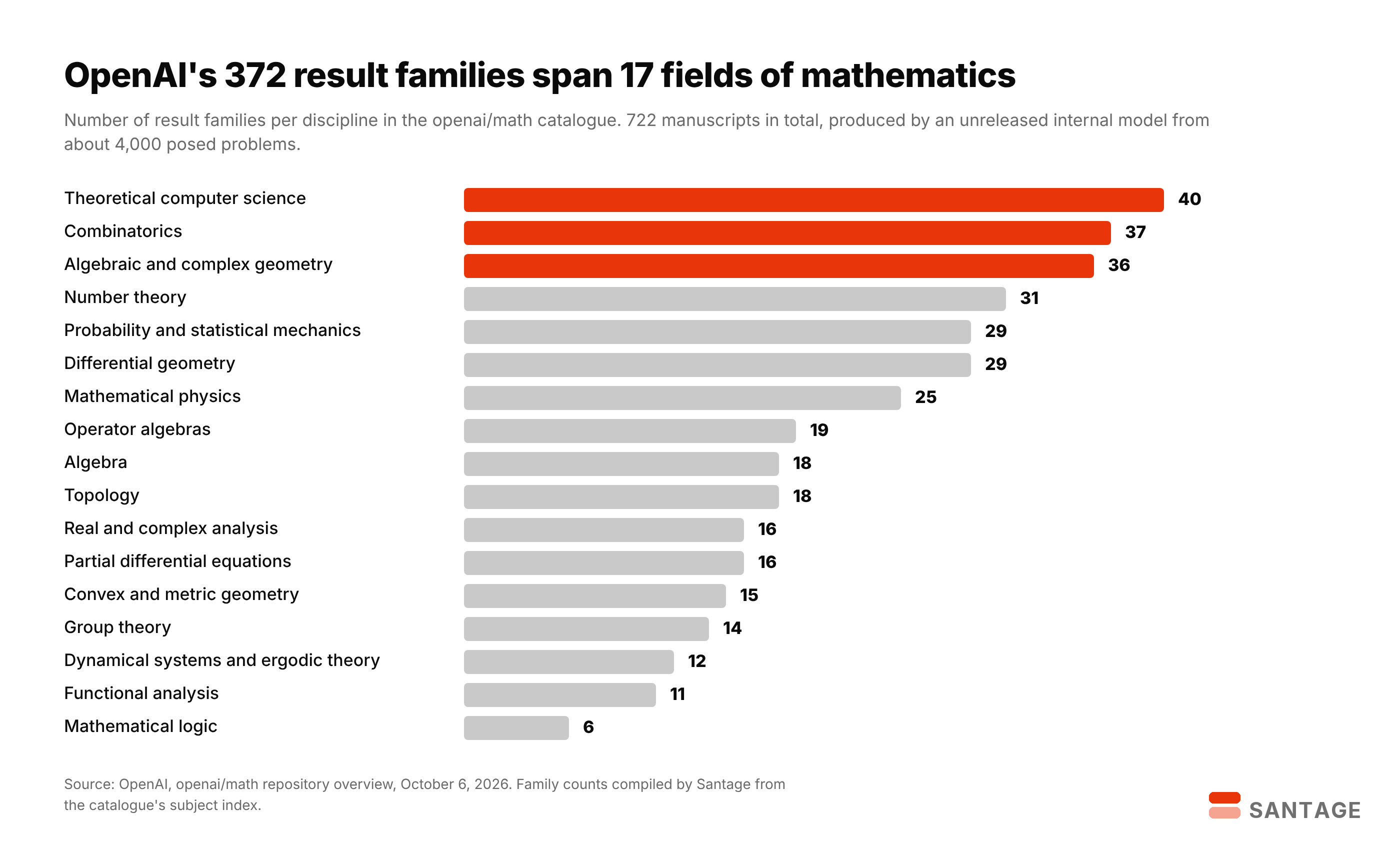
- OpenAI released 722 manuscripts in 372 result families, produced after its internal model was posed about 4,000 problems, with each result using about three hours of ChatGPT Pro thinking compute on average.
- The catalogue claims proofs of Khot's Unique Games Conjecture, a negative answer to Hilbert's tenth problem over the rationals and the Mahler conjectures, among other long-open results.
- 162 manuscripts carry a Lean formalization of their main result, so the large majority still depend on human review that has barely started.
OpenAI has put 722 mathematical manuscripts written by an unreleased internal model into a public GitHub repository, two weeks after it said the same system had resolved more than 100 open problems without showing the work. The papers, released on October 6 under an Apache 2.0 license, group into 372 result families and claim progress on some of the best-known open questions in number theory, geometry and computer science. Most have not been checked by independent mathematicians, and OpenAI says some of them may contain errors.
OpenAI's internal model produced 722 papers from about 4,000 problems
The repository describes a single, repeated procedure run on an unreleased reasoning model. OpenAI expanded its evaluations to open research problems after, in its words, performance on its existing mathematical evaluations saturated. Over the run the model was posed approximately 4,000 problems, and OpenAI kept the outputs it judged significant enough to publish. Every manuscript in the collection is dated between September 22 and October 5, 2026, so the entire catalogue was written in roughly a fortnight.
| Manuscripts released | 722 |
| Result families | 372, across 17 fields of mathematics |
| Problems posed to the internal model | About 4,000 |
| Average compute per result | About 3 hours of ChatGPT Pro thinking |
| Manuscripts with a Lean formalization of the main result | 162 |
The claims cover a wide range of mathematics. The model's output includes a proof of the Unique Games Conjecture, which Subhash Khot posed in 2002, a negative resolution of Hilbert's tenth problem over the rational numbers, the symmetric and general Mahler conjectures, and a proof that every Dirichlet L-function is zero-free for real part above 7/8, which OpenAI labels the quasi-Riemann hypothesis. That result is a partial step toward the Riemann Hypothesis and leaves the full conjecture open. Two pieces of work, the zeta function result and a proof of the Hodge conjecture for CM abelian varieties, were produced outside the standard procedure, and OpenAI says a human edited the zeta writeup for readability.
| Claimed result (family) | Field | Lean scope page |
|---|---|---|
| Unique Games Conjecture (102) | Theoretical computer science | Yes |
| Mahler conjectures (087) | Convex geometry | Yes |
| Quasi-Riemann hypothesis, Re(s) > 7/8 (003) | Number theory | Yes |
| Free group factor isomorphism (287) | Operator algebras | Yes |
| Hilbert's tenth problem over the rationals (004) | Number theory | No |
| Goldfeld's conjecture (006) | Number theory | No |
Source: OpenAI, openai/math catalogue and overview, October 6, 2026. Compiled by Santage. A Lean scope page describes what has been formalized and does not by itself certify the full manuscript.
Lean proofs cover a minority of the 722 manuscripts
The repository says plainly how far verification has gone.
“This collection includes results at different stages of verification. Not all have accompanying Lean formalizations. We will continue to update this repository with Lean formalizations as we obtain them. Some of the unformalized results could have issues. We will endeavor to fix any such issues quickly.”
OpenAI, openai/math repository, October 6, 2026
Lean formalizations let a computer check each logical step, so the 162 formalized manuscripts can be audited by anyone with the patience to compile them, while the remaining 560 depend on human referees. When OpenAI announced its first claims on September 21, Santage reported that the proofs had not been published for review. This release answers that criticism with a public, versioned record, and it also hands the mathematics community a refereeing load far larger than any single journal handles in a year. arXiv began capping submitters at two papers a month on October 1, partly because AI tools were overwhelming its moderators, and OpenAI has chosen to publish outside both arXiv and the journals.
OpenAI says it will fund workshops on the results and still intends to release the model itself responsibly, as it states in its announcement. The scale of the release shifts the problem from producing candidate proofs to checking them. Mathematicians now have a public record of 722 papers to test, and their review of the formalized minority will show whether the rest of the catalogue should be trusted.
Santage is committed to independent, transparent journalism. This article is produced in accordance with Santage's Editorial Standards and aims to provide accurate and timely information. Readers are encouraged to verify information independently.