
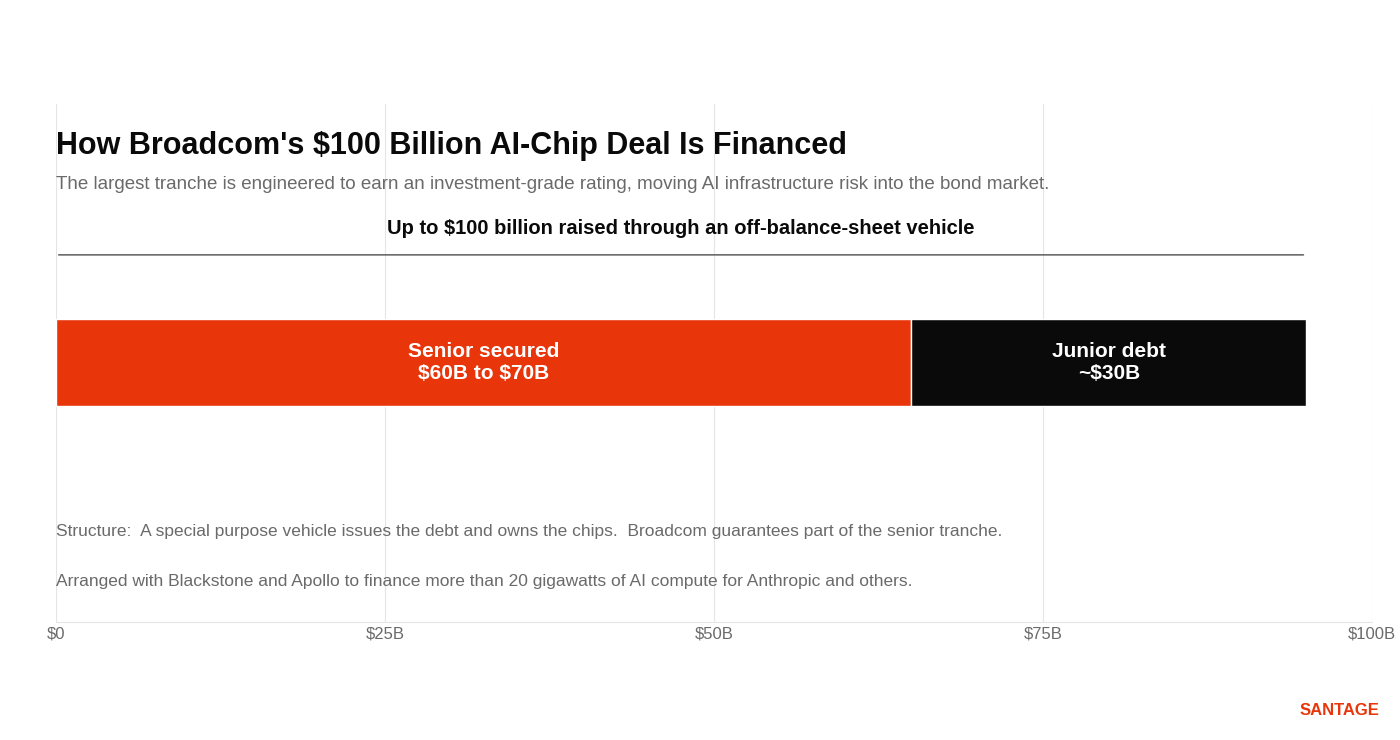
- Broadcom is in talks to raise as much as $100 billion in debt through a special purpose vehicle, with a senior secured tranche of $60 billion to $70 billion designed to earn an investment-grade rating and a junior tranche of roughly $30 billion.
- The vehicle would own the chips and lease the capacity to Anthropic and other AI companies, keeping the borrowing off Broadcom's own balance sheet while Broadcom guarantees part of the senior debt.
- Blackstone and Apollo are in talks to arrange the financing, an extension of a June partnership that aims to fund more than 20 gigawatts of AI compute.
Broadcom wants to borrow $100 billion to buy Anthropic's chips
Broadcom is arranging one of the largest corporate debt packages ever assembled for a single purpose: buying the semiconductors that will run the next wave of AI. The company is in talks to raise as much as $100 billion, split between a senior secured tranche of $60 billion to $70 billion engineered to achieve an investment-grade rating and a junior portion of about $30 billion, according to reporting confirmed by Bloomberg.
The money would not sit on Broadcom's books. A separate special purpose vehicle would issue the debt, buy the custom chips and data center equipment, and lease that capacity to the AI companies that need it, first among them Anthropic. Broadcom would guarantee a portion of the senior tranche. Blackstone and Apollo, which formed a compute-financing partnership in June, are in talks to arrange the deal, with the broader effort aimed at more than 20 gigawatts of computing power.
| Up to $100 billion | total debt raised through a special purpose vehicle |
| $60B to $70B | senior secured tranche, built to earn an investment-grade rating |
| ~$30 billion | junior tranche carrying the higher risk and higher yield |
| 20+ gigawatts | of AI compute the wider partnership intends to fund |
Why AI infrastructure is moving off the tech balance sheet
For three years the AI buildout ran on equity. Labs raised enormous private rounds, and the hyperscalers funded their data centers from cash flow and their own credit. That model is reaching its ceiling. The capital required to keep pace now exceeds what even the largest technology balance sheets can absorb without straining their credit ratings, and it exceeds what private equity markets can supply on their own.
The Broadcom vehicle is the answer the market has settled on. By moving the borrowing into a separate entity that owns the hardware, the arrangement turns AI compute into something the bond market already knows how to price: a pool of physical assets, backed by long-term lease payments, sliced into senior and junior tranches. It is the logic of project finance and commercial real estate, applied to silicon.
AI is no longer being funded by people betting on the future. It is being funded by bondholders who expect to be paid back on a schedule, and who hold the chips as collateral if they are not.
The risk most coverage is skipping
The structure is elegant, and that is exactly the concern. Investment-grade ratings on the senior tranche depend on the assumption that the leased chips hold their value and that the AI companies renting them keep paying. Both assumptions are less solid than they look. Advanced AI accelerators depreciate quickly as each new generation ships, so the collateral behind this debt is a depreciating asset, not land or a power plant. And the lease payments rest on the revenue of AI companies that, Anthropic included, are still spending far more than they earn.
When financing moves off the balance sheet, the risk does not disappear. It moves to whoever holds the debt. A wave of investment-grade paper backed by AI compute pulls pension funds, insurers, and bond funds into the AI trade whether or not they intended to make that bet. The exposure that once sat with venture investors who understood they could lose everything is being repackaged for buyers who are told the senior tranche is safe.
What a bond-market bet on AI means for everyone else
For Broadcom and its AI customers, the deal is a way to keep building at a scale equity alone can no longer support, and to do it without the buildout showing up as debt on their own financial statements. For Anthropic, it secures the chips it needs on the eve of a public offering, without diluting shareholders further. For Blackstone and Apollo, it opens a vast new market: financing the physical layer of AI at bond-market volume.
For everyone else, the shift is quieter and more consequential. The first phase of the AI boom was contained inside technology companies and their investors, the people best positioned to absorb a loss. This next phase is being wired directly into the credit markets that sit underneath insurance policies, retirement funds, and the broader financial system. Broadcom is not just buying chips. It is turning the AI buildout into an asset class, and once that happens, a stumble in AI stops being a technology story and becomes a credit-market one.
Santage is committed to independent, transparent journalism. This article is produced in accordance with Santage's Editorial Standards and aims to provide accurate and timely information. Readers are encouraged to verify information independently.