
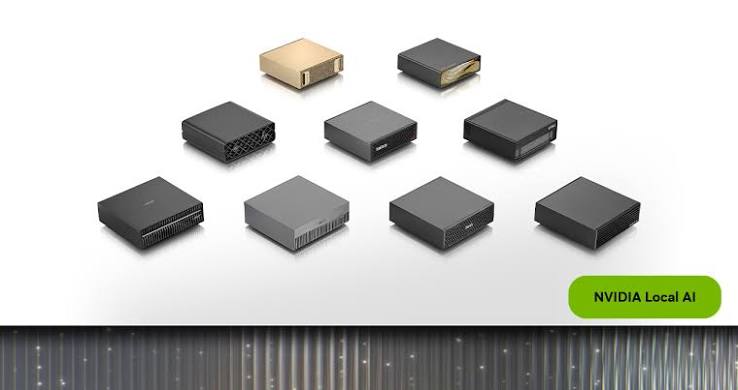
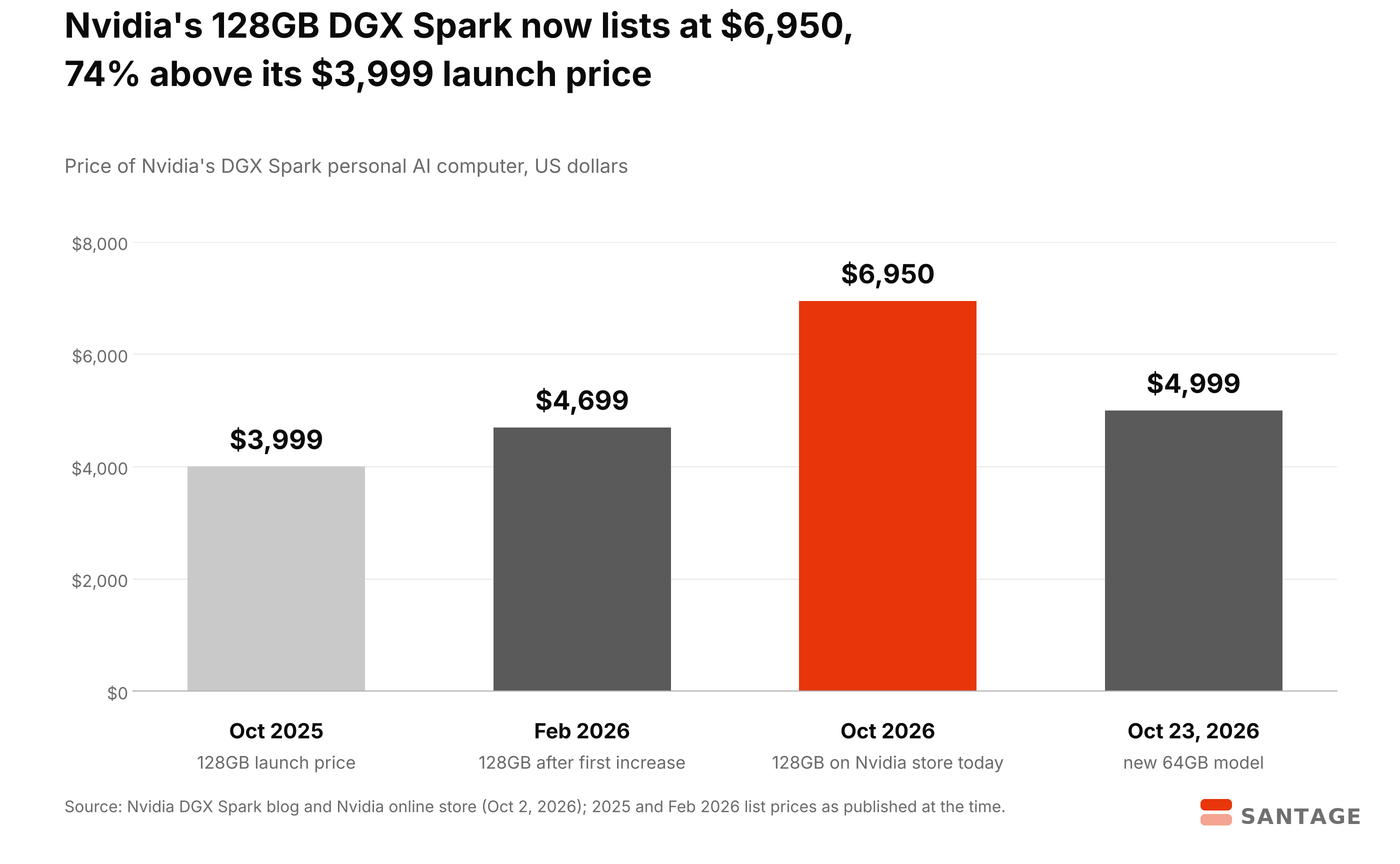
- A new 64GB DGX Spark goes on sale on October 23 for $4,999 through Acer, ASUS, Dell, Gigabyte, HP and MSI, handling models of up to 100 billion parameters.
- The original 128GB model, launched at $3,999 in October 2025, rose to $4,699 in February and is now listed at $6,950 and out of stock on Nvidia's own store.
- Micron said on September 30 that memory demand will exceed supply through 2027 and 2028, so the cost of local AI hardware is now set by the data center buildout.
Nvidia's DGX Spark, the palm-sized AI computer it sells to developers who want to run models at their desks, now lists at $6,950 for the 128GB version, 74% above its $3,999 launch price a year ago, and Nvidia is answering the jump with a cheaper model that carries half the memory.
Nvidia's 64GB DGX Spark keeps the same chip at $4,999
The new configuration, announced in an Nvidia blog post on October 2, uses the same GB10 Grace Blackwell Superchip, DGX OS and preinstalled software as the 128GB machine, including Ollama, vLLM, PyTorch and Nvidia's Nemotron open models. Memory is the headline change, and it caps the cheaper unit at roughly 100 billion parameters for local inference.
“The new 64GB configuration, available exclusively from manufacturer partners, keeps the platform at an accessible price point while retaining the GB10 Grace Blackwell Superchip, DGX OS and full NVIDIA AI software stack.”
Nvidia, DGX Spark 64GB announcement, October 2, 2026
Nvidia is pairing the launch with clustering software. A tool called Sync Cluster Assistant detects linked units and configures their ConnectX-7 networking automatically, and a Sync Model Launcher arrives at the end of October. In Nvidia's own testing, two clustered 64GB units ran Qwen 3.8 27B up to 1.7 times faster than a single system.
Data center demand is setting the price of a developer desktop
The price path tracks the memory market. Micron, one of three companies that make most of the world's DRAM, told investors on its September 30 earnings call that it sees “demand exceeding supply” in both 2027 and 2028, and that it does “not have line of sight to when supply and demand will return to balance.” Most of that memory goes into high-bandwidth stacks for AI accelerators, a squeeze Santage tracked when SK Hynix warned of a coming shortage after its July IPO and when Nvidia's $500 billion Korea deal turned on memory access.
| 128GB model, Nvidia store | $6,950, up from $3,999 at launch |
| New 64GB model | $4,999, on sale October 23, 2026 |
| Largest local model, 64GB | About 100 billion parameters |
| Two clustered 64GB units | $9,998 for the same 128GB of memory |
| Clustering speedup, Qwen 3.8 27B | Up to 1.7x over one unit |
The arithmetic favors the larger machine for anyone who needs memory more than compute. Two 64GB units cost $3,048 more than a single 128GB unit for the same 128GB of total memory, although they double the processing and bandwidth. For an individual developer, the 64GB model is the entry ticket, and its $4,999 price is still $1,000 above what the full machine cost at launch.
Running AI locally was pitched as the escape from cloud pricing, with fixed hardware, private data and no per-token bills. The DGX Spark shows that escape has a ceiling, because the memory inside a $5,000 desktop comes off the same production lines that hyperscalers are booking years ahead, and as long as Micron sees no balance in sight, the AI infrastructure boom will keep setting the price of the machine on a developer's desk.
Santage is committed to independent, transparent journalism. This article is produced in accordance with Santage's Editorial Standards and aims to provide accurate and timely information. Readers are encouraged to verify information independently.