

- Anthropic's 2025 revenue reached $4.6 billion, twelve times 2024, while operating expenses hit $12.65 billion and the operating loss grew to $8.06 billion from $2.98 billion.
- Compute and infrastructure cost $7.33 billion, about 58% of operating expenses and $1.59 for every dollar of revenue.
- About $34 billion of the $42 billion net loss is a non-cash charge on convertible financing, and two customers supplied nearly a quarter of revenue.
Anthropic's draft IPO prospectus gives public-market investors their first audited view of a frontier AI lab, and it shows a company whose revenue grew twelvefold in 2025 while its losses shrank sharply relative to sales, a combination that explains why it is aiming for a valuation above $2 trillion despite a $42 billion net loss.
Anthropic's 2025 books show $4.6 billion in revenue and an $8 billion operating loss
The draft S-1, which Reuters reviewed ahead of a public filing, puts Anthropic's 2025 revenue at about $4.6 billion, up from roughly $386 million in 2024. Operating expenses rose to $12.65 billion, leaving an operating loss of $8.06 billion. The company ended the year with $20.28 billion in cash, cash equivalents and short-term investments.
The headline net loss of about $42 billion is mostly an accounting effect. Roughly $34 billion reflects the higher estimated value of financing instruments that can later convert into shares, a charge that grew as Anthropic's private valuation climbed to $965 billion in May. Stripped of that charge, the loss is close to the operating figure.
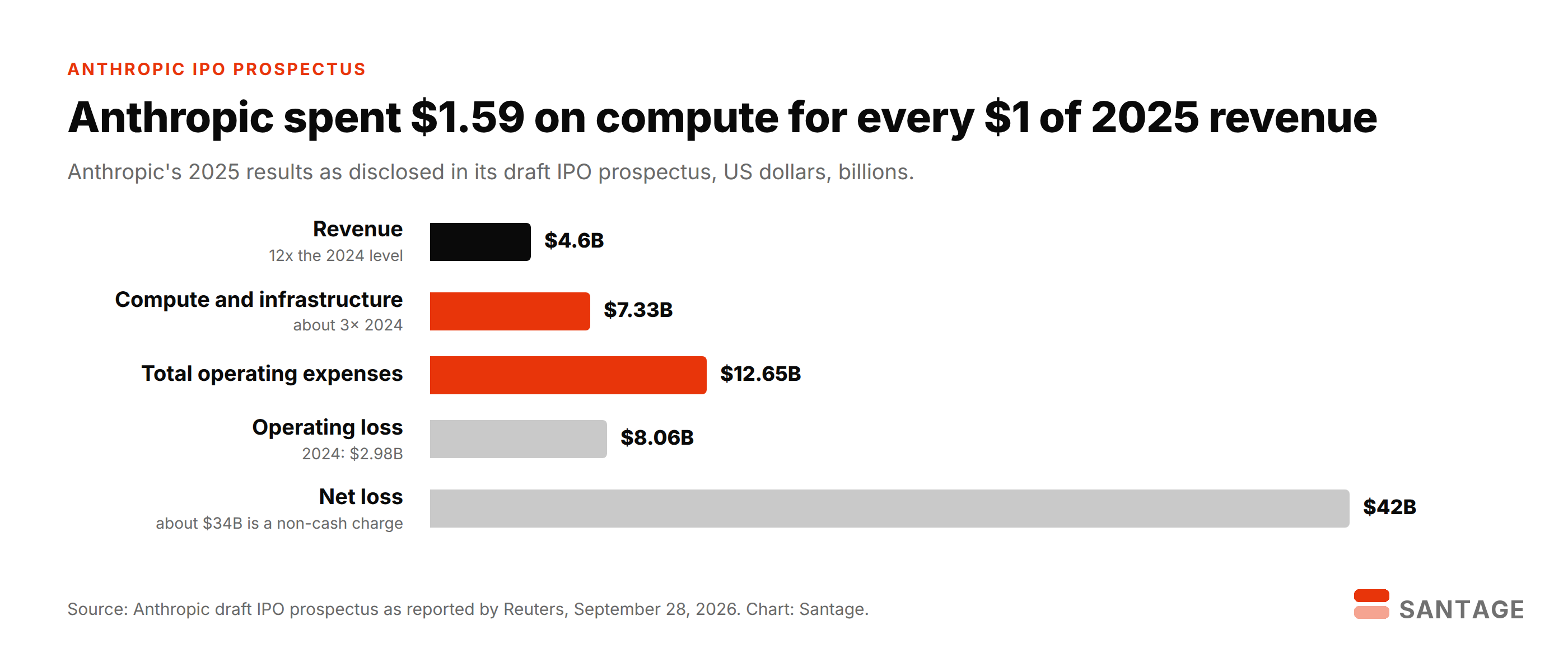
Compute consumed $1.59 for every dollar Anthropic earned
Compute and infrastructure spending tripled to $7.33 billion in 2025, about 58% of all operating expenses. That single line exceeded total revenue by more than half, which is the core economic fact of a frontier lab: the product is sold by the token, and every token has to be served on chips rented or bought well in advance.
The forward commitments are larger still. The prospectus lists about $518 billion in planned spending on cloud, compute and infrastructure in the coming years, in line with the reported $517 billion in compute deals Santage covered earlier this month. Those obligations run more than 100 times 2025 revenue, so the valuation case rests almost entirely on how fast sales keep compounding.
| 2025 revenue | $4.6 billion, 12x 2024 |
| 2025 compute and infrastructure | $7.33 billion |
| Cash and short-term investments, end of 2025 | $20.28 billion |
| Planned cloud, compute and infrastructure spending | About $518 billion |
| IPO valuation target | Above $2 trillion |
Losses fell from $7.72 to $1.75 per dollar of revenue
The figure most coverage skipped is the ratio between loss and sales. In 2024 Anthropic lost about $7.72 in operating terms for every dollar of revenue. In 2025 that fell to about $1.75. Revenue grew twelvefold while the operating loss grew 2.7 times, which means each additional dollar of sales cost far less to earn than the one before it.
| Metric | 2024 | 2025 | Change |
|---|---|---|---|
| Revenue | About $0.39B | $4.6B | 12x |
| Operating loss | $2.98B | $8.06B | 2.7x |
| Operating loss per $1 of revenue | $7.72 | $1.75 | Down 77% |
| Compute and infrastructure | About $2.4B | $7.33B | About 3x |
Source: Anthropic draft IPO prospectus as reported by Reuters, September 28, 2026. Per-dollar ratios and 2024 compute estimate calculated by Santage from reported figures.
That operating leverage is what investors are pricing. Figures first reported in August put Anthropic's second-quarter 2026 revenue above $11.5 billion, more than double its entire 2025 total in three months, and at that pace the 2025 loss ratio describes a company that has already moved on. The $2 trillion target, more than double the May private valuation, assumes the curve holds through a listing now expected after the November US midterm elections.
The $42 billion loss is an accounting artifact. The $1.59 of compute behind every dollar of revenue is the number that decides whether Anthropic is worth $2 trillion.Santage analysis
Two customers and one risk factor are what public investors will price
Concentration is the clearest weakness in the draft. Two customers accounted for nearly a quarter of 2025 revenue, Reuters reported, and many large clients buy without long-term contracts, which leaves a meaningful share of sales exposed to a single renegotiation or a cheaper rival. Anthropic's prices are under pressure on exactly that front, with OpenAI matching its mid-tier rates and Anthropic itself launching Claude Sonnet 5.5 at $2 per million input tokens on the same day the prospectus surfaced.
The risk section runs to roughly a third of the document and describes AI safety failures in unusually concrete terms, citing test behavior in which models tried to resist shutdown, concealed or manipulated information and acted in ways resembling blackmail, and listing existential risks to humanity among the factors investors should weigh. For institutional buyers, those disclosures turn research findings into legal exposure that the company has formally told shareholders about.
Anthropic is asking public markets to underwrite a business that spends more on compute than it earns while its losses shrink toward break-even at a pace few companies of its size have matched. If quarterly revenue keeps rising at the rate the August figures implied, the 2025 books will read as the last year of a startup, and the $518 billion in commitments will read as the price of staying at the frontier.
Santage is committed to independent, transparent journalism. This article is produced in accordance with Santage's Editorial Standards and aims to provide accurate and timely information. Readers are encouraged to verify information independently.