
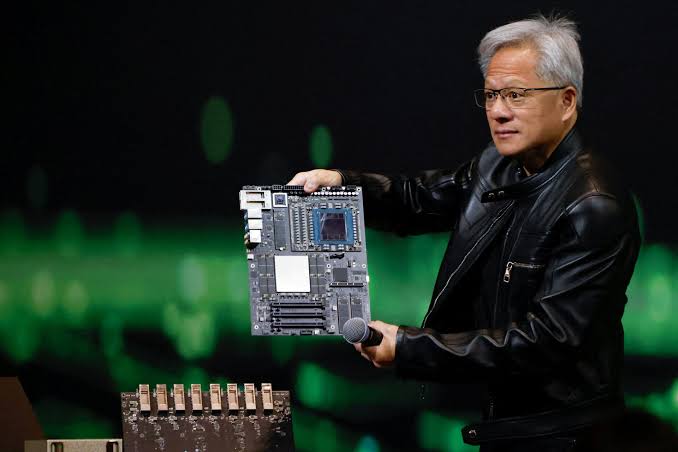
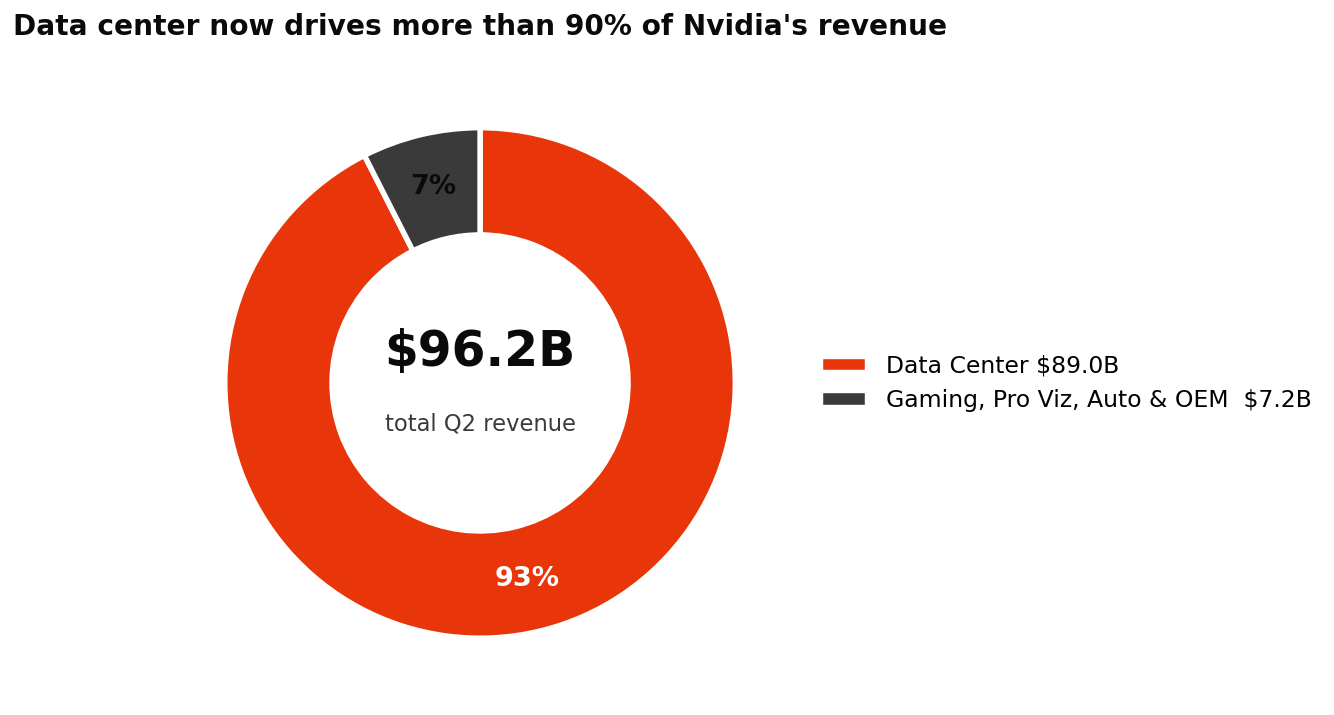
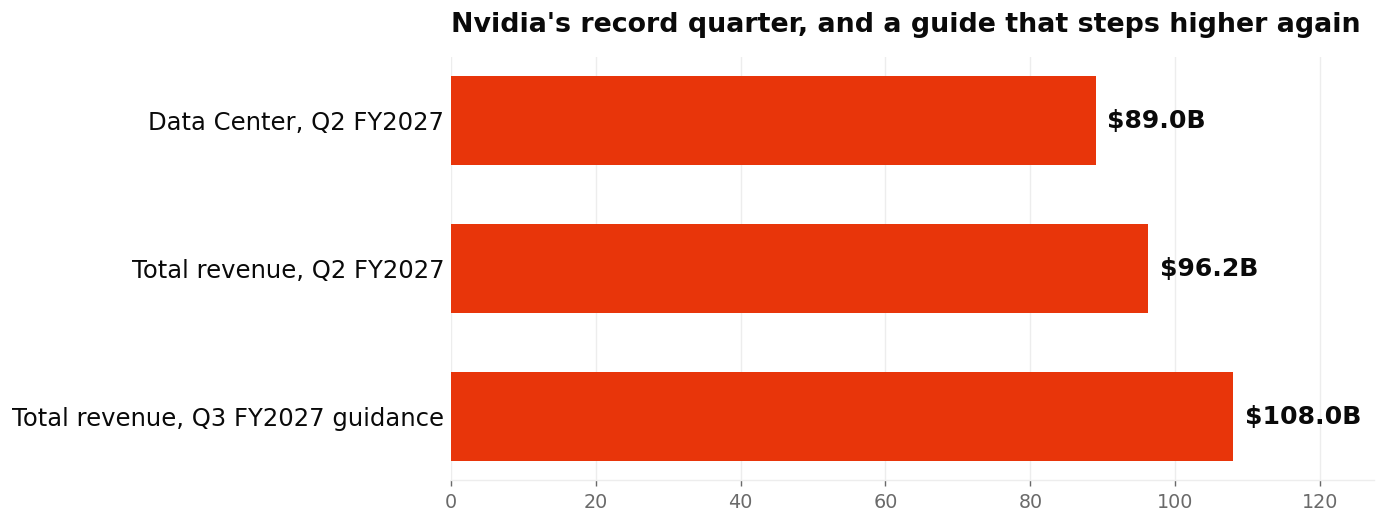
- Nvidia reported record second quarter revenue of 96.2 billion dollars, up 106 percent from a year earlier, with data center sales of 89.0 billion dollars, up 117 percent, and a 75 percent gross margin.
- The company guided to about 108 billion dollars for the current quarter and, for the first time, offered a year ahead view, with Jensen Huang forecasting roughly 70 percent revenue growth in fiscal 2028.
- Nvidia assumes no data center revenue from China in that outlook, and its shares slipped in after hours trading even though every headline figure beat published estimates.
Nvidia's data center business alone now runs near a $360 billion annual pace
Nvidia's second quarter did not just beat expectations. It reset the scale of the numbers the company is working with. Revenue reached 96.2 billion dollars for the three months, more than double the same quarter a year earlier, according to the company's results. Data center, the segment that sells the accelerators behind nearly every large language model, brought in 89.0 billion dollars on its own, a figure that annualizes to roughly 360 billion dollars and now accounts for the overwhelming majority of the company.
The profitability moved with it. Gross margin held at 75 percent, net income landed near 59.7 billion dollars for the quarter, and Nvidia returned about 26 billion dollars to shareholders through buybacks and dividends while leaving most of its repurchase authorization untouched. These are the financials of a company converting demand for AI infrastructure into cash at a rate few businesses of any size have matched.
| $96.2B | total Q2 revenue, up 106 percent year over year |
| $89.0B | data center revenue, up 117 percent year over year |
| 75% | gross margin, with net income near $59.7 billion |
Why Huang gave a year ahead forecast Nvidia has never offered before
The more consequential move was not the past quarter but the guidance. Nvidia projected about 108 billion dollars for the current quarter, another sequential step up. Then Jensen Huang went further than the company normally does, telling investors on the earnings call to expect roughly 70 percent revenue growth in fiscal 2028. Nvidia does not usually give a year ahead number. Offering one now was a decision, not a routine disclosure.
The reason sits in the debate that has shadowed the stock all year. Skeptics argue that AI infrastructure spending is a bubble inflated by circular financing, where chipmakers, cloud providers, and model labs pass the same dollars between one another. A concrete, unusually long dated forecast is the sharpest tool a chief executive has to push back on that, because it stakes credibility on demand that has not yet been booked.
Huang framed the whole picture around a single idea, that AI compute has crossed from experiment into production and is now generating money for the companies that run it.
AI has reached its inflection point. It's doing useful work. Its tokens are productive and profitable. Now, compute is revenue.Jensen Huang, Chief Executive, Nvidia. Source: NVIDIA second quarter fiscal 2027 results
The China zero that quietly makes the forecast more aggressive
There is one line in the outlook that changes how the forecast should be read. Nvidia said it is not assuming any data center revenue from China. Export restrictions and the uncertain status of its China specific parts have made that market impossible to count on, so the company has built its guidance as if it earns nothing there.
That framing cuts two ways. It protects Nvidia from a miss if China stays closed, and it makes the growth number more striking, because roughly 70 percent expansion is being promised without one of the largest computing markets in the world. Any thaw in China would then arrive as upside on top of a forecast that already assumes its absence.
Nvidia is guiding to about 70 percent growth while counting on nothing from China, which makes the forecast a floor the company chose rather than a ceiling it hopes to reach.
Why the stock slipped on a record that beat every estimate
The market reaction was the quiet contradiction of the day. Every headline figure cleared the published estimates, and yet Nvidia's shares slipped after hours. That gap is the real signal. When a stock has priced in perfection, even a record and a first ever forecast can read as merely meeting the bar rather than clearing it.
NVDA share price over the past three months, updated live. Source: TradingView.
It marks a change in what the debate is about. For two years the open question was whether demand for AI compute was real. Nvidia has now answered that with a data center business at a 360 billion dollar pace and a customer base still ordering ahead. The new question is durability, whether spending can keep compounding off a base this large without the circular financing critics warn about eventually tightening.
Huang's forecast is a deliberate attempt to move the argument from belief to arithmetic. If fiscal 2028 lands near 70 percent growth, the bubble framing loses its strongest talking point. If it falls short, the miss will be measured against a number the company did not have to give. Either way, Nvidia has chosen to be judged on a promise, and that is the most revealing thing about a quarter full of records.
Santage is committed to independent, transparent journalism. This article is produced in accordance with Santage's Editorial Standards and aims to provide accurate and timely information. Readers are encouraged to verify information independently.