
- Nvidia has told the contract manufacturers that build its AI servers for Microsoft, Google, and Oracle to expect price increases above 15 percent on systems shipping in early 2027, the first broad hardware price rise of the current buildout.
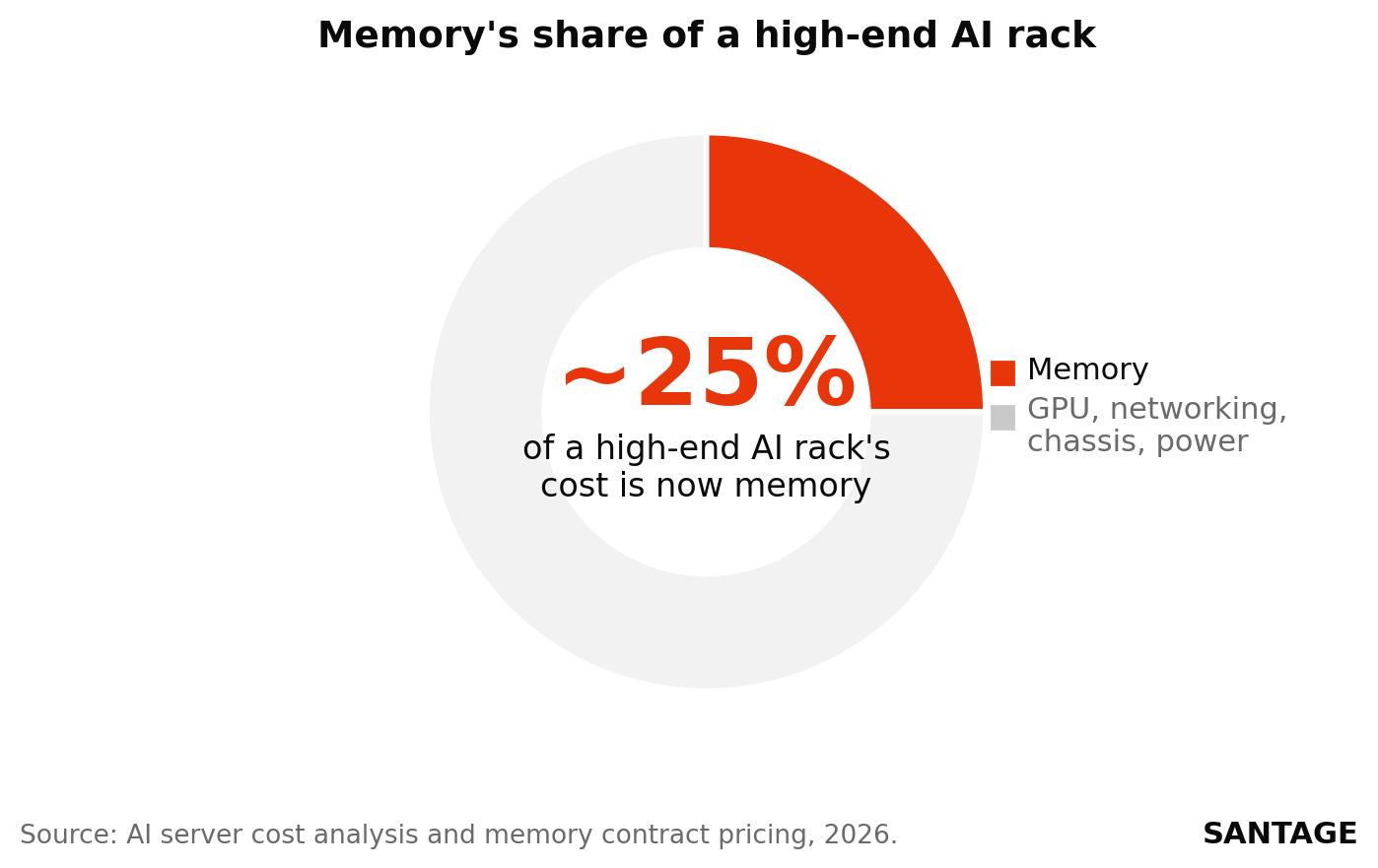
- The driver is memory, not logic. Memory now accounts for roughly a quarter of a high-end AI rack's total cost, and the memory bill alone climbed about 2.5 times between the Blackwell and Vera Rubin generations.
- A top-end Vera Rubin rack is expected to sell for 5 to 7 million dollars, up from 2.8 to 3.4 million for the Blackwell system it replaces, with contract memory prices rising as much as 90 percent in a single quarter.
The increase lands on Nvidia's 2027 Vera Rubin and Blackwell systems
Nvidia has notified the companies that assemble its servers that the next generation of AI systems will cost more than 15 percent above current pricing, according to Bloomberg, which reviewed communications sent to the builders supplying the largest cloud operators. The increases apply to Grace Blackwell and Vera Rubin systems scheduled to ship in early 2027, and the exact figure rises with the amount of memory each machine carries.
The notice is unusual because compute has moved in one direction for a decade. Each generation of accelerator delivered more performance for roughly the same money, and that steady deflation is what made frontier AI infrastructure economically thinkable in the first place. A double-digit price rise on the flagship product interrupts that pattern for the first time in this cycle, and it does so exactly as the largest buyers commit to multi-year, multi-gigawatt orders.
Nvidia unveiled the Vera Rubin platform at GTC 2026. It is now the system carrying the price increase. Source: NVIDIA (official channel).
| 15%+ | price rise Nvidia has flagged on 2027 AI servers for its largest customers |
| ~25% | share of a high-end AI rack's total cost that is now memory |
| 2.5x | rise in the memory bill from the Blackwell to the Vera Rubin generation |
Why memory, not the GPU, is setting the price of AI compute
The processor is no longer the part of an AI server whose cost is running away. Memory is. Every large language model has to hold its weights and its working context in memory the chip can reach at enormous speed, and the only technology that delivers that today is high-bandwidth memory, or HBM, stacked in tall dies beside the logic. Because HBM consumes far more silicon wafer area than ordinary DRAM to deliver the same capacity, every gigabyte added to a GPU pulls scarce fabrication capacity away from the rest of the market.
That scarcity now shows up directly in price. Server DRAM contract pricing roughly doubled across the first quarter of 2026, conventional DRAM jumped as much as 90 to 95 percent quarter over quarter with a further 58 to 63 percent forecast for the second, and the two dominant suppliers raised this year's HBM contract prices by about 20 percent. Memory, as one supply-chain analysis put it, is the one component nobody can design out.
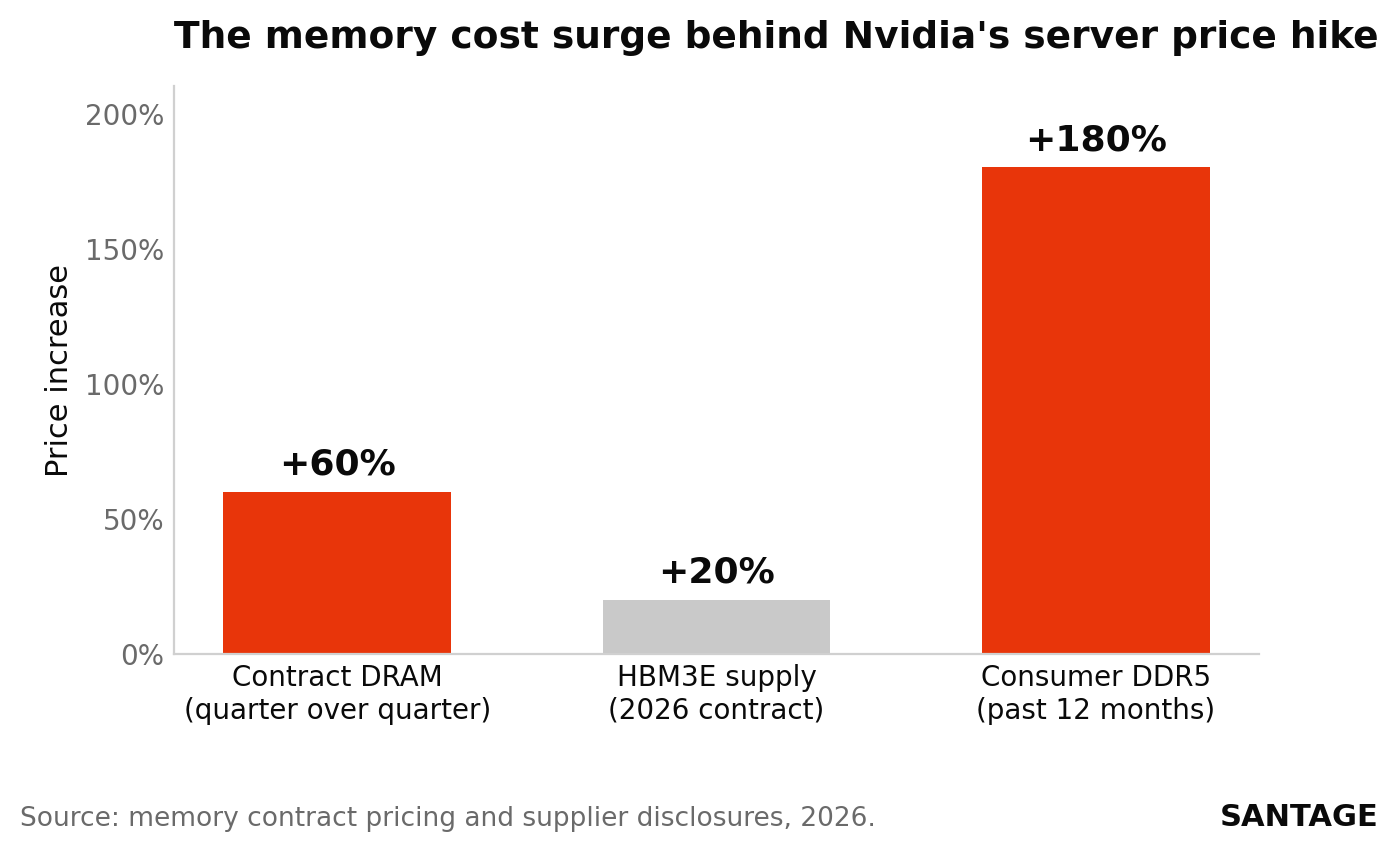
The result is that memory has quietly become the center of an AI server's cost structure rather than a supporting line item.
The jump is clearest at the system level, where the same rack configuration has nearly doubled in price across one generation.
| AI rack system (NVL72 class) | Approximate price |
|---|---|
| Blackwell GB200 (current) | 2.8 to 3.4 million dollars |
| Vera Rubin VR200 (early 2027) | 5 to 7 million dollars |
Source: AI server system pricing estimates, 2026.
For two years the constraint on the buildout was the number of accelerators Nvidia could ship. That bottleneck is quietly moving one layer down, into the memory stacked beside each chip, and this price notice is the first time the shortage has shown up on the invoice rather than in the lead time. The companies spending the most on AI have optimized relentlessly for dollars per unit of compute. The variable they did not budget for was the price of remembering, and it is now the line that moves the total.
Santage is committed to independent, transparent journalism. This article is produced in accordance with Santage's Editorial Standards and aims to provide accurate and timely information. Readers are encouraged to verify information independently.