
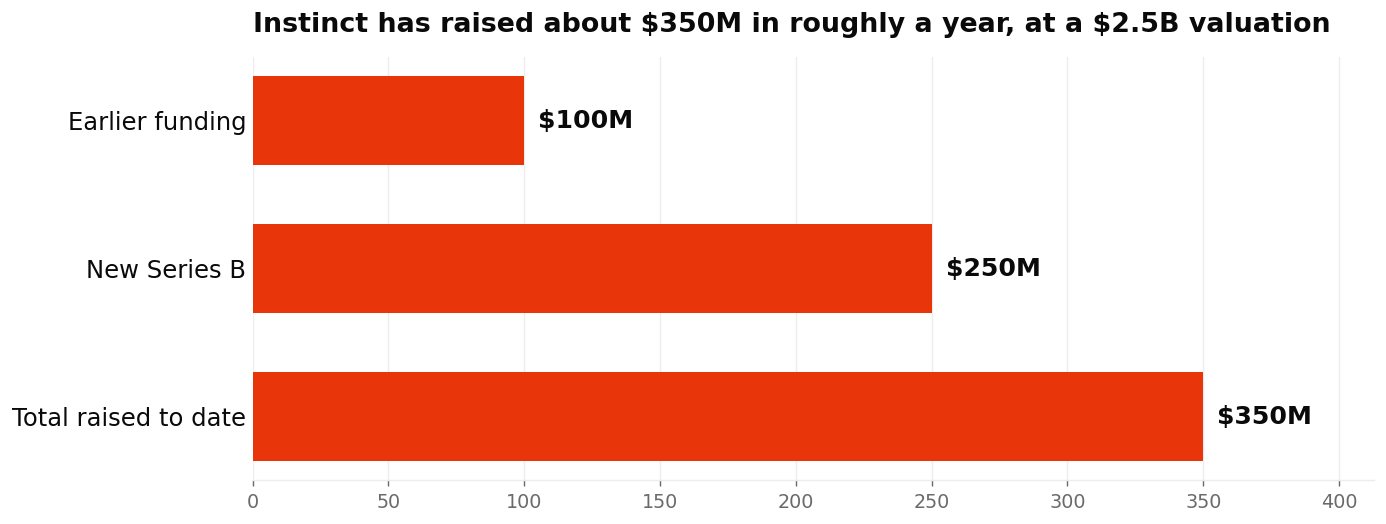
- Instinct, a personal AI assistant founded roughly a year ago by 23 year old Noah Shinn, has raised about 350 million dollars in total, including a new 250 million dollar Series B that values the company at 2.5 billion dollars.
- Index Ventures and Benchmark co led the round, and the valuation has climbed close to fivefold in a matter of weeks while the product remains in private, invite only beta.
- Instinct connects to a user's apps and devices and takes instructions by text message and phone call, a consumer agent pitch that has drawn both a funding rush and early privacy scrutiny.
A one year old consumer AI agent raises $350 million before it opens to the public
Instinct has become the most aggressively funded consumer AI story of the month without shipping a public product. The company, built around a personal AI agent that manages everyday tasks, has raised roughly 350 million dollars in total, capped by a 250 million dollar Series B that sets its valuation at 2.5 billion dollars. Index Ventures and Benchmark co led the new round, two of the most established names in venture capital.
The pace is the striking part. Instinct's valuation has moved close to fivefold in a span of weeks, and the assistant is still gated behind a private, invite only beta. The founder, Noah Shinn, is 23 and started the company about a year ago. What investors are backing is a bet on a specific product shape rather than a track record of revenue.
| $2.5B | valuation set by the new Series B, up close to fivefold in weeks |
| $350M | raised in total in roughly a year, including a $250M Series B |
| 23 | age of founder Noah Shinn, with the product still in private beta |
The product itself is a departure from the chatbot format. Instinct connects to a person's apps, accounts, and devices, then takes instructions through ordinary text messages and phone calls rather than a dedicated app screen. In practice it acts less like a search box and more like an assistant that carries out agentic tasks across services on a user's behalf.
They've planned cross-country road trips, bought weekly groceries and concert tickets, and cancelled hundreds of dollars of subscriptions. Someone's even planning their wedding with Instinct.Noah Shinn, Founder and Chief Executive, Instinct, describing what early testers have done
Why investors are paying a $2.5 billion price for a product in beta
The round captures a shift in where venture money is flowing. For most of the past two years the largest consumer AI valuations went to the model builders. Instinct is not a model lab. It is an application layer company that wraps existing language models in deep access to a user's digital life, and the frenzy around it reflects a thesis that the assistant, not the model, is where consumer habits and switching costs will form. The wager is that whoever owns the assistant a person talks to every day will sit above whichever model happens to answer, the way an operating system sits above the apps that run on it.
That same deep access is also the source of the early concern. Because Instinct asks for broad permission to a user's apps and accounts to do its work, security researchers have already flagged questions about how much the assistant can see and do, and how clearly its terms explain that reach. The tension is built into the pitch. The more an assistant is allowed to touch, the more useful it becomes and the more it has to be trusted.
For a company still in invite only beta, a 2.5 billion dollar price sets a high bar for what the public launch has to prove. The capital buys time and talent, but it also fixes expectations that Instinct now has to grow into before scrutiny of a consumer agent with this much reach catches up with the funding.
Santage is committed to independent, transparent journalism. This article is produced in accordance with Santage's Editorial Standards and aims to provide accurate and timely information. Readers are encouraged to verify information independently.