

- Lovable raised $400 million at a $13.3 billion valuation, roughly double its $6.6 billion Series B price from December 2025, co-led by Menlo Ventures and the European Commission's Scaleup Europe Fund.
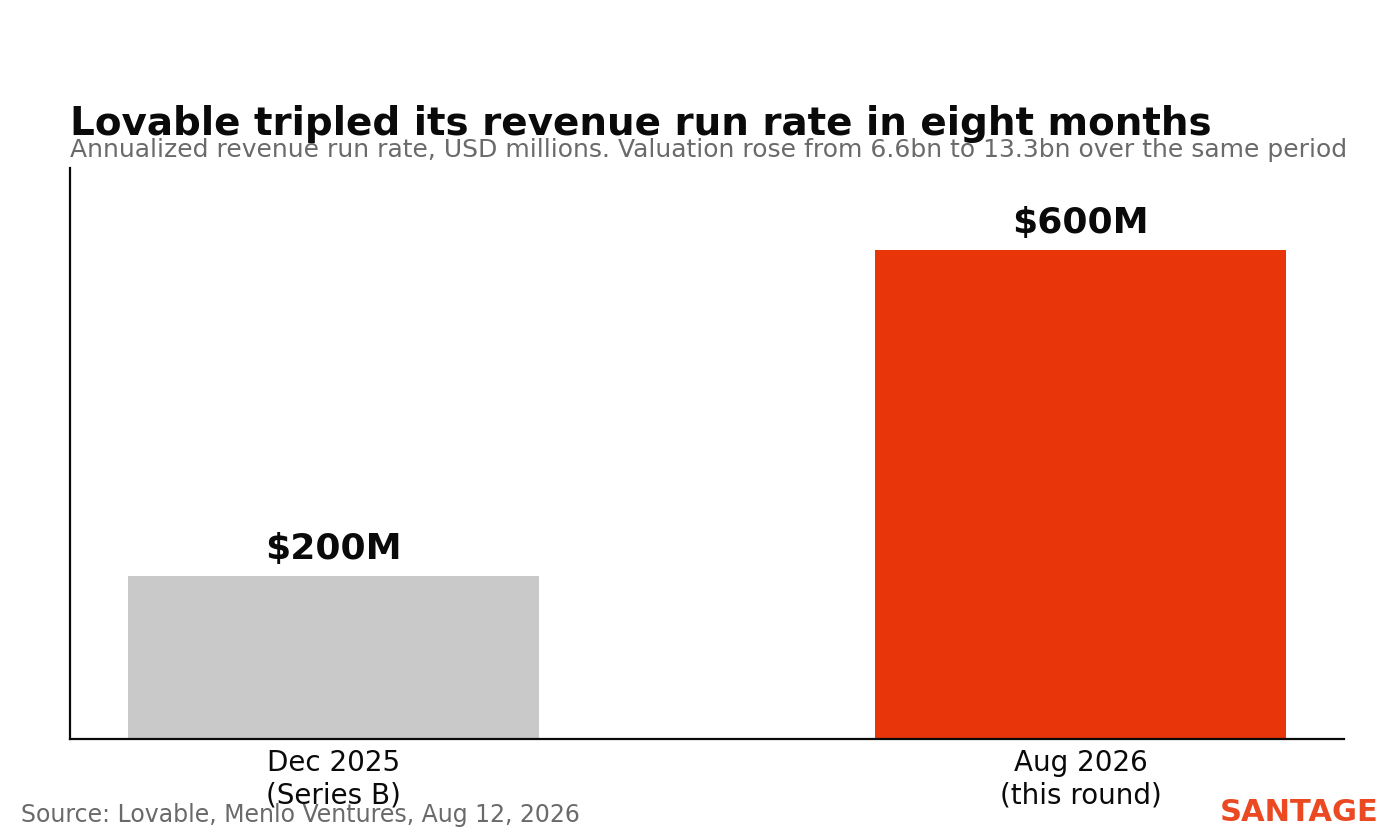
- The company's annualized revenue run rate reached about $600 million, up from roughly $200 million eight months earlier, a near-tripling on a base of about 450 employees.
- Launched only in November 2024, Lovable reached its $13.3 billion valuation in about nine months, one of the steepest scaling curves any European software company has posted.
Lovable tripled revenue to a $600 million run rate in eight months
The largest AI valuations of the past year belonged to model labs and chip makers. This one belongs to an app. Lovable, the Stockholm startup whose product lets a person build a working website or application by describing it in plain language, raised $400 million at a $13.3 billion valuation. The round was co-led by Menlo Ventures and the European Commission's Scaleup Europe Fund, with Balderton Capital, World Innovation Lab, and Tencent participating.
The valuation is not the headline. The revenue underneath it is. Lovable's annualized run rate reached roughly $600 million, up from about $200 million at its December Series B, a near-tripling in eight months. The company did this with around 450 employees, a figure it plans to grow by half over the year. On a revenue-per-head basis, that is a ratio traditional software companies reach after a decade, not after twenty months of existence.
A Stockholm app-builder became Europe's fastest-scaling AI company
Europe has spent a decade being told it cannot produce companies that scale like American ones. Lovable is the counterexample the continent has been waiting for, and the presence of the European Commission's own growth fund as a co-lead is a signal as much as an investment. The bloc is putting sovereign capital behind a homegrown AI winner rather than watching it decamp to the Bay Area for its next round.
| Raised in this round | $400 million |
| Valuation, from $6.6B eight months earlier | $13.3 billion |
| Annualized revenue run rate, up from ~$200M | ~$600 million |
| Employees behind that revenue | ~450 |
What Lovable sells is not a coding tool for engineers. It is software creation for people who do not code, and the customer list reflects that reach: Nvidia, Adidas, Hearst, and Zendesk all appear alongside a long tail of solo founders and small teams. Chief executive Anton Osika frames the shift in plain terms.
Some founders now run their entire businesses on software built with Lovable.Anton Osika, CEO, Lovable
That sentence is the whole thesis. When the person with the problem can build the software that solves it, the traditional handoff to a development team, an agency, or a SaaS vendor becomes optional. Lovable is not competing with other coding assistants for engineers. It is competing with the reason most people hire engineers at all.
The round in numbers
| Metric | Figure |
|---|---|
| Amount raised | $400 million |
| Valuation | $13.3 billion |
| Prior valuation (Dec 2025) | $6.6 billion |
| Revenue run rate now | ~$600 million |
| Revenue run rate (Dec 2025) | ~$200 million |
| Co-leads | Menlo Ventures, EC Scaleup Europe Fund |
| Other backers | Balderton, World Innovation Lab, Tencent |
| Launched | November 2024 |
| Headcount | ~450, planned to grow 50% |
Lovable's August 2026 round and trajectory. Source: Lovable, Menlo Ventures.
What a $13.3 billion vibe-coding company signals about software value
The uncomfortable question for the rest of the software industry is who loses when building software gets this cheap. The optimistic reading is that Lovable expands the market, letting millions of non-developers create tools that would never have existed, none of them displacing paid seats at established vendors. The pessimistic reading is that a meaningful share of the long tail of simple business software, the internal tools, landing pages, and small apps that firms used to buy or commission, now gets generated in an afternoon for a subscription.
Lovable is not competing with other coding tools for engineers. It is competing with the reason most companies hire engineers at all.
Both readings can be true, and the run-rate curve suggests the second is already happening at the edges. Revenue that triples in eight months does not come only from net-new creation. Some of it is substitution, work that used to flow to agencies, freelancers, and horizontal SaaS now flowing to a prompt box.
The durability question is the one investors are underwriting at $13.3 billion. Lovable sits on top of frontier models it does not own, in a category where the barrier to entry is a good interface and distribution rather than proprietary technology. Its moat has to be built from brand, workflow lock-in, and the accumulated software its users cannot easily migrate, not from a model advantage that any competitor can rent. The valuation is a bet that Osika builds that moat before a better-funded rival, or one of the model labs themselves, decides that the application layer is where the money actually is.
For now, the number that matters is the one growing fastest. A twenty-month-old company approaching $600 million in annualized revenue, in a market it partly created, is the clearest evidence yet that the value in AI is migrating from the models to the products people actually touch.
Santage is committed to independent, transparent journalism. This article is produced in accordance with Santage's Editorial Standards and aims to provide accurate and timely information. Readers are encouraged to verify information independently.