
- Etched raised $700 million at a $21 billion valuation, roughly double the $10.3 billion it carried a month earlier and quadruple its $5 billion price in December 2025.
- The round was led by Jane Street, the quant trading firm that also took delivery of Etched's first production rack in July and put it to work on live workloads.
- Etched says it now holds more than $1 billion in customer contracts and reached first working silicon in under three years, an unusually short path for a custom AI chip.
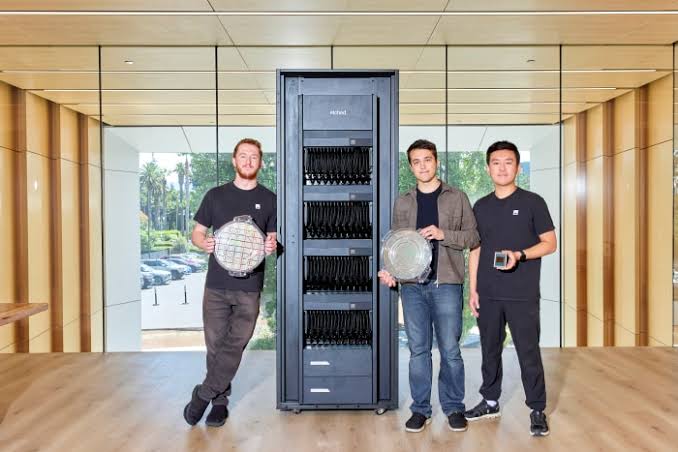
Jane Street led the round and took the first rack off the line
Etched, the inference-chip startup that spent two years as the most doubted name in AI silicon, said it has raised $700 million at a $21 billion valuation. The lead investor is Jane Street, joined by Kleiner Perkins, Sequoia, Andreessen Horowitz, Tiger Global, Bain Capital Ventures, and Blackstone, among others. The number that matters is not the raise. It is the speed of the repricing behind it.
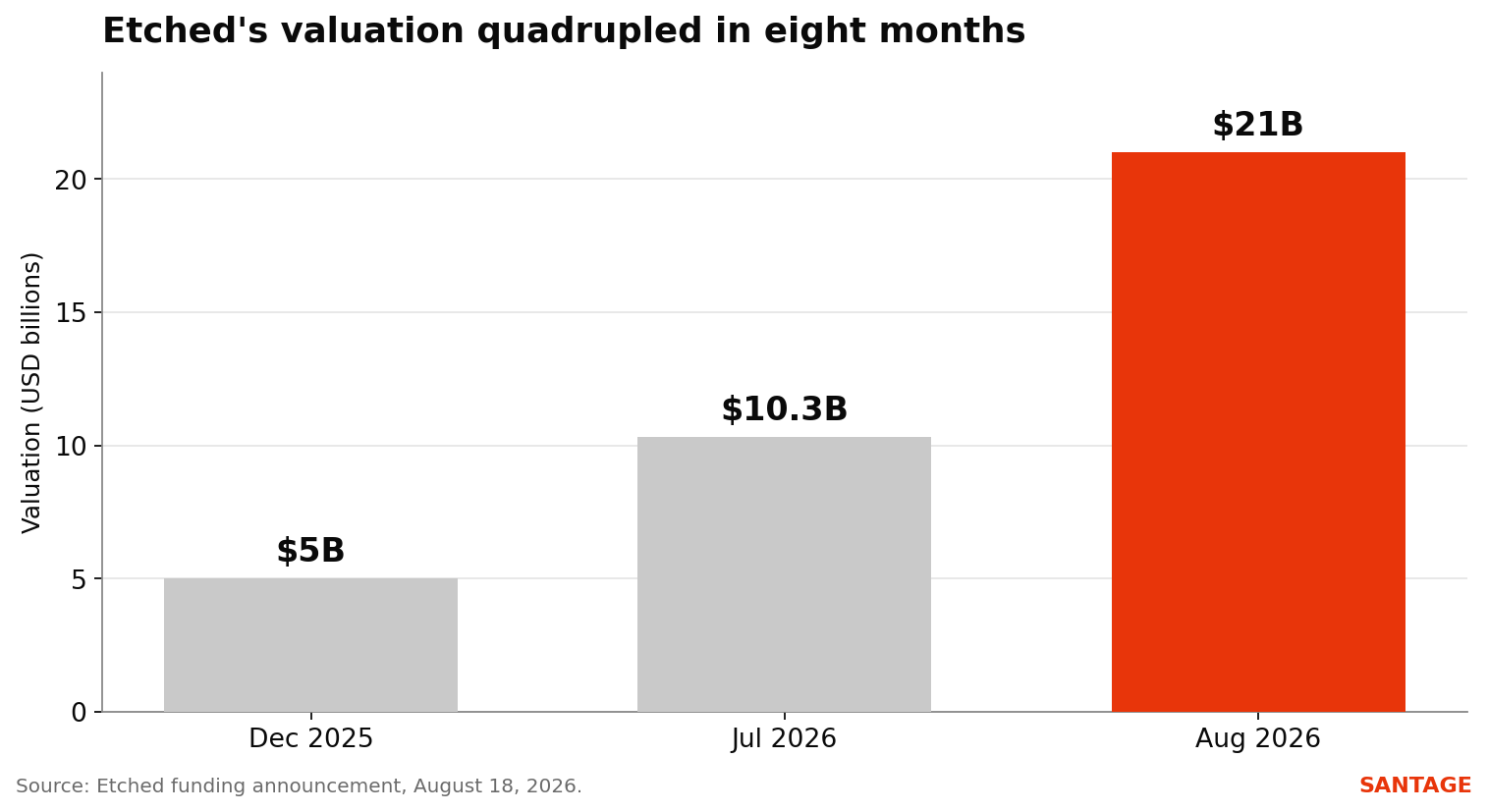
Eight months ago Etched was worth $5 billion. In July it closed a $300 million round at $10.3 billion. This new round doubles that again. Repricings that steep usually follow a product that is selling, not a promise, and this one did. In the same announcement, Etched said it had shipped its first rack to Jane Street in July and that the system is already running production workloads inside the firm's data center.
| New raise | $700 million |
| Valuation | $21 billion, up from $10.3 billion in July |
| Valuation in December 2025 | $5 billion |
| Customer contracts signed | More than $1 billion |
| First customer delivery | Jane Street, July 2026 |
| Time from seed to working silicon | Under three years |
Why a trading firm is buying inference silicon before the hyperscalers
Jane Street is not a lab and not a cloud. It is a proprietary trading firm whose edge is measured in the precision and latency of the models it runs against markets. That makes it a revealing first customer. When a company that keeps its methods secret and answers to no one but its own profit and loss chooses an unproven chip over Nvidia's shipping product, it is making a statement about the economics, not the branding.
Etched built its name on Sohu, a chip specialized for the transformer, the architecture underneath almost every modern AI model. Rather than a general accelerator, it now sells complete inference clusters built from two custom pieces. A Low Voltage Inference design targets the compute-heavy prefill stage, where a model reads a prompt, while a Cluster Scale Memory system pools memory across an entire rack for the memory-bound decode stage, where a model writes each token. Splitting inference into those two problems and optimizing each separately is the wager, and it is meant to buy speed and cost a general-purpose GPU cannot.
| Etched component | Stage it targets | Why it matters |
|---|---|---|
| Low Voltage Inference | Prefill, reading the prompt | Higher compute density at lower power |
| Cluster Scale Memory | Decode, writing each token | Shared memory across a full rack, lower latency |
The firm framed the delivery as a test that passed, not a favor to a portfolio company.
We tested the chip and are pleased with the early results. Etched's unique approach to inference delivers the precision we will need to support our most demanding workloads.Jane Street, in Etched's funding announcement
What changes when the lead investor is also the first customer
For most of Etched's life the criticism was structural. Founded by two college dropouts, Gavin Uberti and Chris Zhu, it had raised heavily on silicon tied to a single architecture, and skeptics argued that betting a chip on the transformer was reckless in a field that reinvents itself yearly. The company has now inverted that story. It says its clusters run any frontier model, and it has a paying deployment to point to rather than a benchmark slide.
The financing structure is the real signal. Jane Street did not write a check and wait for a roadmap. It bought the hardware, ran it on real workloads, and then led the round. Customer and lead investor became the same entity, which compresses the usual gap between someone funding a chip and someone depending on it to zero. Chief executive Gavin Uberti said the company has felt the urgency to get its hardware into customers' hands and run real workloads since day one, and the raise rewards exactly that sequencing.
For the market, this lands at a specific moment. Inference, not training, is now the cost that scales with every user and every agent, and it is the line item hyperscalers most want to pull away from a single supplier. A credible second source for inference silicon is worth a premium to anyone whose margins bend to the price of a token. That is why a chip startup can quadruple in eight months while still shipping its first units.
The safest way to fund hardware turned out to be selling it first.
The detail most coverage skipped
Etched reached first-pass working silicon in under three years from seed. First-pass success, meaning a chip that works without a costly re-spin, is rare even at established firms and rarer still at a startup, and it is the quiet technical fact underneath the valuation. The $21 billion is not paying for a deck. It is paying for a working part that a demanding customer already trusts in production.
The lesson of this round is not that a chip company got expensive. It is that the surest way to raise money for hardware turned out to be selling it first. Etched did not raise to go prove its silicon. It proved its silicon, delivered it to the buyer, and let the buyer lead the round.
Santage is committed to independent, transparent journalism. This article is produced in accordance with Santage's Editorial Standards and aims to provide accurate and timely information. Readers are encouraged to verify information independently.